Panelists discuss how future progress depends on better biomarkers (especially within pMMR), smarter sequencing across expanding modalities, and stronger survivorship planning as more patients experience durable control.
Panelists discuss how future progress depends on better biomarkers (especially within pMMR), smarter sequencing across expanding modalities, and stronger survivorship planning as more patients experience durable control.
Panelists discuss how real-world findings suggest platinum re-challenge offers limited, short-lived benefit in this disease and is often less favorable than newer systemic options after recurrence.
Panelists discuss how real-world use of lenvatinib plus pembrolizumab generally aligns with trial outcomes but often requires individualized dosing, and how post-adjuvant analyses raise interest in earlier-line incorporation while more evidence matures.
Panelists discuss how combining controlled trial evidence with real-world experience supports more realistic discussions of prognosis, tolerability, and the value of durable long-term follow-up.
Panelists discuss how proactive management of hypertension, diarrhea, and hypothyroidism—plus dose holds and reductions—helps patients stay on lenvatinib-based therapy long enough to realize benefit.
Panelists discuss how counseling differs for dMMR versus pMMR disease by framing dMMR as more likely to achieve durable benefit from immunotherapy while presenting pMMR gains as modest but meaningful with potential added options from PARP–IO strategies.
Panelists discuss how trial survival curves show an emerging long-term “tail,” strongest in dMMR disease, and how differences between PD-1 and PD-L1 regimens may reflect mechanism and study-design factors when counseling patients.
Panelists discuss how emerging 5-year survival data—once rare in this setting—are influencing guideline evolution by increasing confidence in regimens that deliver sustained benefit and informing more nuanced sequencing decisions.
Panelists discuss how DUO-E and AtTEnd broaden options beyond PD-1 approaches, with PD-L1 and PARP–immunotherapy combinations offering promising signals for selected pMMR subgroups amid real-world access and tolerability considerations.
Panelists discuss how comparing LEAP-001, KEYNOTE-775, RUBY, and NRG-GY018 helps position lenvatinib plus pembrolizumab mainly after chemotherapy (or when chemo isn’t feasible) while reinforcing chemo–PD-1 combinations—especially in dMMR disease.
Panelists discuss how LEAP-001, despite missing primary endpoints, suggested meaningful activity for lenvatinib plus pembrolizumab in dMMR and post-adjuvant subgroups who may need alternatives to standard frontline chemotherapy.
Panelists discuss how advanced/recurrent endometrial cancer has remained a high unmet need due to years of minimal survival gains with carboplatin/paclitaxel until immunotherapy began shifting outcomes.

Nicoletta Colombo, MD, PhD, discusses the rationale for evaluating pembrolizumab plus weekly paclitaxel with/without bevacizumab in recurrent PROC.

At the 2025 ESMO Congress, leading oncologists reflected on data expected to redefine practice across breast, genitourinary, and gynecologic malignancies.

Nicoletta Colombo, MD, PhD, discusses the next steps with pembrolizumab in cervical cancer.

Nicoletta Colombo, MD, PhD, discusses efficacy achieved with the addition of pembrolizumab to chemotherapy in patients with persistent, recurrent, or metastatic cervical cancer.
Experts give insight on what they are looking forward to in the endometrial cancer space.
Nicoletta Colombo, MD, PhD, reviews surgical advancements in endometrial cancer.
Experts in endometrial cancer comment on novel targets of interest that are currently being investigated.
Key opinion leaders take a look at the evolving treatment landscape in endometrial cancer, discussing ongoing trials in the space.
Experts discuss the importance of incorporating molecular features into the selection of adjuvant treatment.
Experts in endometrial cancer comment on therapeutic sequencing in endometrial cancer.
Key opinion leaders emphasize the importance of the management of adverse events in using pembrolizumab and lenvatinib.
Experts give insight on their clinical use of pembrolizumab-lenvatinib. They highlight dose adjustments and the importance of the increased knowledge of adverse events.
Key opinion leaders discuss the presented data from Study 309/KEYNOTE-775, highlighting patient reported outcomes, safety, and dosing.
Vicky Makker, MD, presents the results from Study 309/KEYNOTE-775, as well as key safety findings.
Vicky Makker, MD, walks through the trial design of Study 309/KEYNOTE-775.
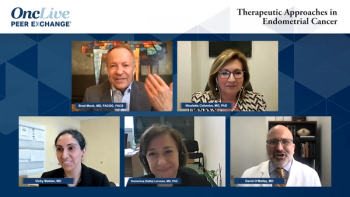
Experts review optimal approaches to treatment in advanced endometrial cancer, touching on clinical trial data.
Key opinion leaders share their thoughts on biomarker testing and multidisciplinary approaches for endometrial cancer at their institutions globally.

Experts in gynecologic cancer discuss the heterogeneity of endometrial cancer..
May 18th 2021
June 1st 2021
May 25th 2021
May 18th 2021
May 25th 2021