Articles by Roy S. Herbst, MD, PhD
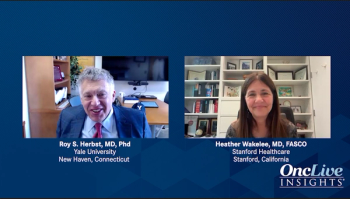
Panelists discuss how despite significant advances in EGFR-targeted therapy, critical unmet needs persist in EGFR-positive non–small cell lung cancer (NSCLC), including the need for better strategies to combat resistance mechanisms, more effective treatments for brain metastases, improved options for uncommon EGFR mutations, and the development of biomarker-driven approaches to optimize sequencing of available therapies.
Panelists discuss how the MARIPOSA trial demonstrated strong efficacy with amivantamab plus lazertinib that appears comparable to FLAURA2’s results with osimertinib plus chemotherapy, although cross-trial comparisons should be interpreted cautiously given differences in study populations and the need for mature overall survival data from both trials.
Panelists discuss how managing adverse events (AEs) with osimertinib requires proactive monitoring and intervention, with monotherapy generally being well-tolerated aside from common AEs like rash and diarrhea.
Panelists discuss how FLAURA2's impressive progression-free survival (PFS) benefit with osimertinib plus chemotherapy was particularly pronounced in patients with extrathoracic metastases, suggesting this combination approach may be especially valuable for this higher-risk population, though careful consideration of individual patient factors and toxicity management remains important in treatment selection.
Panelists discuss how osimertinib monotherapy demonstrated robust progression-free survival and overall survival benefits in FLAURA, while FLAURA2 showed that adding chemotherapy to osimertinib further improved progression-free survival (PFS) although overall survival (OS) data remains immature, leading to ongoing debate about the optimal first-line approach.
Panelists discuss how EGFR tyrosine kinase inhibitors (TKIs) have revolutionized first-line treatment for EGFR-positive non–small cell lung cancer (NSCLC).
Roy S. Herbst, MD, PhD, discusses advances in EGFR inhibition throughout the past several decades in patients with lung cancer.

Roy S. Herbst, MD, PhD, discusses ongoing, planned, and future research for the management of unmutated non–small cell lung cancer.
Roy S. Herbst, MD, PhD, discusses the evolution of targeted therapies in EGFR-mutated NSCLC, as well as hurdles associated with biomarker testing.
Roy S. Herbst, MD, PhD, discusses the importance of consulting a multidisciplinary tumor board when making treatment decisions for patients with NSCLC.

Roy S. Herbst, MD, PhD, discusses findings from the overall survival analysis of the phase 3 ADAURA trial of adjuvant osimertinib in patients with stage IB to IIIA resected non–small cell lung cancer harboring EGFR mutations.

Roy S. Herbst, MD, PhD, discusses the implications of the phase 3 AEGEAN trial in patients with resectable non–small cell lung cancer.

Roy S. Herbst, MD, PhD, discusses the significance of the FDA approval of adjuvant pembrolizumab in patients with non–small cell lung cancer.

Roy S. Herbst, MD, PhD, discusses the evolving treatment landscape of targeted therapies in non–small cell lung cancer.

Roy S. Herbst, MD, PhD, discusses the approval of adjuvant osimertinib in EGFR-positive non–small cell lung cancer.

Roy S. Herbst, MD, PhD, discusses biomarkers for immunotherapy response that are currently under investigation in non–small cell lung cancer (NSCLC).


