





Breast Cancer
Latest News
Advertisement
Latest Videos



































































Advertisement
More News

Breast cancer specialists outline their institution’s practices regarding the choice between subcutaneous fixed-dose pertuzumab – trastuzumab-hyaluronidase and intravenous pertuzumab and trastuzumab.
Kandace P. McGuire, MD, provides clinical insights on how patient monitoring practices inform discussions around surgical options, providing the potential for deescalating surgical management.

A panel of experts give perspectives on optimizing biomarker testing in Advanced HR+/HER2- Breast Cancer.
A panel of experts discuss advancements in adjuvant therapy for early-stage breast cancer.

Kevin Kalinsky, MD, MS, discusses the outcomes of the postMONARCH study in patients with HR+/HER2– breast cancer following disease progression.

Jason Abdou Mouabbi, MD, discusses considerations for the use of ribociclib vs abemaciclib in patients with HR-positive, HER2-negative breast cancer.

Antonio Llombart-Cussac, MD, PhD, discusses preventing neutropenia and diarrhea with sacituzumab govitecan in HR+/HER2– advanced breast cancer.

The FDA has approved a new drug application for Tepylute, a ready-to-dilute formulation to treat breast and ovarian cancers.

Joyce O'Shaughnessy, MD, on the impact of MammaPrint H1 and H2 status on 3-year relapse-free survival in HR-positive, HER2-negative early breast cancer.

Adrienne G. Waks, MD, discusses efforts to address unmet needs in HER2-positive breast cancer.

David Rimm, MD, PhD, discusses challenges in distinguishing between HER2-low and HER2-ultralow breast cancer using current diagnostic kits.

Peter Forsyth, MD, on the investigation of intrathecal dendritic cells for leptomeningeal disease in triple-negative and HER2-positive breast cancer.

Adam M. Brufsky, MD, PhD, and Erika P. Hamilton, MD, delve into the most clinically significant genomic tests and biomarker assays employed in HR+/HER2- breast cancer, focusing on BRCA mutations, PIK3CA alterations, AKT1 alterations, and PTEN alterations, which play crucial roles in determining prognosis and guiding treatment decisions.
Medical experts share their strategies for choosing initial treatment options for HR+/HER2- locally advanced or metastatic breast cancer, debating the most effective frontline therapies based on clinical trial evidence, while also discussing their aspirations for a new standard of care, and the challenges of managing disease progression.
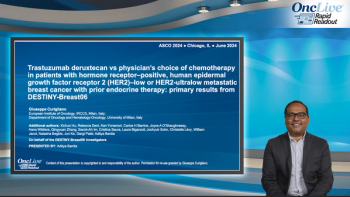
Dr. Aditya Bardia presents the findings of DESTINY-Breast06 (NCT04494425) in chemotherapy naive patients with HER2-low and HER2-ultra low metastatic breast cancer demonstrating progression-free survival of trastuzumab deruxtecan compared to chemotherapy treatment of physician’s choice.

China’s NMPA approved toripalimab plus nab-paclitaxel for the first-line treatment of recurrent or metastatic triple-negative breast cancer.
Expert breast oncologists examine adjuvant therapy approaches for early-stage hormone receptor-positive breast cancer, emphasizing the distinct treatment strategies and outcomes observed in pre- and post-menopausal patient populations.
Leading oncologists explore optimal biomarker testing strategies for early-stage breast cancer, examining the comparative advantages of tissue and liquid biopsies to guide personalized treatment decisions.

The key opinion leaders (KOLs) review the current testing methods for detecting ESR1 mutations and explore the existing strategies employed to overcome or delay the development of these mutations and the associated endocrine resistance in patients with HR+/HER2- metastatic breast cancer.
Virginia Kaklamani, MD, DSc, and Heather McArthur, MD, explore the clinical significance of *ESR1* mutations in HR+/HER2- metastatic breast cancer patients, including their impact on disease prognosis, treatment outcomes, and the increasing prevalence of these mutations with each line of endocrine therapy, ultimately informing their therapeutic approach.
Ian Krop, MD, PhD, outlines his institution’s approach to utilizing neoadjuvant therapy in patients with HER2+ early breast cancer, and Melinda Telli, MD, discusses the role of surgery.
A panel of experts on breast cancer provide insights on challenges encountered during the diagnosis of HER2+ early breast cancer and discuss the role of immunohistochemistry and FISH testing.

Key opinion leaders anticipate future developments in HER2-positive breast cancer, and on the potential for translating therapeutic advances from the metastatic landscape into early-stage disease management.

Trilaciclib plus chemotherapy failed to improve overall survival in metastatic triple-negative breast cancer.

Lauren E. Nye, MD, discusses the use of CDK4/6 inhibitors in HR-positive metastatic breast cancer and the evolution of ADCs in HER2-positive disease.
Advertisement
Advertisement
Trending on OncLive
1
FDA Approves Tucatinib Plus Trastuzumab/Pertuzumab as First-Line Maintenance in Advanced HER2+ Breast Cancer
2
Iberdomide Plus Daratumumab/Dexamethasone Yields Significant PFS Benefit in R/R Myeloma
3
FDA Approves Atezolizumab Plus Chemo for Stage III dMMR Colon Cancer
4
VIR-5500 Receives FDA Fast Track Designation in mCRPC
5