
Genitourinary Cancers
Latest News
Advertisement
Latest Videos



























































Advertisement
More News
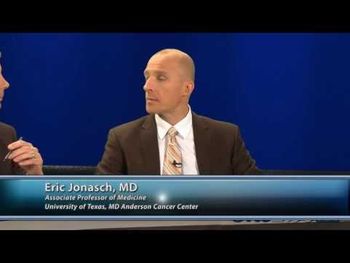

Thomas Hutson, DO, PharmD, discusses tivozanib for the treatment of advanced renal cell carcinoma (RCC).
Robert Figlin, MD, FACP, discusses the sequencing of mTOR inhibitors and tyrosine kinase inhibitors in renal cell carcinoma.

"If you build it, they will come," became a catchphrase thanks to the 1989 movie "Field of Dreams." For the founders of The Urology Center of Colorado (TUCC), it was more than just a saying.
The FDA has rejected a new drug application for tivozanib for the treatment of advanced renal cell carcinoma, recommending an additional clinical trial to address concerns over existing clinical data.
The mortality rate from prostate cancer has declined significantly in the past few decades; however, there is much debate over how much PSA screening contributed to that decline.
Raoul S. Concepcion, MD, from the Urology Associates, PC, Nashville, TN, discusses a recent FDA investigation into spikes in reported adverse events associated with the use of robotic-assisted surgery.
Deepak A. Kapoor, MD, president of the Large Urology Group Practice Association, provides his opinion on current prostate cancer screening recommendations.

A peer-reviewed summary of the ablative techniques currently available for the treatment of small renal masses.

An antibody that targets PD-L1 to unleash the body's immune system has demonstrated a 21% response rate in a phase I study of patients with multiple solid tumors, setting the stage for an advance in immunotherapy with broad implications for treatment.

We need to begin to migrate toward a system that embraces evidence-based medicine, and begin the development of protocols and the measurement of quality metrics.

An estimated 16,000 urologists will be needed to provide specialty care by 2025, but estimates of the number of urologists likely to be in practice at that time range between 6800 and 7400.

Nicholas J. Vogelzang, MD, from the Comprehensive Cancer Centers of Nevada, discusses the comparison of axitinib to sorafenib as first-line therapy in patients with metastatic renal cell carcinoma.

The 108th AUA Annual Meeting held May 4-8 in San Diego, California, contained over 2,000 presentations focused on urologic medicine. This entry contains summaries of four abstracts focused on urothelial, testicular, and prostate cancer.

Steve Dobbs, the CEO of Urologic Specialists of Oklahoma, Inc, discusses the viability, legality, and successful implementation of an office-based medication-dispensing solution.

A single clinical trial was deemed insufficient to support approval of tivozanib for the treatment of patients with advanced renal cell carcinoma, according to a 13-1 vote by the FDA's Oncologic Drugs Advisory Committee.
Robert Dreicer, MD, MS, from the Cleveland Clinic in Ohio, discusses a 2-weeks-on and 1-week-off (2/1) schedule of sunitinib for patients with metastatic renal cell carcinoma.

AGS-003, a personalized dendritic cell immunotherapy, demonstrated prolonged survival benefits in patients with metastatic renal cell carcinoma, with one-third of those who took the drug during a phase II trial still alive after nearly four years.

An international group of investigators provided first-time evidence of the impact of smoking on outcomes in bladder cancer in results from two studies.

An interview with Bryan Mehlhaff, MD, and retired physician Robert Litin, MD, about how Oregon Urology Institute is adapting its well-established practice to an ever-shifting healthcare landscape.

Karen E. Hoffman, MD, MHSc, MPH, from the MD Anderson Cancer Center, describes the diagnosing urologist's influence on the initial treatment selected for elderly men with favorable prostate cancer.
Robert J. Motzer, MD, from Memorial Sloan-Kettering Cancer Center, discusses the COMPARZ trial that compared pazopanib to sunitinib as a first-line therapy for patients with metastatic renal cell carcinoma.

Leonard G. Gomella, MD, discusses the benefits of the multidisciplinary center at Jefferson Kimmel Cancer Center.
Advertisement
Advertisement
Trending on OncLive
1
Savolitinib Plus Osimertinib NDA Submitted to FDA for MET-Driven, EGFR-Mutated NSCLC After EGFR TKI
2
FDA Grants Priority Review to Elinzanetant for Endocrine Therapy–Associated Vasomotor Symptoms in HR+ Breast Cancer
3
China's NMPA Approves Pirtobrutinib Across CLL
4
Calculating the Real Cost of False Positive Findings in Cancer Screening
5