



Gynecologic Oncology
Latest News


Dostarlimab Plus Chemo Followed by Dostarlimab/Niraparib Improves PFS in Endometrial Cancer
By Kristi Rosa
Advertisement
Latest Videos

































































Advertisement
More News

Hope Cottrill, MD, highlights practice-changing developments in endometrial cancer care, the benefits of local control with radiation in patients with locally aggressive disease, and questions that remain regarding treatment sequencing with immunotherapy.
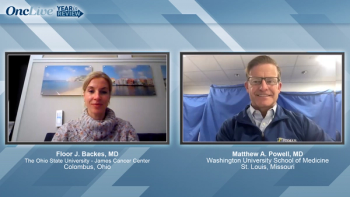
Floor Backes, MD, and Matthew Powell, MD, review data on sacituzumab govitecan, an antibody-drug conjugate targeting topoisomerase in patients with advanced endometrial cancer.
Drs Backes and Powell discuss the management of adverse events between upfront immunotherapy versus chemotherapy followed by later immunotherapy for endometrial cancer, noting the need for molecular subgroup data from trials like LEAP-001.

The combination of pembrolizumab and lenvatinib failed to produce a statistically significant improvement in progression-free survival and overall survival vs platinum-based chemotherapy with carboplatin and paclitaxel as frontline therapy in patients with advanced or recurrent endometrial cancer whose disease in mismatch repair proficient/not microsatellite instability–high or mismatch repair deficient.

The European Commission has granted marketing authorization to dostarlimab paired with carboplatin and paclitaxel in adults with dMMR/MSI-H primary advanced or recurrent endometrial cancer who are eligible to receive systemic treatment.

Key opinion leaders share excitement about antibody-drug conjugates targeting HER2 in advanced or recurrent endometrial cancer, and debate optimal HER2 testing methods, with some preferring gastric cancer scoring criteria over breast cancer criteria.
The panel reviews results from the ATTEND and DUO-E trials in advanced endometrial cancer, suggesting pembrolizumab remains the standard for the dMMR patient subset while combinations with PARP inhibitors may improve outcomes in pMMR.
Matthew Powell, MD, and Floor Backes, MD, discuss real-world evidence from recent trials confirming benefit of immunotherapies in practice for patients with advanced endometrial cancer.
Drs Powell and Backes discuss additional immunotherapy trial results from ESMO 2023 including AtTEnd and DUO-E, noting differences across trials likely due to patient population composition rather than drug differences, and need for caution with PARP inhibitor maintenance.
Dr Thomas C. Krivak highlights key data from the GY018 trial investigating chemotherapy plus pembrolizumab in both dMMR and pMMR advanced endometrial cancer, confirming and extending the findings from the RUBY trial supporting pembrolizumab's approval and use in both dMMR and pMMR populations.
Thomas C. Krivak, MD, shares the positive results from the RUBY trial of pembrolizumab plus chemotherapy followed by maintenance in patients with dMMR advanced endometrial cancer, supporting its approval and use in this population.
Matthew Powell, MD, and Floor Backes, MD, enthusiastically discuss the practice-changing RUBY trial results presented at the 2023 ESMO Congress showing impressive survival benefits with immunotherapy plus chemotherapy for both MMR-deficient and MMR-proficient advanced endometrial cancer.

Experts Ritu Salani, MD, MBA, and Bhavana Pothuri, MD, explore the significance of enrolling diverse patients in clinical trials and the pivotal role of community settings in advancing endometrial cancer research and treatment.
Experts review data on single-agent immunotherapy in patients with endometrial cancer from recent conferences, including ASCO 2023.
Delve into the exciting developments in endometrial cancer treatment, including HER2 antibody drug conjugates, checkpoint inhibitors, and the promising impact of these therapies in the quest to reduce chemotherapy use.

Neoadjuvant chemotherapy preceding surgery did not result in a significant difference in 5-year overall survival rates compared with concomitant chemoradiotherapy in patients with stage IB2 to IIB cervical carcinoma, according to findings from the phase 3 EORTC-55994 trial.
David M. O’Malley, MD, details the definition of dMMR (mismatch repair deficiency), its prevalence in advanced endometrial cancer, and current treatment approaches for dMMR patients, with a focus on the potential for cure in recurrent/metastatic dMMR patients based on clinical trial data.
The panel discusses factors to consider when determining best treatment options for patients with recurrent or advanced endometrial cancer, including traditional clinical trial endpoints, cost, chance for cure versus disease control, and most importantly, patient preference.

The combination comprised of camrelizumab and famitinib showcased improved efficacy with a manageable safety profile vs camrelizumab monotherapy or investigator’s choice of chemotherapy in patients with recurrent or metastatic cervical cancer.
Nimotuzumab given concurrently with chemoradiotherapy demonstrated efficacy and favorable tolerability in patients with locally advanced cervical squamous cell carcinoma, according to data from a randomized, controlled, open-label, multicenter study.

Retifanlimab-dlwr continued to elicit responses with acceptable tolerability in patients with recurrent microsatellite instability–high or mismatch–repair deficient endometrial cancer, according to final findings from cohort H of the phase 1 POD1UM-101 trial.
The frontline combination of cadonilimab and platinum-based chemotherapy with or without bevacizumab provided a progression-free survival benefit in patients with recurrent or metastatic cervical cancer.
Explore the groundbreaking shift in frontline treatment for endometrial cancer, driven by recent data from trials like RUBY and GY018, highlighting the significant impact of checkpoint inhibitors in patients with mismatch repair deficiency.
Discover strategies for minimizing adverse events and overlapping toxicities in patients undergoing lenvatinib and pembrolizumab therapy for recurrent endometrial cancer.
Drs Backes and Powell highlight key advances in endometrial cancer treatment from the 2023 SGO, ASCO, and ESMO conferences, including HER2-targeted therapies showing promising response rates.
Advertisement
Advertisement
Trending on OncLive
1
The OncFive: Top Oncology Articles for the Week of 10/4/2026
2
FDA Approves Atezolizumab Plus Chemo for Stage III dMMR Colon Cancer
3
FDA Grants Breakthrough Device Designation to Natera’s Multi-Cancer Early Detection Assay
4
VIR-5500 Receives FDA Fast Track Designation in mCRPC
5