




Gynecologic Oncology
Latest News

Simple Hysterectomy Is Noninferior to Radical Hysterectomy in Low-risk, Early-stage Cervical Cancer
By Gina Mauro
Advertisement
Latest Videos



































































Advertisement
More News

Bhavana Pothuri, MD, expands on challenges that still need to be addressed for the treatment of patients with endometrial cancer, highlights potential practice-changing data from the phase 3 NRG-GY018 and RUBY trials, details the evolving role of PARP inhibitors for patients with ovarian cancer, and touches on key emerging data from trials for patients with cervical cancer.

The National Institute for Health and Care Excellence has recommended the combination of pembrolizumab and lenvatinib for use in previously treated patients with advanced or recurrent endometrial cancer whose cancer has progressed on or after platinum-based chemotherapy and who cannot have curative surgery or radiotherapy.

For the 11th consecutive year, OncLive is honored to recognize oncology leaders whose innovations have contributed to immeasurable improvements in outcomes for countless patients.

R. Wendel Naumann, MD, FACOG, FACS, discusses how the evolution of immunotherapy has changed the treatment landscape for patients with recurrent or metastatic cervical cancer.
The European Medicines Agency has validated a type II variation for potential approval of dostarlimab in combination with carboplatin and paclitaxel for the treatment of patients with mismatch repair–deficient/microsatellite instability–high primary advanced or recurrent endometrial cancer.

Joshua G. Cohen, MD, FACOG, FACS, expands on the role of PARP inhibitors in the recurrent and up-front settings in ovarian cancer, and the clinical significance of the RUBY and NY-GY018 trials in endometrial cancer.

The combination of the potentially first-in-class off-the-shelf therapeutic cancer vaccine candidate VB10.16 and atezolizumab elicited a median overall survival greater than 25 months in patients with PD-L1–positive, human papillomavirus 16–positive advanced cervical cancer.

A deep learning risk prediction model was able to accurately identify patients with endometrial cancer at low and high risk of distant recurrence, according to data presented during the 2023 AACR Annual Meeting.

Fewer Americans are aware of the fact that the human papillomavirus can cause certain types of cancer, and vaccination rates against the virus are lagging, according to recent research presented at the AACR Annual Meeting 2023.
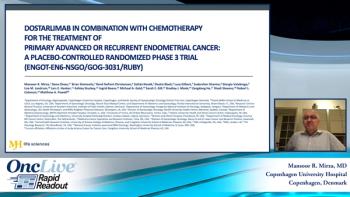
Mansoor R. Mirza, MD, reviews data from the phase 3 RUBY trial investigating dostarlimab in combination with carboplatin and paclitaxel for the treatment of primary advanced or recurrent endometrial cancer.

Trastuzumab Deruxtecan Displays Antitumor Activity, Safety in HER2-Expressing Uterine Carcinosarcoma
The antibody-drug conjugate trastuzumab deruxtecan led to durable responses and a tolerable safety profile in patients with HER2-expressing uterine carcinosarcoma.

Shannon N. Westin, MD, MPH, FACOG, shares preclinical data that provided the impetus for the SOLAR trial of olaparib and selumetinib in patients with RAS-mutated gynecologic cancers, key findings from the dose-escalation and -expansion portions of the research, and next steps with the combination.

Amanda Nickles Fader, MD, discusses the randomized, phase 3 NRG-GY019 trial evaluating letrozole with or without paclitaxel and carboplatin in patients with stage II to IV primary low-grade serous carcinoma of the ovary or peritoneum.

Brian M. Slomovitz, MD, discusses the classification of molecular subtypes to guide treatment and care in endometrial cancers.

Han T. Cun, MD, MS, discusses the findings from a retrospective comprehensive molecular classification of patients with grade 3 endometrioid endometrial adenocarcinoma.

Dr Gilbert discusses the FDA approval of dostarlimab in patients with endometrial cancer, key efficacy data from the GARNET trial, and how this agent bolsters the endometrial cancer treatment paradigm.

Marilyn Huang, MD, contextualizes findings within the endometrial cancer treatment landscape and emphasizes the unanswered questions regarding optimal therapies for patients with mismatch repair–proficient disease.

Dr Fashemi on the Effect of Entinostat on Olaparib Responsiveness in Mouse HRP Ovarian Cancer Models
Bisiayo Fashemi, PhD, discusses how the addition of entinostat to olaparib could help combat PARP inhibitor-resistance in homologous recombination proficient ovarian cancer, as well as the clinical significance of utilizing mouse organoid models to investigate such strategies.

Catherine John, MD, discusses the antitumor effects of sulindac on the prevention and treatment of obesity-driven models of endometrial cancer.

Ramez N. Eskander, MD, highlights the potential implications of the NRG GY018 trial as well as safety and efficacy results from the trial.

Presenters from the 2023 SGO Annual Meeting share their insights on the treatment of patients with gynecologic cancers.

The use of next-generation sequencing demonstrated that the most prevalent genomic alterations in patients with endometrioid ovarian carcinoma include ARID1A, PIK3CA, PTEN, CTNNB1, KRAS, and P53.

Combining the immune checkpoint inhibitor dostarlimab-gxly with standard-of-care chemotherapy elicited an increase in progression-free survival rates compared with chemotherapy alone for patients with primary advanced or recurrent endometrial cancer.

Dr Zeybek on the Investigation of Neoadjuvant Olaparib in Newly Diagnosed BRCA-Mutant Ovarian Cancer
Burak Zeybek, MD, discusses key results and clinical implications from the phase 1 NOW trial investigating neoadjuvant olaparib in patients with newly diagnosed, BRCA-mutant ovarian cancer.

A recent retrospective study found that patients with endometrial cancer in International FICO stage I high- intermediate risk subgroups with fewer than 2 risk factors had a greater than 95% cause-specific survival at 3-year follow-up, and subgroups with 2 or more risk factors had poorer outcomes.
Advertisement
Advertisement
Trending on OncLive
1
The OncFive: Top Oncology Articles for the Week of 10/4/2026
2
FDA Approves Atezolizumab Plus Chemo for Stage III dMMR Colon Cancer
3
FDA Grants Breakthrough Device Designation to Natera’s Multi-Cancer Early Detection Assay
4
FDA Flashback: Hematologic Cancer Decisions and News From September 2026
5