


Hematologic Oncology
Latest News


Axi-cel Maintains PFS and ORR Benefit in 3-Year Follow-Up of ZUMA-5 in Indolent NHL
By Ryan Scott
Advertisement
Latest Videos






















































Advertisement
More News

Emma Searle, PhD, provides an overview of findings from the MajesTEC-2 trial in patients with relapsed/refractory multiple myeloma, elaborates on the safety of teclistamab plus daratumumab and lenalidomide, and discusses the next steps for evaluating the combination.

Moxetumomab pasudotox-tdfk will be permanently discontinued in the United States market for the treatment of relapsed/refractory hairy cell leukemia.

A brief review of the different regimens used by experts for GvHD prevention at their institutions and discuss the importance of GvHD Prevention.

Expert oncologists define graft vs host disease (GvHD) and discuss which risk factors might increase a patient’s risk of developing GvHD.

Closing out their discussion on the management of myelofibrosis, panelists highlight updated data with fedratinib and ruxolitinib, respectively.
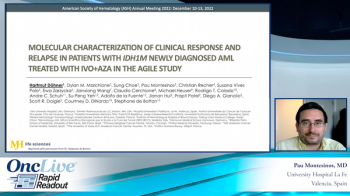
Pau Montesinos, MD discusses key updates from the global phase 3 AGILE study, as presented at the 2022 American Society of Hematology Annual Meeting, and speaks to the clinical implications of these data.
A brief review of the biology of myelofibrosis, the potential for disease modification, and subsequent implications for treatment.

The European Commission has issued an orphan drug designation to duvelisib for the treatment of adult patients with peripheral T-cell lymphoma.

Chan Y. Cheah, MD, MBBS, discusses the the phase 1 BGB-11417-101 trial, which showed that the BCL-2 inhibitor BGB-11417, administered alone or in combination with the BTK inhibitor zanubrutinib, induced promising response rates and was well tolerated patients with chronic lymphocytic leukemia.

Japan’s Ministry of Health, Labor, and Welfare has approved acalabrutinib for the treatment of previously untreated patients with chronic lymphocytic leukemia and small lymphocytic lymphoma.

The FDA has accepted a biologics license application for glofitamab for the treatment of adult patients with relapsed or refractory large B-cell lymphoma after 2 or more lines of systemic therapy.

Key opinion leaders on myeloproliferative neoplasms review clinical data behind pacritinib therapy in the setting of myelofibrosis.

Switching their focus to myelofibrosis management, expert panelists reflect on clinical data behind momelotinib, a novel JAK2 inhibitor.

Joseph Alvarnas, MD, discusses the importance of access to CAR T-cell therapy in cancer care.

Sanjeet Singh Dadwal, MD, discusses the investigation of posoleucel as a prevention strategy for infections in patients following an allogenic hematopoietic cell transplant.

Johannes Zakrzewski, MD, discusses the investigation of a nanoframework-based delivery system for IT848 in hematologic malignancies.

Max S. Topp, MD, highlights the rationale for studying bispecific antibodies in newly diagnosed diffuse large B-cell lymphoma, how the safety profile of glofitamab plus R-CHOP contributes to its potential for outpatient administration, and where future directions with this research may lead.

The past decade has been a time of great progress in the research of Waldenström macroglobulinemia and the care of patients with the rare form of non-Hodgkin lymphoma.

A teenage injury cost him a career among the stars, so John F. DiPersio, MD, PhD, became a star hematologist/oncologist instead.

Japan’s Ministry of Health, Labor and Welfare has approved axicabtagene ciloleucel for the initial treatment of patients with relapsed/refractory large B-cell lymphoma, including diffuse large B-cell lymphoma, primary mediastinal large B-cell lymphoma, transformed follicular lymphoma, and high-grade B-cell lymphoma.

Lisaftoclax alone or in combination with acalabrutinib or rituximab was active across a range of doses and displayed a tolerable safety profile in patients with relapsed/refractory and treatment-naïve chronic lymphocytic leukemia and small lymphocytic lymphoma.

The FDA has approved mosunetuzumab-axgb (Lunsumio) for the treatment of adult patients with relapsed or refractory follicular lymphoma after 2 or more lines of systemic therapy.

Edward J. Pearson, MD, and colleagues, discuss the expanded role of targeted therapies in the treatment of patients with hematologic malignancies.
Shared insight on how a patient’s symptom burden can impact management strategies within essential thrombocytopenia and polycythemia vera.
Expert perspectives on the respective treatment landscapes of essential thrombocytopenia (ET) and polycythemia vera (PV) following the ASH 2022 Annual Meeting.
Advertisement
Advertisement
Trending on OncLive
1
FDA Approves Zidesamtinib in Pretreated ROS1+ NSCLC
2
Sacituzumab Govitecan Yields Responses in Platinum-Resistant Ovarian Cancer
3
Ivonescimab Plus Chemotherapy Sustains OS Benefit Across Western and Asian Patients in Pretreated EGFR-Mutated NSCLC
4
Dr Mardones on Giredestrant Plus Palbociclib in Estrogen Receptor+ Breast Cancer
5