


Hematologic Oncology
Latest News
Advertisement
Latest Videos
















































Advertisement
More News
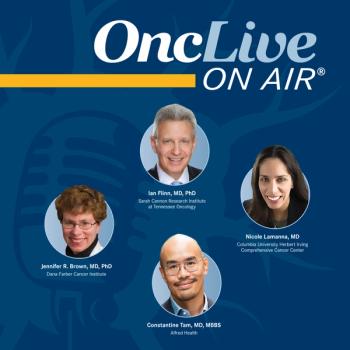
Drs Flinn, Lamanna, Brown, and Tam discuss the FDA approval of zanubrutinib in chronic lymphocytic leukemia and small lymphocytic lymphoma.

The fully-human scFv CD19-targeted CAR T-cell therapy JCAR021 elicited durable responses but with a high rate of neurotoxicity when administered at a dose of 7 x 10⁶ cells/kg in patients with relapsed or refractory large B-cell lymphoma, according to data from a phase 1/2 trial.

An independent data monitoring committee has recommended that a phase 3 trial evaluating uproleselan plus chemotherapy for patients with relapsed/refractory acute myeloid leukemia should continue to the planned overall survival event trigger.

The panelists discuss Dr Cluzeau’s presented case, emphasizing the importance of pathology reporting, and expand upon approaches to second-line treatment selection for patients with MDS-RS.
Dr Cluzeau introduces a second patient case of lower-risk MDS-RS with an SF3B1 mutation and symptomatic anemia, who received a first-line erythropoiesis-stimulating agent (ESA) and second-line luspatercept.
The primary end point of the phase 3 PhALLCON study was met as first-line ponatinib plus reduced-intensity chemotherapy outperformed imatinib for the treatment of patients with newly diagnosed Philadelphia chromosome–positive acute lymphoblastic leukemia.
Advances in the development of bispecific antibodies have demonstrated response rates close to or surpassing those of other agents in development, offering investigators an avenue to pursue phase 3 studies such as EPCORE DLBCL-1 to challenge standard of care with the CD3 × CD20 agent, epcoritamab in diffuse large B-cell lymphoma.

Amer Zeidan, MBBS, and Rami Komrokji, MD, offer closing remarks on recent advances in MF and MDS, and look towards the future of treatment.

Comprehensive discussion on the emergence of CPX-351 as a first-line treatment option for patients with acute myeloid leukemia.
Expert perspective on the role of a pharmacist in managing patients with identified tumor lysis syndrome.
Shared insight on IDH-mutated acute myeloid leukemia and appropriate first-line treatment options in this setting.
Anthony Perissinotti, PharmD, BCOP, highlights associated risk for tumor lysis syndrome and identifies signs and symptoms.

Shared insight on recently updated data in acute myeloid leukemia following the ASH 2022 annual meeting.

Experts in hematologic oncology review and analyze updated data in chronic myeloid leukemia from ASH 2022.

Following the ASH 2022 Annual Meeting, hematologic oncology experts discuss updated data in acute lymphocytic leukemia.
Tae Kon Kim, MD, PhD, discusses key results on the synergistic effects of PD-1H blockade in acute myeloid leukemia..
Topline results from the phase 1 European MB-105 clinical trial showed that new safety results for annamycin, a next-generation anthracycline, are in keeping with previous findings for patients with relapsed/refractory acute myeloid leukemia.

The combination of maveropepimut-S, pembrolizumab, and intermittent low-dose cyclophosphamide elicited responses in patients with relapsed or refractory diffuse large B-cell lymphoma, according to preliminary findings from the phase 2b VITALIZE trial.

Experts define and review treatment options for patients with chronic GvHD that are also steroid refractory.
Comprehensive discussion into the available treatment options for patients that present with chronic GvHD.
The CAR T-cell therapy brexucabtagene autoleucel produced a median overall survival of 26 months in patients with relapsed/refractory B-cell acute lymphoblastic leukemia.
Alfred L. Garfall, MD, discusses the durability of responses teclistamab elicited in the MajesTEC-1 trial and how this agent will change the treatment regimen for relapsed/refractory multiple myeloma.

Dr Komrokji leads a discussion on emerging data on how p53 mutations and chromosome 5q deletions may affect prognosis, treatment response, and outcomes for patients with MDS.
Expert panelists reflect on the case presented by Dr Garcia-Manero and share their unique perspectives on how they might have approached treatment and followup for this patient in their own practice.
In this fifth episode of OncChats: Unpacking Data From Pivotal Trials in Multiple Myeloma, Hamza Hashmi, MD, reviews the implications of up-front vs delayed transplant on survival, quality of life, and risk of secondary malignancies in newly diagnosed, multiple myeloma.
Advertisement
Advertisement
Trending on OncLive
1
FDA Approves Zidesamtinib in Pretreated ROS1+ NSCLC
2
Sacituzumab Govitecan Yields Responses in Platinum-Resistant Ovarian Cancer
3
Ivonescimab Plus Chemotherapy Sustains OS Benefit Across Western and Asian Patients in Pretreated EGFR-Mutated NSCLC
4
Dr Mardones on Giredestrant Plus Palbociclib in Estrogen Receptor+ Breast Cancer
5