
HER2+ Breast Cancer
Latest News
Advertisement
Latest Videos






























































Advertisement
More News
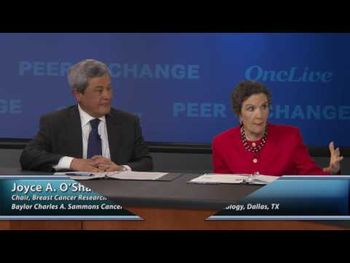
Howard A. "Skip" Burris, MD, offers insight on patient-reported outcomes from the MARIANNE trial and highlights exciting advancements in the neoadjuvant landscape of HER2-positive breast cancer.

Lisa A. Carey, MD, comments on the recent I-SPY 2 and KRISTINE findings, the I-SPY 2 program as a whole, and the work ahead in the neoadjuvant landscape of HER2-positive breast cancer.
Denise A. Yardley, MD, senior investigator, Breast Cancer Research Program, principal investigator, Sarah Cannon Research Institute, discusses the phase II HERMIONE-2 trial, which is a randomized, open label trial comparing MM-302 plus trastuzumab with chemotherapy of physician’s choice plus trastuzumab, in patients with anthracycline-naive HER2-positive, locally advanced/metastatic breast cancer who were previously treated with pertuzumab and ado-trastuzumab emtansine (T-DM1).
After years of anticipation, biosimilar versions of the most widely administered monoclonal antibodies in oncology care are moving closer to fruition for the US market, starting with a new form of trastuzumab (Herceptin).

A biosimilar version of trastuzumab demonstrated equivalent efficacy and safety to the FDA-approved branded drug in a randomized phase III study among patients with HER2-positive metastatic breast cancer.

Luca Gianni, MD, discusses the significance of the long-term NeoSphere trial results and how the regimen is already impacting the landscape of HER2-positive breast cancer.
Sunil Verma, MD, discusses the current landscape in HER2-positive breast cancer and his views on neoadjuvant treatment options.
A 5-year follow-up of the phase II NeoSphere trial confirmed that patients with HER2-positive breast cancer receiving a 3-drug neoadjuvant pertuzumab regimen had better outcomes compared with patients receiving trastuzumab and docetaxel.
Sara Hurvitz, MD, medical oncologist, General Internal Medicine, Hematology and Oncology at UCLA, discusses neoadjuvant treatment options for patients with HER2-positive breast cancer.

Sara Hurvitz, MD, discusses ongoing neoadjuvant studies in HER2-positive breast cancer, as well as what the future holds for neoadjuvant therapy.
Meredith Buxton, PhD, research director, assistant professor, University of California, San Francisco School of Medicine, discusses the I-SPY 2 trial for patients with HER2-positive breast cancer.

Angela M. DeMichele, MD, explains the significance of the I-SPY 2 data, the advantages of T-DM1 versus standard of care, and what is on the horizon for the use of T-DM1 in HER2-positive disease.

Angela M. DeMichele, MD, professor of Medicine and Epidemiology, University of Pennsylvania, discusses results of the HER2-positive breast cancer cohort of the phase II ISPY-2 trial, which investigated the neoadjuvant combinations of ado-trastuzumab emtansine (T-DM1) and pertuzumab (Perjeta) versus paclitaxel (Abraxane) and trastuzumab (Herceptin).
The combination of ado-trastuzumab emtansine and pertuzumab was superior to the combination of paclitaxel and trastuzumab as neoadjuvant treatment for women with HER2-positive breast cancer.

Early intervention has increasingly become the new standard of care for many patients with breast cancer, with an ever-growing collection of phase III trials currently exploring several novel or improved approaches.

William Gradishar, MD, Betsy Bramsen Professorship of Breast Oncology, Professor in Medicine-Hematology/Oncology, Northwestern University Feinberg School of Medicine, discusses changes to the NCCN Breast Cancer Guidelines.

Puma Biotechnology announced that it plans to delay the submission of a new drug application until mid-2016 for neratinib as an extended adjuvant treatment for patients with HER2-positive early breast cancer following a trastuzumab-based regimen.
Erika P. Hamilton, MD, discusses the significance of these trials and the impact ONT-380 may have on the treatment paradigm of HER2-positive breast cancer.

Hans Wildier, MD, provides an overview of the TH3RESA study and discusses the trial’s significance in the field of HER2-positive breast cancer.
Sunil Verma, MD, department head, Clinical Department of Oncology, Calgary Zone, medical director, Tom Baker Cancer Centre, discusses recent advancements in the field of HER2-positive breast cancer.
Advertisement
Advertisement
Trending on OncLive
1
FDA Approves Tucatinib Plus Trastuzumab/Pertuzumab as First-Line Maintenance in Advanced HER2+ Breast Cancer
2
VIR-5500 Receives FDA Fast Track Designation in mCRPC
3
Iberdomide Plus Daratumumab/Dexamethasone Yields Significant PFS Benefit in R/R Myeloma
4
FDA Approves Atezolizumab Plus Chemo for Stage III dMMR Colon Cancer
5