





Immuno-Oncology
Latest News
Advertisement
Latest Videos

































































Advertisement
More News

The European Medicines Agency’s Committee for Medicinal Products for Human Use has recommended approval of pembrolizumab (Keytruda) for the treatment of adult patients with recurrent or metastatic head and neck squamous cell carcinoma who progressed following platinum-based chemotherapy and have a PD-L1 tumor proportion score ≥50%.

The European Medicines Agency’s Committee for Medicinal Products for Human Use has recommended approval of frontline pembrolizumab (Keytruda) for use in combination with standard chemotherapy for patients with metastatic nonsquamous non–small cell lung cancer without EGFR or ALK mutations, regardless of PD-L1 expression.

As the checkpoint inhibitors move into the frontline setting for patients with non–small cell lung cancer, the focus has been placed on the duration of therapy and what to do in the second-line setting following progression.
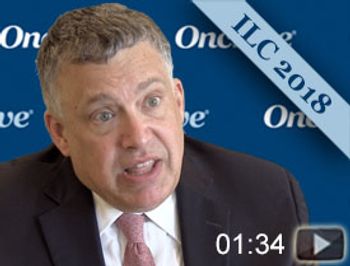
Roy S. Herbst, MD, PhD, Ensign Professor of Medicine and professor of pharmacology, chief of Medical Oncology, Yale Cancer Center and Smilow Cancer Hospital; associate director for Translational Research, Yale Cancer Center; Disease Aligned Research Team (DART) Leader, Thoracic Oncology Program, Yale Cancer Center, discusses immunotherapy combinations that have potential in non-small cell lung cancer (NSCLC).
The past year has witnessed an explosion in immunotherapy combinations for patients with lung cancer, accompanied by a growing knowledge of biomarkers such as PD-L1 and tumor mutation burden; however, an exact standard of care remains elusive.
Paul A. Bunn Jr, MD, distinguished professor, Division of Medical Oncology/University of Colorado, James Dudley Chair in Lung Cancer Research, University of Colorado Denver, 2014 Giant of Cancer Care

Leonid Shunyakov, MD, hematologist/oncologist, Central Care Cancer Center, discusses how genomics have impacted personalized therapy in oncology.

The European Medicines Agency’s Committee for Medicinal Products for Human Use has recommended approval of durvalumab for the treatment of patients with locally advanced, unresectable stage III non–small cell lung cancer who have not progressed following chemoradiotherapy and whose tumors express PD-L1 on ≥1% of tumor cells.

Immunotherapy should be given as a tailored, not blanket, treatment approach, especially for patients with lung cancer, according to Giorgio Scagliotti, MD, PhD.
Thomas Lynch, Jr, MD, Vice President and Chief Scientific Officer at Bristol-Myers Squibb, discusses the Immuno-Oncology (IO) Network at Bristol-Myers Squibb.
Joshua Bauml, MD, assistant professor, Perelman School of Medicine, University of Pennsylvania, discusses emerging biomarkers in non–small cell lung cancer (NSCLC).
Panagiotis A. Konstantinopoulos, MD, PhD, director, Translational Research, Gynecologic Oncology, Dana-Farber Cancer Institute, associate professor of medicine, Harvard Medical School, discusses the rationale behind the TOPACIO trial for the treatment of patients with recurrent ovarian cancer.
Paul Nghiem, MD, PhD, Michael Piepkorn Endowed Chair in Dermatology Research, professor of Dermatology/Medicine at Fred Hutchinson Cancer Research Center, University of Washington Medicine, discusses immunotherapy for the treatment of Merkel cell carcinoma.

Pembrolizumab (Keytruda) significantly improved overall survival compared with the standard frontline regimen of cetuximab (Erbitux) plus platinum chemotherapy and 5-FU in patients with recurrent or metastatic HNSCC.
Jessica Bauman, MD, addresses current and emerging therapeutic options for patients with BRAF, ROS1, and RET abnormalities in non–small cell lung cancer.

John A. Kosteva, MD, discusses the adoption of immunotherapy into the treatment paradigm for patients with non–small cell lung cancer.

Jeffrey S. Weber, MD, PhD, deputy director and co-director of the Melanoma Program, NYU Langone’s Perlmutter Cancer Center, 2016 Giant of Cancer Care® in Melanoma, discusses updated data for the Checkmate-238 trial.
Although impressive single-agent data have been seen with agents such as pembrolizumab (Keytruda) versus chemotherapy in a high–PD-L1 population, the combination of PD-L1 inhibitors and chemotherapy may prove to be beneficial in a broader group of patients.
David A. Reardon, MD, clinical director, Center for Neuro-Oncology, Dana-Farber Cancer Institute, discusses pembrolizumab (Keytruda) and bevacizumab (Avastin) for the treatment of patients with recurrent PD-L1–positive glioblastoma.
Sanjiv S. Agarwala, MD, chief of medical oncology and hematology, St. Luke’s Cancer Center, professor of medicine, Temple University School of Medicine, discusses the impact of combining entinostat with pembrolizumab (Keytruda) across a number of tumor types.

Peter J. Van Veldhuizen, MD, discusses available and emerging therapies for patients with kidney cancer.

Adding atezolizumab to pemetrexed and cisplatin or carboplatin in the frontline setting reduced the risk of disease progression or death versus chemotherapy alone in patients with advanced nonsquamous non–small cell lung cancer, according to findings from the phase III IMpower132 study.

Sara M. Tolaney, MD, MPH, instructor of medicine, Harvard Medical School, attending physician of medical oncology, Dana-Farber Cancer Institute, discusses the phase Ib results of abemaciclib (Verzenio) plus pembrolizumab (Keytruda) for hormone receptor-positive, HER2-negative metastatic breast cancer.

Suresh A. Ramalingam, MD, reflects on recent data in small cell lung cancer and what is on the horizon in the landscape.
H. Jack West, MD, medical director of thoracic oncology, Swedish Cancer Institute of Swedish Medical Center, discusses the latest immunotherapy findings for lung cancer treatment.
Advertisement
Advertisement
Trending on OncLive
1
FDA Approves Tucatinib Plus Trastuzumab/Pertuzumab as First-Line Maintenance in Advanced HER2+ Breast Cancer
2
FDA Grants Breakthrough Device Designation to Natera’s Multi-Cancer Early Detection Assay
3
VIR-5500 Receives FDA Fast Track Designation in mCRPC
4
Iberdomide Plus Daratumumab/Dexamethasone Yields Significant PFS Benefit in R/R Myeloma
5