




Lung Cancer
Latest News
Advertisement
Latest Videos































































Advertisement
More News
Panelists discuss how the MARIPOSA trial (ASCO 2024) showed improved overall survival (OS) with amivantamab plus lazertinib vs osimertinib in first-line EGFR-mutant non–small cell lung cancer (NSCLC), supporting its FDA approval (October 2024). This regimen may become standard of care for select patients, but osimertinib with or without chemo remains vital. The complete response letter (CRL) for subcutaneous amivantamab may delay uptake.
Panelists discuss how osimertinib has been approved for patients with unresectable, EGFR-mutated stage III non–small cell lung cancer (NSCLC) following chemoradiation, based on the LAURA trial, which demonstrated a significant improvement in progression-free survival. In clinical practice, osimertinib is administered as consolidation therapy until disease progression or unacceptable toxicity. Ongoing studies like PACIFIC-9 and PACIFIC-8 are exploring the efficacy of combining durvalumab with other agents, potentially influencing future chemo-immunotherapy strategies in advanced NSCLC.
The FDA granted orphan drug designation to rhenium (186Re) obisbemeda for the treatment of leptomeningeal metastases from lung cancer.

MT-8421, a novel engineered toxin body targeting CTLA-4, was not associated with grade 4 or 5 toxicities in patients with select advanced solid tumors.

Amivantamab plus lazertinib was approved in Canada for first-line EGFR-mutated locally advanced or metastatic non–small cell lung cancer.

Frontline treatment with datopotamab deruxtecan plus durvalumab with/without carboplatin proved active in advanced NSCLC without actionable alterations.
The Chinese NMPA has approved sacituzumab tirumotecan for EGFR-mutant advanced NSCLC following progression on an EGFR TKI and chemotherapy.
China’s NMPA has accepted an MAA seeking the approval of foritinib for ALK-positive advanced non–small cell lung cancer.

The top 5 OncLive videos of the week cover insights in TGCT, NSCLC, TNBC, AML, and MDS.
Panelists discuss how recent data from KEYNOTE-671, AEGEAN, and CheckMate 77T reinforce neoadjuvant therapy’s efficacy in early-stage non–small cell lung cancer (NSCLC), showing consistent survival benefits. In contrast, adjuvant data remain conflicting, limiting its role. Neoadjuvant therapy should be prioritized, with adjuvant therapy reserved for select high-risk patients.

The expert discussion concludes with reflections on the rapid advancements in the treatment of locally advanced lung cancer, emphasizing the importance of personalized therapy, multidisciplinary collaboration, and continued progress in improving patient outcomes.
The discussion explores promising future directions for managing locally advanced disease, focusing on combination immunotherapy approaches and the ongoing trials investigating their efficacy, as well as the potential role of combining chemotherapy (CRT) with immunotherapy in treatment regimens.
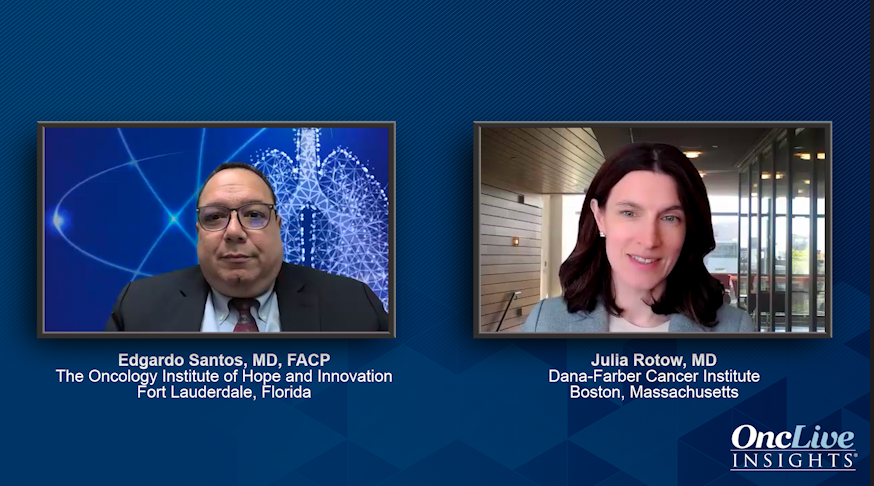
The discussion focuses on the LAURA trial, which demonstrated that osimertinib significantly improved progression-free survival in patients with EGFR-mutated (EGFRm) locally advanced non–small cell lung cancer (NSCLC) after chemoradiotherapy (CRT), establishing it as a new standard of care with manageable safety concerns.
A 76-year-old woman with EGFR exon 19–positive adenocarcinoma and N3 disease undergoes chemoradiotherapy followed by osimertinib after a multidisciplinary evaluation and biomarker testing.
This segment explores the use of stereotactic body radiation therapy (SBRT) for treating small peripheral lesions in patients with lymph node–positive cancer, compared with conventional intensity-modulated radiation therapy. It discusses the potential advantages of SBRT in reducing treatment duration, its theoretical biological effects, and ongoing studies like the LU008 phase 3 trial.
This video discusses the clinical considerations around pneumonitis in patients undergoing chemoradiation and immunotherapy, including how to distinguish between radiation-induced and immune-related pneumonitis, and the importance of consulting specialists to avoid prematurely discontinuing treatment like durvalumab.
This video discusses evolving treatment paradigms for locally advanced lung cancer, highlighting the impact of trials like PACIFIC on the role of chemoradiotherapy and consolidation therapy with durvalumab, the potential integration of circulating tumor DNA (ctDNA) for personalized treatment decisions, and the implications for both surgical and nonsurgical patient populations.
This segment transitions to discussing the management of unresectable non–small cell lung cancer (NSCLC), focusing on the distinctions between concurrent and sequential chemoradiation. It highlights patient selection, treatment tolerability, the role of advanced radiation technologies, and considerations for minimizing adverse effects while ensuring optimal outcomes.

Alberto Chiappori, MD, details how to select between ensartinib and approved ALK TKIs for NSCLC, as well as considerations with ensartinib’s FDA approval.
Clinicians parse through the impacts of tumor-agnostic FDA approvals, examining T-DXd and repotrectinib's 2024 approvals in particular.
Caicun Zhou, MD, PhD, discusses data for ivonescimab vs pembrolizumab as first-line treatment for patients with PD-L1–positive advanced NSCLC.

The CHMP has recommended the approval of perioperative durvalumab plus neoadjuvant chemotherapy for patients with resectable NSCLC.
The top 5 videos of the week cover insights in ovarian cancer, NSCLC, CSCC, follicular lymphoma, and CLL.
Panelists discuss how emerging antibody-drug conjugate (ADC) data from TROPiCS-03 and IDeate-Lung01 suggest potential in extensive-stage small cell lung cancer (ES-SCLC), impacting sequencing with current therapies. T-cell engagers like BI 764532 and HPN328 may reshape treatment. MRI surveillance, per retrospective data and MAVERICK, offers an alternative to prophylactic cranial irradiation (PCI), though select factors may still justify PCI use.
Panelists discuss how the DeLLphi-301 trial demonstrated that tarlatamab, administered biweekly at a 10 mg dose, achieved a 40% objective response rate in patients with previously treated extensive-stage small cell lung cancer (ES-SCLC). This led to its accelerated FDA approval in May 2024. Integrating tarlatamab into clinical practice may present challenges, including managing cytokine release syndrome and neurologic toxicities, as well as addressing financial considerations.
Advertisement
Advertisement
Trending on OncLive
1
FDA Approves Tucatinib Plus Trastuzumab/Pertuzumab as First-Line Maintenance in Advanced HER2+ Breast Cancer
2
Iberdomide Plus Daratumumab/Dexamethasone Yields Significant PFS Benefit in R/R Myeloma
3
FDA Approves Atezolizumab Plus Chemo for Stage III dMMR Colon Cancer
4
VIR-5500 Receives FDA Fast Track Designation in mCRPC
5