

Lung Cancer
Latest News

Advertisement
Latest Videos

































































Advertisement
More News
Adagrasib led to an intracranial objective response rate of 32% and a median intracranial duration of response that was not reached in patients with KRAS G12C–mutant non–small cell lung cancer and active, untreated CNS metastases, according to findings from the KRYSTAL-1 trial.
Afatinib may prove effective and tolerable in patients with advanced or metastatic solid tumors with NRG1 gene fusions, according to the rationale for a prospective real-world outcomes study that was presented as a trial in progress at the 2022 ASCO Annual Meeting.
Treatment with frontline pembrolizumab demonstrated meaningful improvements in long-term survival in patients with EGFR- or ALK- wild-type non–small cell lung cancer and a tumor proportion score of at least 90% vs those with a tumor proportion score between 50% and 89%, according to 3-year findings from a correlative analysis.
Treatment with larotrectinib led to early onset and clinically meaningful improvements in health-related quality of life that were sustained for more than 12 months in most adult and pediatric patients with TRK fusion lung cancer, according to results from an expanded dataset.

Pembrolizumab plus concurrent chemoradiation, followed by single-agent pembrolizumab, maintained survival benefits in patients with previously untreated, locally advanced stage III non–small cell lung cancer.
Sugemalimab plus chemotherapy improved overall survival (OS) vs placebo plus chemotherapy in patients with newly diagnosed metastatic non–small cell lung cancer, irrespective of PD-L1 expression or tumor histology.
OncLive® will be LIVE with OncLive® News Network: On Location at the 2022 ASCO Annual Meeting. Each day, we will broadcast a series of interviews with top thought leaders, to learn their thoughts and reactions to data presented across oncology during the conference.
Adjuvant pembrolizumab was found to generally improve disease-free survival over placebo in patients with completely resected early-stage non–small cell lung cancer, irrespective of type of surgical resection, tumor size, and type or extent of adjuvant chemotherapy.
Rapid onset and sustained responses translating to extended survival and a favorable toxicity profile were seen with larotrectinib in patients with advanced lung cancer harboring NTRK gene fusions, including in those with central nervous system metastases, according to results from an expanded cohort.
Results of a 5-year analysis of the phase 3 CheckMate 227 trial showed that the combination of nivolumab plus ipilimumab elicited durable overall survival benefit in patients with metastatic non–small cell lung cancer regardless of PD-L1 expression compared with chemotherapy.
Neoadjuvant nivolumab in combination with platinum-based doublet chemotherapy extended event-free survival in patients with stage IB-IIA non–small cell lung cancer who had pathologic complete response, according to a post hoc analysis of the phase 3 CheckMate 816 trial.
The addition of the MET inhibitor capmatinib to pembrolizumab failed to improve clinical outcomes in patients with treatment-naïve non–small cell lung cancer with PD-L1 expression of at least 50% vs pembrolizumab alone, according to an analysis of outcomes of patients in the MET unselected population treated in a phase 2 trial.

Mobocertinib may have limited intracranial activity in patients with EGFR exon 20 insertion–positive, non–small cell lung cancer with brain metastases at baseline, given the numerically lower response rate observed with the agent in this population.
The combination of lurbinectedin and pembrolizumab demonstrated preliminary efficacy signals and was shown to be tolerable with a median relative dose intensity exceeding 90% in patients with small cell lung cancer that relapsed on platinum-based chemotherapy, according to findings from the phase 1/2 LUPER study.
Tiragolumab combined with atezolizumab plus carboplatin and etoposide demonstrated no additional survival benefits compared with atezolizumab plus chemotherapy alone in patients with treatment-naïve, extensive-stage small cell lung cancer.
Treatment with larotrectinib elicited robust and durable responses, had a favorable safety profile, and sustained survival benefit in patients with central nervous system TRK fusion cancers.
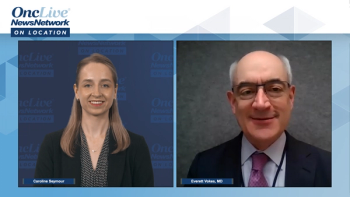
OncLive® will be LIVE with OncLive® News Network: On Location at the 2022 ASCO Annual Meeting. Each day, we will broadcast a series of interviews with top thought leaders, to learn their thoughts and reactions to data presented across oncology during the conference.
The selective EGFR inhibitor CLN-081 elicited objective responses in heavily pretreated patients with non–small cell lung cancer with EGFR exon 20 insertions and was found to have an acceptable toxicity profile, according to data from the phase 1/2a CLN-081-001 trial.
The addition of ramucirumab to pembrolizumab elicited significant response among patients with advanced non–small cell lung cancer who experienced disease progression following treatment with PD-1/PD-L1 inhibitors and platinum-based doublet chemotherapy.
Adagrasib led to early onset and deep responses translating to encouraging survival as a single agent in previously treated patients with KRAS G12C–mutated non–small cell lung cancer, according to results from cohort A of the phase 1/2 KRYSTAL-1 trial.
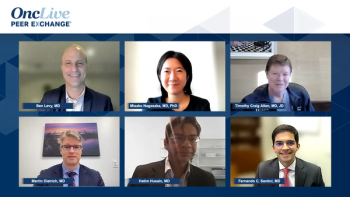
Lung cancer experts share final thoughts on their thorough discussion of treatments in NSCLC and what to look for in the future.
Dr Martin Dietrich gives an overview of novel antibody-drug conjugates in the NSCLC treatment landscape.
For the 10th consecutive year, OncLive® is honored to recognize oncology leaders whose innovations have contributed to immeasurable improvements in outcomes for countless patients.

New systemic regimens are being integrated into the treatment paradigm for resectable non–small cell lung cancer in the neoadjuvant and adjuvant settings, expanding options for patients with earlier-stage disease who face a challenging prognosis.

Uliledlimab in combination with toripalimab generated notable response rates in patients with advanced non–small cell lung cancer who were previously ineligible to receive standard-of-care treatment.
Advertisement
Advertisement
Trending on OncLive
1
Five Under 5: Top Oncology Videos for the Week of 10/5/2026
2
Guardant360 CDx Receives European Approval as Companion Diagnostic for Camizestrant in ESR1-Mutated Advanced Breast Cancer
3
GI Cancer Monthly Rewind: Key News and Expert Insights You May Have Missed in September 2026
4
The OncFive: Top Oncology Articles for the Week of 10/4/2026
5