



Lung Cancer
Latest News

Abivertinib Demonstrates Response and Survival Benefits in Pretreated EGFR T790M–Mutant NSCLC
By Chris Ryan

Bevacizumab Biosimilar CT-P16 Approved in Europe for Multiple Cancer Types
By Kristi Rosa
Advertisement
Latest Videos




































































Advertisement
More News
The FDA has granted an orphan drug designation to the fixed-dose combination capsule of the PARP inhibitor senaparib and temozolomide for the treatment of adult patients with small cell lung cancer.

Successful, established immunotherapies that have been approved for use in the metastatic setting are rapidly moving forward into the adjuvant and neoadjuvant settings, and novel agents are emerging in later lines.

The Guardant Reveal assay has been expanded for the detection of minimal residual disease and disease recurrence in patients with early-stage breast cancer and lung cancer.
The FDA has approved the Oncomine Dx Target Test as a companion diagnostic to identify patients with NSCLC harboring an activating HER2 mutation who may derive clinical benefit from treatment with fam-trastuzumab deruxtecan-nxki.

Closing out their discussion on non–small cell lung cancer, panelists share their expectations for future improvements in care.
Expert oncologists consider novel targeted agents in the setting of NSCLC with mutations in HER2, MET exon14, and RET, respectively.

The anti–interleukin-1β monoclonal antibody canakinumab did not generate a disease-free survival benefit vs placebo in adult patients with stages II to IIIA and IIIB completely resected non–small cell lung cancer, failing to meet the primary end point of the phase 3 CANOPY-A trial.
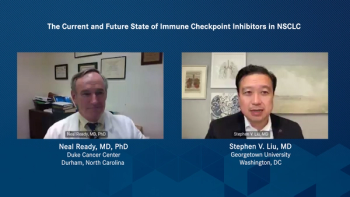
Closing out their discussion on the treatment paradigm of advanced NSCLC, key opinion leaders review emerging targets and ongoing clinical trials.
The FDA has granted an accelerated approval to fam-trastuzumab deruxtecan-nxki for adult patients with unresectable or metastatic non–small cell lung cancer whose tumors have activating HER2 mutations, as detected by an FDA-approved test, and who have received previous systemic therapy.
The FDA has granted regular approval to capmatinib (Tabrecta) for adult patients with metastatic non–small cell lung cancer whose tumors have a mutation leading to MET exon 14 skipping, as detected by an FDA-approved test.

The panel shares clinical pearls for community oncologists treating small cell lung cancer.

Yasir Y. Elamin, MD, discusses the efficacy of poziotinib in patients with EGFR exon 20–mutated non–small cell lung cancer with near-loop vs far-loop mutations.

Taofeek Owonikoko, MD, PhD, highlights investigational agents and ongoing clinical trials in SCLC he looks forward to.
Experts provide insights on choosing the optimal therapy in patients with small cell lung cancer in the second line and beyond.

Treatment with durvalumab and concurrent radiotherapy provided a significant benefit in progression-free survival in patients with locally advanced non–small cell lung cancer, meeting the primary end point of the phase 2 DOLPHIN trial.

Although frontline treatment with avelumab resulted in a longer overall survival and progression-free survival than that observed with platinum-based chemotherapy in patients with advanced non–small cell lung cancer and high PD-L1 positivity, this difference did not achieve statistical significance.

Sunvozertinib monotherapy produced meaningful responses in patients with locally advanced or metastatic non–small cell lung cancer harboring EGFR exon 20 insertion mutations who received prior treatment with platinum-based chemotherapy, according to pooled data from the phase 1 WU-KONG1 and WU-KONG2 trials, plus the phase 2 WU-KONG6 trial.

Brandon S. Sheffield, MD, discusses the economic cost of delaying treatment while conducting biomarker testing in non–small cell lung cancer.

Benjamin Levy, MD, discusses the efficacy findings of the combination of datopotamab deruxtecan and pembrolizumab, with or without chemotherapy, in non–small cell lung cancer.

There is an obvious way to double survival in patients with lung cancer in the next 5 years: remove barriers to screening, especially for high-risk populations.
The FDA has granted an orphan drug designation to THIO for the treatment of patients with small cell lung cancer.

Focusing on ALK-rearranged non–small cell lung cancer, expert panelists review data behind alectinib, brigatinib, and lorlatinib.
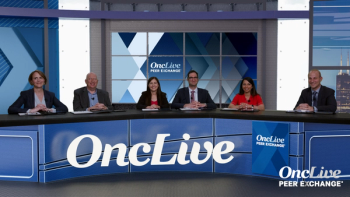
Expert perspectives on the management of KRAS G12C–mutant non–small cell lung cancer in the context of novel targeted agents.

The combination of datopotamab deruxtecan and pembrolizumab, with or without platinum-based chemotherapy, displayed promising efficacy and a manageable safety profile in patients with advanced/metastatic non–small cell lung cancer.

The combination of pembrolizumab and etoposide maintained benefits in overall survival (OS) and progression-free survival vs etoposide plus placebo in patients with previously untreated extensive-stage small cell lung cancer.
Advertisement
Advertisement
Trending on OncLive
1
FDA Approves Tucatinib Plus Trastuzumab/Pertuzumab as First-Line Maintenance in Advanced HER2+ Breast Cancer
2
GI Cancer Monthly Rewind: Key News and Expert Insights You May Have Missed in September 2026
3
FDA Grants Breakthrough Device Designation to Natera’s Multi-Cancer Early Detection Assay
4
Five Under 5: Top Oncology Videos for the Week of 10/5/2026
5