



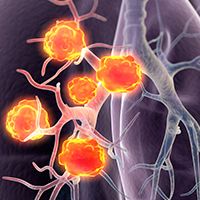

Lung Cancer
Latest News

Talazoparib Plus Low-Dose Temozolomide Improves ORR Over Historical Control in R/R ES-SCLC
By Kristi Rosa
Advertisement
Latest Videos





































































Advertisement
More News

New combinations and strategies are needed for patients with non–small cell lung cancer who progress after first-line chemoimmunotherapy after results of a retrospective analysis showed modest efficacy with second-line chemotherapy.

EGFR C797X mutations have become a leading mechanism of acquired resistance following treatment with the third-generation EGFR inhibitor osimertinib, outpacing MET amplification.

Amivantamab in combination with lazertinib plus carboplatin and pemetrexed elicited encouraging responses in pretreated patients with EGFR-mutant non–small cell lung cancer, according to findings from the phase 1 CHRYSALIS-2 trial.

Drs Edward S. Kim and Alexander Spira answer viewer questions on ADCs in non-small cell lung cancer.

An overall survival trend in favor of adjuvant atezolizumab over best supportive care was observed in patients with stage II to IIIA resected non–small cell lung cancer with a PD-L1 tumor cell (TC) expression of at least 1%, with a clinically meaningful OS trend noted in those with a PD-L1 TC expression of 50% or higher.

The addition of nivolumab to chemotherapy provided progression-free survival and overall survival benefits compared with chemotherapy alone in patients with stage IIIA/B non–small cell lung cancer.

The combination of pembrolizumab and lenvatinib generated promising clinical activity with a manageable safety profile in pretreated patients with malignant pleural mesothelioma.
The combination of sotorasib and the small molecule SHP2 inhibitor RMC-4630 led to an investigator-assessed objective response rate of 27% and 50% in pretreated and KRAS G12C inhibitor–naïve patients with non–small cell lung cancer, respectively.

The robust efficacy achieved with tepotinib in patients with non–small cell lung cancer harboring MET exon 14 skipping alterations was independently confirmed in data from the primary analysis of cohort C of the phase 2 VISION trial.

A lead-in dosing strategy for the combination of sotorasib in combination with either pembrolizumab or atezolizumab showed promising efficacy and relatively low rates of hepatotoxicity in patients with KRAS G12C–positive non–small cell lung cancer.

Sitravatinib in combination with tislelizumab demonstrated a confirmed investigator-assessed overall response rate of 30.4% in patients with PD-L1–positive, treatment-naïve, locally advanced or metastatic squamous non–small cell lung cancer.
GDC-6036, a novel KRAS G12C inhibitor, produced encouraging antitumor activity with a manageable safety profile as a single agent in previously treated patients with KRAS G12C–mutated NSCLC, according to data from a phase 1a trial.

Sintilimab, both as a single agent and in combination with chemotherapy, generated comparable efficacy and safety vs pembrolizumab in patients with untreated metastatic non–small cell lung cancer.
Four distinct subgroups, each associated with distinctive signaling pathways, microenvironments, and clinical-pathologic futures, were discovered in a population of patients with MET exon 14 skipping non–small cell lung cancer.

The use of a platinum-based chemotherapy and anti–PD-1 regimen was supported by differences in upregulated antigen processing, T-cell receptor coexpression, and lymphocyte infiltration pathways in patients with or without pathologic complete responses who had stage IIIA resectable non–small cell lung cancer.

Sugemalimab appeared to be safe and effective when used as consolidation therapy for patients with unresectable stage III non–small cell lung cancer (NSCLC) who did not have disease progression following concurrent chemoradiation or sequential chemoradiation.

Larotrectinib continued to elicit durable responses and a low toxicity profile in patients with NTRK fusion–positive lung cancer, according to long-term follow-up data from the phase 2 NAVIGATE trial and phase 1 LOXO-TRK-14001 trial.

Ociperlimab, an anti-TIGIT monoclonal antibody, plus the anti–PD-L1 monoclonal antibody tislelizumab induced promising efficacy in adults with treatment-naïve, metastatic, PD-L1–positive non–small cell lung cancer, according to data from the dose-expansion cohort of the AdvanTIG-105 trial.

The addition of tremelimumab to durvalumab and chemotherapy improved clinical benefit and survival benefit vs. chemotherapy alone in patients with PD-L1–negative metastatic non–small cell lung cancer.
Second- or third-line tislelizumab continued to display an overall survival benefit vs docetaxel in patients with non–small cell lung cancer.

Neoadjuvant adagrasib as monotherapy or in combination with nivolumab may elicit improved pathologic complete response rates in patients with resectable, KRAS G12C–mutated non–small cell lung cancer, according to the rationale for the phase 2 Neo-KAN study.

The antibody-drug conjugate sacituzumab govitecan will be evaluated vs single-agent docetaxel during the phase 3 EVOKE-01 trial in patients with metastatic non–small cell lung cancer.
Acquired resistance because of genetic alterations in the MET receptor has limited the efficacy of the EGFR inhibitor osimertinib in patients with non–small cell lung cancer. Investigators have sought to circumvent this barrier through targeting MET protein activity with the addition of the novel MET TKI, savolitinib.
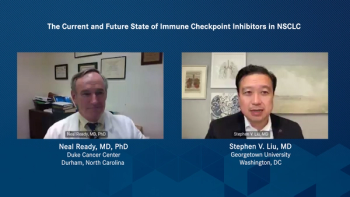
Shared insight on the CheckMate 9LA trial, which combined dual IO therapy with chemotherapy in the setting of advanced non–small cell lung cancer.
Expert perspectives on the CheckMate 227 clinical trial, which combined ipilimumab and nivolumab IO therapy in patients with advanced NSCLC.
Advertisement
Advertisement
Trending on OncLive
1
FDA Approves Tucatinib Plus Trastuzumab/Pertuzumab as First-Line Maintenance in Advanced HER2+ Breast Cancer
2
GI Cancer Monthly Rewind: Key News and Expert Insights You May Have Missed in September 2026
3
FDA Grants Breakthrough Device Designation to Natera’s Multi-Cancer Early Detection Assay
4
Five Under 5: Top Oncology Videos for the Week of 10/5/2026
5