



Lung Cancer
Latest News
Advertisement
Latest Videos

































































Advertisement
More News
A brief review of AEs seen with immunotherapy in advanced non–small cell lung cancer followed by advice on how to nuance safety data in this setting.

Focusing the discussion on the clinical trials that led to the FDA approval of trilaciclib, experts in ES-SCLC share key insights into the drug’s safety and its effect on patient quality of life.
Alexander Spira, MD, PhD, FACP, and Edward S. Kim, MD, MBA, shift their focus to the use of antibody-drug conjugates in non-small cell lung cancer treatment with a review of ADC clinical trial data.
Expert perspectives on use of immunotherapy in the adjuvant setting of early-stage NSCLC in light of data from IMpower010 and PEARLS.
Advances in Testing and Targeted Therapy for NSCLC: Translating Evidence to Clinical Practice

Pralsetinib has been approved in Hong Kong, China, for use in treatment-naïve and pretreated adult patients with RET fusion–positive, metastatic non–small cell lung cancer.
Dr Charles Rudin highlights other notable clinical trials and real-world studies in patients with SCLC in the frontline setting.

IMpower 133 Trial and Patient Selection for Durvalumab + Chemotherapy vs Atezolizumab + Chemotherapy
Dr Charu Aggarwal shares data from the IMpower133 trial of atezolizumab plus chemotherapy for SCLC, and how to select the appropriate frontline therapy.
Julie R. Brahmer, MD, MSc, discusses the examination of nemvaleukin alfa in solid tumors.
Focusing on single-agent immunotherapy in advanced NSCLC, experts review key data from the KEYNOTE-024, IMpower110, and EMPOWER-Lung 1 clinical trials.
Expert oncologists review the current state of molecular testing and PD-L1 expression in the setting of advanced non–small cell lung cancer management.
Renowned leaders in thoracic oncology discuss efficacy data from key clinical trials that led to the FDA approval of the CDK4/6 inhibitor trilaciclib for CIM prophylaxis in ES-SCLC, including the drug’s role in later treatment lines.
Edgardo Santos, MD, FACP, and Martin Dietrich, MD, PhD, share insights into the mechanism of action of CDK4/6 inhibitors for the prevention of myelosuppression in ES-SCLC.
Nir Peled, MD, PhD, FCCP, discusses the rationale of evaluating the combination of lenvatinib and pembrolizumab plus chemotherapy in non–small cell lung cancer.
Edward S. Kim, MD, MBA, and Alexander Spira, MD, PhD, FACP, provide an overview of antibody-drug conjugates, including mechanism of action, historical milestones in development, and the approved ADCs for non–small cell lung cancer treatment.
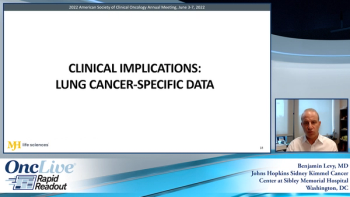
Dr Levy presents updated safety and efficacy results on larotrectinib in patients with TRK fusion-positive lung cancer.
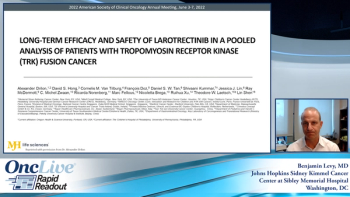
Dr Benjamin Levy reviews long-term, pooled safety and efficacy data on larotrectinib in patients with TRK fusion-positive cancers.
Shared insight on the role and selection of adjuvant chemotherapy for patients with early-stage non–small cell lung cancer.
Shifting focus to early-stage NSCLC, expert panelists define the role of resection and consider when it is appropriate to utilize adjuvant radiation therapy.

Vivek Subbiah, MD, analyzes adverse events observed with durvalumab plus chemotherapy in patients with SCLC and how they can be managed.
Jared Weiss, MD, reviews data from the CASPIAN trial of durvalumab plus chemotherapy in patients with extensive-stage small cell lung cancer.
Expert panelists review considerations in the prophylactic treatment of chemotherapy-induced myelosuppression with special attention paid to unmet needs related to the use of G-CSF and ESAs.
Two leaders in the management of ES-SCLC provide an overview of chemotherapy-induced myelosuppression including key risk factors and its effect on patient outcomes.
A thoracic oncology expert provides perspective on ctDNA as a tool and its future as part of the NSCLC landscape.
A comprehensive review of data presented at ASCO 2022 on ctDNA and MRD detection in NSCLC.
Advertisement
Advertisement
Trending on OncLive
1
FDA Approves Tucatinib Plus Trastuzumab/Pertuzumab as First-Line Maintenance in Advanced HER2+ Breast Cancer
2
GI Cancer Monthly Rewind: Key News and Expert Insights You May Have Missed in September 2026
3
FDA Grants Breakthrough Device Designation to Natera’s Multi-Cancer Early Detection Assay
4
Five Under 5: Top Oncology Videos for the Week of 10/5/2026
5