


Multiple Myeloma
Latest News
Advertisement
Latest Videos



CME Content



































Advertisement
More News
Michael J. Fallon, MD, discusses supportive care considerations for patients with relapsed/refractory multiple myeloma.
In this fifth episode of OncChats: Unpacking Data From Pivotal Trials in Multiple Myeloma, Hamza Hashmi, MD, reviews the implications of up-front vs delayed transplant on survival, quality of life, and risk of secondary malignancies in newly diagnosed, multiple myeloma.
Carmelo Carlo-Stella, MD, PhD, discusses the evaluation of subcutaneous and intravenous RG6234 in relapsed/refractory multiple myeloma.
David Siegel, MD, PhD, discusses the importance of investigating idecabtagene vicleucel in patients with relapsed/refractory multiple myeloma.
Natalie S. Callander, MD, contextualizes the implications of the phase 3 ATLAS trial findings alongside other trials investigating maintenance regimens with triplet therapies in multiple myeloma.

Hana Safa, MD, shares data on quadruplet therapies in the treatment of relapsed multiple myeloma.
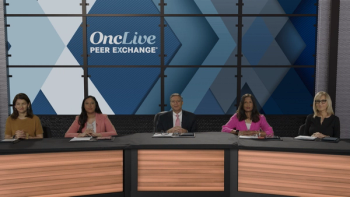
The panel debates the options for treatment of late relapsed multiple myeloma.

Andrzej Jakubowiak, MD, PhD, highlighted several key studies that influenced the development and design of the ATLAS trial, introduced conclusions from the initial efficacy data, and discussed how ongoing analysis could further contextualize and inform post-transplant treatment approaches in multiple myeloma.
David Siegel, MD, discusses the significance of updated data from cohort 2C of the phase 2 KarMMa-2 trial in multiple myeloma.
Emma Searle, MD, discusses early findings from cohort E of the phase 1b MajesTEC-2 trial (NCT04722146) evaluating teclistamab-cqyv (Tecvayli) plus daratumumab (Darzalex) and lenalidomide (Revlimid) in multiple myeloma.
In this fourth episode of OncChats: Unpacking Data From Pivotal Trials in Multiple Myeloma, Hamza Hashmi, MD, explains the optimal use of CAR T-cell therapy and common symptoms of adverse effects, including cytokine release syndrome and immune effector cell–associated neurotoxicity syndrome in relapsed/refractory multiple myeloma.
Andrzej Jakubowiak, MD, PhD, discusses initial efficacy results from the phase 3 ATLAS trial in multiple myeloma.
Drs Hana Safah and Krina Patel share data from key clinical trials investigating the treatment of relapsed multiple myeloma.
Dr Amrita Krishnan explains the difference between biochemical and clinical relapse in multiple myeloma.
Shaji Kumar, MD, discusses the MAIA trial; key takeaways regarding the long-term safety and efficacy of daratumumab, lenalidomide, and dexamethasone, in transplant-ineligible patients with newly diagnosed multiple myeloma; and the implications of this research on clinical practice.
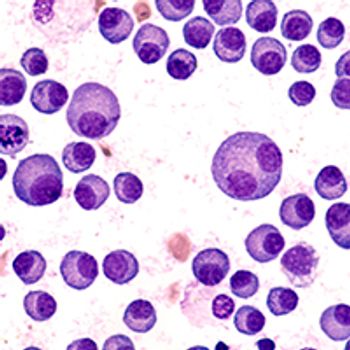
Ciltacabtagene autoleucel demonstrated a significant improvement in progression-free survival in patients with relapsed/lenalidomide-refractory multiple myeloma who received 1 to 3 prior lines of therapy.

Maintenance therapy with carfilzomib, lenalidomide, and dexamethasone led to a significant improvement in progression-free survival vs lenalidomide alone in patients with newly diagnosed multiple myeloma who underwent autologous stem cell transplant after induction therapy, according to an unplanned interim analysis of the phase 3 ATLAS trial.
In this third episode of OncChats: Unpacking Data From Pivotal Trials in Multiple Myeloma, Hamza Hashmi, MD, highlights the efficacy and safety profile of teclistamab, a BCMA-directed bispecific T-cell engager, in heavily pretreated multiple myeloma.
Sergio A. Giralt, MD, discusses long-term outcomes with hematopoietic stem cell transplant in multiple myeloma
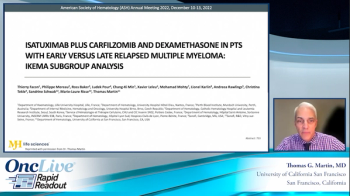
Expert hematologist-oncologist Thomas G. Martin, MD, shares data from the IKEMA subgroup analysis in patients with relapsed multiple myeloma treated with isatuximab, carfilzomib, and dexamethasone.
David Siegel, MD, PhD, discusses the evaluation of idecabtagene vicleucel in cohort 2C of the KarMMa-2 trial and what these data could mean for this population and others with multiple myeloma.
Noopur Raje, MD, details the data on treatment duration in older patients with multiple myeloma and transplant-eligible patients.
Amrita Krishnan, MD, and Hana Safah, MD, discuss how to measure frailty in patient with multiple myeloma.
Ajay Chari, MD, discusses several avenues for future study in newly diagnosed multiple myeloma.
In this second episode of OncChats: Unpacking Data From Pivotal Trials in Multiple Myeloma, Hamza Hashmi, MD, discusses the depth of response reported with daratumumab, carfilzomib, lenalidomide, and dexamethasone in transplant-eligible multiple myeloma.
Advertisement
Advertisement
Trending on OncLive
1
Five Under 5: Top Oncology Videos for the Week of 8/31/26
2
FDA Approves Camizestrant Plus a CDK4/6 Inhibitor for Emergent ESR1-Mutated HR+, HER2– Advanced Breast Cancer
3
Ivonescimab Meets OS End Point vs Pembrolizumab in First-Line PD-L1+ NSCLC
4
B7-H4–Targeted ADCs Signal a New Frontier for Platinum-Resistant Ovarian and Endometrial Cancer
5