

Multiple Myeloma
Latest News
Advertisement
Latest Videos
CME Content





































Advertisement
More News
Dr Joseph Mikhael and expert panel re-visit the patient case and offer their final thoughts on the impact of clinical trial updates in the treatment landscape of multiple myeloma.
Ajai Chari, MD, shares some background on talquetamab, reported safety and efficacy findings from MonumenTAL-1, and highlighted other ways in which the agent is being explored in multiple myeloma.
Dr Joseph Mikhael and expert panel discuss key efficacy and safety outcomes of pivotal clinical trials evaluating treatment regimens in patients with R/R multiple myeloma.

Jenny Ahlstrom, a patient with multiple myeloma, shares considerations for patients going through treatment, including toxicities, follow-up, and travel planning.
Shaji Kumar, MD, and Krina Patel, MD, discuss the treatment options for patients with newly-diagnosed multiple myeloma who are not eligible for stem cell transplant.
Dr Joseph Mikhael and expert panel review current treatment options for patients with early relapse multiple myeloma, in accordance with current NCCN guidelines.
Dr Joseph Mikhael and expert panel review a case study in early relapse multiple myeloma and the impact of cytogenetics in risk assessment for patients with early relapse multiple myeloma.
Dr Krina Patel discusses updates in the treatment of newly-diagnosed from recent meetings how the appropriate treatments are selected in patients with newly-diagnosed multiple myeloma.
Dr Shaji Kumar reviews clinical trial data on the role of stem cell transplant as a treatment for newly-diagnosed multiple myeloma in tandem with a multi-agent combination therapy.
Al-Ola A. Abdallah, MD, discusses interim results from an ongoing phase 1 trial of HPN217 in heavily pretreated patients with relapsed/refractory multiple myeloma.
Carmelo Carlo-Stella, MD, PhD, discusses updated results from a phase 1 dose-escalation study of subcutaneous and intravenous RG6234 in relapsed/refractory multiple myeloma.
Shaji Kumar, MD, discusses the updated data from the phase 3 MAIA trial in newly diagnosed multiple myeloma.

Hana Safah, MD, explains the common treatment approaches for patients with transplant-ineligible multiple myeloma.
Sagar Lonial, MD, introduces the expert panel and starts a conversation on data updates in the treatment of transplant-eligible multiple myeloma.

Dr Kumar, Dr Patel, Falbo, and Ahlstrom highlight the importance of community-based discussions regarding adverse effects in multiple myeloma, the benefits of considering the whole treatment course, and subgroup analyses from the MAIA trial.
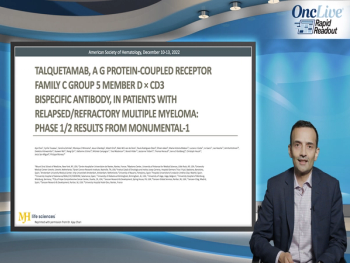
Dr Ajay Chari reviews the results from the MonumenTAL-1 trial which evaluates the use of talquetamab, a GPRC5D x CD3 bispecific antibody in patients with relapsed refractory multiple myeloma.
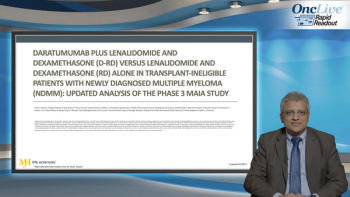
Shaji Kumar, MD, reviews the results of the phase 3 study evaluating the use of daratumumab plus lenalidomide and dexamethasone (D-Rd) versus lenalidomide and dexamethasone (Rd) in transplant-ineligible patients with newly diagnosed multiple myeloma (NDMM).
Krina Patel, MD, details the three- and four-drug regimen first-line treatment options for transplant-eligible newly-diagnosed multiple myeloma and how to make an appropriate treatment decision.
Shaji Kumar, MD, provides an overview of multiple myeloma, and Jenny Ahlstrom, a patient with multiple myeloma, shares the story of her diagnosis and the resources she used to educate herself.

Sandra P. Susanibar-Adaniya, MD, discusses important considerations when treating patients with multiple myeloma.
Among patients with newly diagnosed high-risk multiple myeloma, treatment with BCMA/CD19 dual-targeting FasTCAR-T Cells resulted in an overall response rate of 100%, with all treated patients evaluable for minimal residual disease showing minimal residual disease negativity to 12 months.
The CAR-T cell therapy ciltacabtagene autoleucel has expanded options for adult patients with relapsed/refractory multiple myeloma after 4 or more lines of prior therapy in the United States, and has continued to display promising efficacy in patients with multiple myeloma following early relapse.

Single-agent belantamab mafodotin continued to produce rapid, deep, and durable responses in patients with relapsed/refractory multiple myeloma.
The combination of belantamab mafodotin, pomalidomide, and dexamethasone elicited encouraging responses and survival benefits in patients with triple class–exposed or refractory multiple myeloma.
In this episode, OncLive® speaks with Dr. Noopur Raje on developments in multiple myeloma, Dr. Ryotaro Nakamura on data related to graft-vs-host disease, and Dr. Joshua Brody on the latest in non-Hodgkin lymphoma.
Advertisement
Advertisement
Trending on OncLive
1
Five Under 5: Top Oncology Videos for the Week of 8/31/26
2
FDA Approves Camizestrant Plus a CDK4/6 Inhibitor for Emergent ESR1-Mutated HR+, HER2– Advanced Breast Cancer
3
Ivonescimab Meets OS End Point vs Pembrolizumab in First-Line PD-L1+ NSCLC
4
B7-H4–Targeted ADCs Signal a New Frontier for Platinum-Resistant Ovarian and Endometrial Cancer
5