




Multiple Myeloma
Latest News


UCSF Showcases Potentially Game-Changing Trials Across Multiple Myeloma Settings
By Gina Mauro
Advertisement
Latest Videos







CME Content





































Advertisement
More News
Sagar Lonial, MD, reviews key takeaways from the DREAMM-2 trial, and Katja Weisel, MD, comments on the potential use of belantamab mafodotin in the early relapse setting for multiple myeloma.
Laura Finn, MD, provides a deep dive into pivotal data with combinations and novel agents that have changed the paradigm for patients with newly diagnosed, early relapsed, and late relapsed multiple myeloma.

Douglas W. Sborov, MD, MS, discusses key data and therapeutic developments that have reshaped the treatment of patients with newly diagnosed and relapsed/refractory multiple myeloma.

Jeffrey Zonder, MD, discusses his presentation at the 2021 ASH Annual Meeting on the impact of the phase 1/2 study utilizing REGN5458 in multiple myeloma.

Although cytogenetic abnormalities have helped to characterize prognosis and identify patients who are at high risk of early progression, risk stratification has little effect on management decisions for most patients with multiple myeloma.
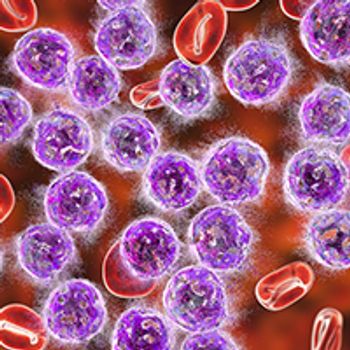
The subcutaneous combination of the BCMA-targeting bispecific antibody teclistamab and daratumumab produced promising preliminary efficacy and favorable tolerability in heavily pretreated patients with relapsed or refractory multiple myeloma, according to results from the phase 1b TRIMM-2 trial.

Neha S. Korde, MD, hematologist, Memorial Sloan Kettering Cancer Center, discusses key updates to the phase 3 Cassiopeia study (NCT02541383) in multiple myeloma.
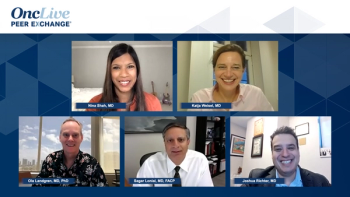
Experts in hematology-oncology review the case of a 59-year-old woman with relapsed/refractory multiple myeloma and discuss their thoughts on the given treatment approach.
Sagar Lonial, MD; Joshua Richter, MD; and Ola Landgren, MD, PhD, comment on the selection of the appropriate treatment regimen at first relapse, including CD38-based, non-CD38–based and non-PI–based treatment regimens for multiple myeloma, and discuss their approach to assessing treatment response.
Closing out his discussion on the ASH 2021 meeting, Saad Usmani, MD, shares key takeaways for clinical practice in multiple myeloma.
Saad Usmani, MD, shares his excitement for additional clinical trial data in multiple myeloma presented at the ASH 2021 annual meeting.
In relapsed/refractory multiple myeloma, a recent study tested the addition of venetoclax to daratumumab and dexamethasone.
Insight on the BELLINI study, which added venetoclax to bortezomib and dexamethasone for patients with relapsed/refractory multiple myeloma.
Closing out his discussion on newly diagnosed multiple myeloma, Saad Usmani, MD, considers the approval and use of subcutaneous daratumumab.
In the context of transplant-ineligible newly diagnosed multiple myeloma, Saad Usmani, MD, considers the role of triplet versus quadruplet therapy.
Expert perspective on results from the MASTER study analyzing daratumumab in combination with KRd in transplant-eligible newly diagnosed multiple myeloma.
Updated results from the GRIFFIN study, which combined daratumumab with RVd in patients with transplant-eligible newly diagnosed multiple myeloma.

Saad Z. Usmani, MD, MBA, FACP, discusses emerging treatment strategies in late relapsed multiple myeloma.

A marketing authorization application has been submitted to the European Medicines Agency seeking the approval of teclistamab for the treatment of patients with relapsed or refractory multiple myeloma.
Ola Landgren, MD, PhD, reviews the results and clinical implications of the IKEMA study for patients with relapsed/refractory multiple myeloma.
Katja Weisel, MD, leads a review of the study design and updated efficacy and safety results of the phase 3 CANDOR study for patients with relapsed/refractory multiple myeloma.
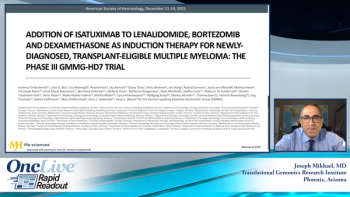
Expert hematologist/oncologist Joseph Mikhael, MD, shares insight on the phase III GMMG-HD7 trial, which added isatuximab to RVd in the setting of newly diagnosed, transplant-eligible multiple myeloma.

Closing out her discussion on the management of newly diagnosed and relapsed/refractory multiple myeloma, Amrita Y. Krishnan, MD, shares key takeaways from the ASH 2021 Annual Meeting.
Amrita Y. Krishnan, MD, considers where bispecific antibodies will fit into the multiple myeloma treatment paradigms as single-agent or combination therapy.
Insight on results from the MonumenTAL-1 and MajesTEC-1 studies, which evaluated bispecific antibodies in patients with relapsed/refractory multiple myeloma.
Advertisement
Advertisement
Trending on OncLive
1
Five Under 5: Top Oncology Videos for the Week of 8/31/26
2
FDA Approves Camizestrant Plus a CDK4/6 Inhibitor for Emergent ESR1-Mutated HR+, HER2– Advanced Breast Cancer
3
Ivonescimab Meets OS End Point vs Pembrolizumab in First-Line PD-L1+ NSCLC
4
B7-H4–Targeted ADCs Signal a New Frontier for Platinum-Resistant Ovarian and Endometrial Cancer
5