

Multiple Myeloma
Latest News

July 26th 2022
By Jason Harris
The addition of pembrolizumab to belantamab mafodotin resulted in a higher overall response rate in patients with relapsed/refractory multiple myeloma than what has been observed with the antibody-drug conjugate alone, according to results from the phase 1/2 DREAMM-4 trial.
Teclistamab Approaches EU Approval for Relapsed/Refractory Multiple Myeloma
By Chris Ryan
Advertisement
Latest Videos


CME Content




































Advertisement
More News

Expert hematologist-oncologists home in on clinical trial data to consider which regimens are most appropriate for patients with transplant-ineligible NDMM.
An overview of the frontline treatment armamentarium for patients with transplant-ineligible multiple myeloma and review of the MAIA and SWOG-S0777 trials.
Before closing out their discussion on transplant-eligible NDMM, expert panelists consider the role of maintenance therapy following transplant.

Dr Nooka reviews the patient reported outcomes from the MajesTEC-1 trial in patients with relapsed/refractory multiple myeloma.
The addition of belantamab mafodotin-blmf to lenalidomide and dexamethasone generated responses with acceptable safety in patients with newly diagnosed multiple myeloma who were ineligible to undergo autologous stem cell transplant.

Real-world evidence is finding an expanded role in oncology, prompting experts to rethink how data are gathered on the day-to-day usefulness of drugs for regulatory decisions.
Expert perspectives on the optimal duration of treatment in patients with transplant-eligible newly diagnosed multiple myeloma.
Comprehensive discussion on the assessment of response to frontline therapy for transplant-eligible multiple myeloma and the role of MRD negativity in assessing response.

Ajai Chari, MD, discusses the evolving landscape and developing therapies within multiple myeloma.
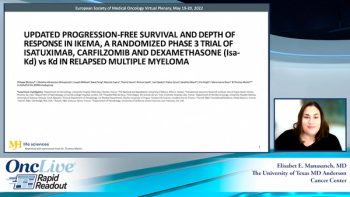
Dr Elisabet Manasanch reviews updated data from the IKEMA study in patients with relapsed multiple myeloma.

The FDA has granted a breakthrough therapy designation to talquetamab for use as a potential therapeutic option in patients with relapsed or refractory multiple myeloma who received at least 4 prior lines of therapy, including a proteasome inhibitor, an immunomodulatory drug, and an anti-CD38 antibody.
Shared insight on clinical trial results from both the GRIFFIN and MASTER trials, and the key role of frontline quadruplet regimens in transplant-eligible NDMM.
Expert hematologist-oncologists open their discussion on NDMM management by reviewing frontline data from the recent DETERMINATION trial.

Teclistamab demonstrated superiority over physician’s choice of therapy for overall survival, progression-free survival, and time to next treatment in patients with relapsed/refractory multiple myeloma.

The CAR T-cell therapy ciltacabtagene autoleucel generated a high response rate in patients with multiple myeloma who experienced early clinical relapse or failure to initial therapy.

The European Medicines Agency's Committee for Medicinal Products for Human Use has unanimously recommended full marketing authorization approval of melphalan flufenamide for patients with triple-class refractory multiple myeloma.
Amrita Krishnan, MD, discusses the effectiveness of teclistamab in relapsed/refractory multiple myeloma.

Monique Minnema, MD, discusses the rationale of the MonumenTAL-1 trial examining talquetamab in multiple myeloma, the safety and efficacy reported thus far with the bispecific antibody, and next steps for further exploration.

A single infusion of the CAR T-cell therapy ciltacabtagene autoleucel produced deep and durable responses in patients with relapsed/refractory multiple myeloma with a manageable toxicity profile, according to long-term follow-up data of the phase 1b/2 CARTITUDE-1 trial.
Andrew Yee, MD, discusses treating patients with relapsed disease in multiple myeloma.
Closing out their discussion on bispecifics in multiple myeloma, expert hematologist-oncologists share practical advice for community physicians alongside their hopes for the future.
Luciano Costa, MD, and Adriana Rossi, MD, consider the possibility of earlier-line bispecific and CAR T-cell therapies in multiple myeloma.
Noopur Raje, MD, discusses current CAR T-cell therapies in multiple myeloma.
RG6234, a novel T-cell engaging bispecific antibody with a 2:1 configuration, induced high response rates and early evidence of durability for patients with relapsed/refractory multiple myeloma.
The bispecific antibody REGN5458 elicited rapid responses that were further characterized by their depth, durability, and low incidence of cytokine release syndrome in patients with relapsed/refractory multiple myeloma.
Advertisement
Advertisement
Trending on OncLive
1
Five Under 5: Top Oncology Videos for the Week of 8/31/26
2
FDA Approves Camizestrant Plus a CDK4/6 Inhibitor for Emergent ESR1-Mutated HR+, HER2– Advanced Breast Cancer
3
Ivonescimab Meets OS End Point vs Pembrolizumab in First-Line PD-L1+ NSCLC
4
B7-H4–Targeted ADCs Signal a New Frontier for Platinum-Resistant Ovarian and Endometrial Cancer
5