


Prostate Cancer
Latest News
Advertisement
Latest Videos



















































Advertisement
More News
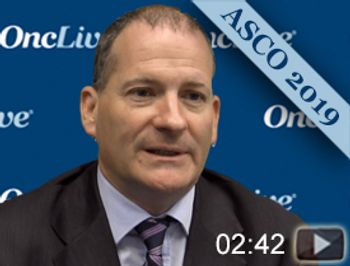
Christopher Sweeney, MBBS, medical oncologist at the Lank Center for Genitourinary Oncology, Dana-Farber Cancer Institute, discusses results of the phase III ENZAMET trial, which looked at standard therapy with or without enzalutamide as a treatment for patients with metastatic hormone-sensitive prostate cancer.
Almost 80% of men with metastatic hormone-sensitive prostate cancer treated with enzalutamide plus standard of care (SOC) were alive after 3 years compared with 72% of patients who received a different non-steroidal anti-androgen plus SOC.


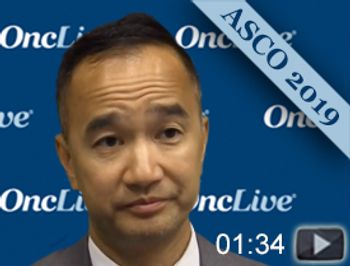
Kim N. Chi, MD, associate director of clinical research, Vancouver Prostate Centre, professor, Department of Medicine, University of British Columbia, discusses the results of the phase III TITAN trial, which evaluated apalutamide versus placebo (PBO) in patients (pts) with metastatic castration-sensitive prostate cancer (mCSPC) receiving androgen deprivation therapy (ADT).

Adding apalutamide to androgen deprivation therapy (ADT) reduced the risk of the death by 33% in patients with metastatic castration-sensitive prostate cancer compared with ADT alone.
Neeraj Agarwal, MD, associate professor, Division of Oncology, Department of Medicine, University of Utah School of Medicine; and director, Genitourinary Oncology Program, Oncology Division, co-leader, Urologic Oncology Multidisciplinary Program, associate director of Clinical Trials, Huntsman Cancer Institute, discusses part 1 findings from the phase III TALAPRO-2 trial in metastatic castration-resistant prostate cancer.

The FDA has granted a fast track designation to ARV-110, a PROTAC® protein degrader, for use as a treatment of patients with metastatic castration-resistant prostate cancer who have disease progression following ≥2 systemic therapies.
PARP inhibitors alone and in combinations are demonstrating potential in castration-resistant prostate cancer, but questions about survival benefit, toxicities, and efficacy remain to be answered.
Pei-Chun McGregor, MD, cardio-oncologist and director of Ambulatory Cardiology at VA Boston Healthcare System, instructor in medicine, Brigham and Women’s Hospital, discusses the data behind the potential link between cardiac complications and androgen deprivation therapy (ADT) in prostate cancer.
Pei-Chun McGregor, MD, discusses where future research with androgen deprivation therapy-associated adverse events is headed, and called for multidisciplinary care for patients receiving this approach.
Atish D. Choudhury, MD, PhD, details the advances in metastatic prostate cancer in light of updated analyses from several clinical trials and forthcoming research in the field.

Richard (Rick) JaeBong Lee, MD, PhD, discusses the differences between second-generation targeted antiandrogens and highlights potential factors to consider in terms of selection.

Celestia Higano, MD, FACP, member, Clinical Research Division, Fred Hutchinson Cancer Research Center, professor, Department of Medicine and Urology, University of Washington, Seattle Cancer Care Alliance, discusses the toxicity of androgen receptor inhibitors in castration-resistant prostate cancer.

David J. Einstein, MD, discusses newer imaging techniques and overall progress in the treatment of patients with nonmetastatic hormone-sensitive prostate cancer.
Advertisement
Advertisement
Trending on OncLive
1
Savolitinib Plus Osimertinib NDA Submitted to FDA for MET-Driven, EGFR-Mutated NSCLC After EGFR TKI
2
Daraxonrasib Approval Signals a New Era for RAS-Targeted Therapy in Pancreatic Cancer
3
Cilta-Cel Shows Long-Term Treatment-Free Remissions in Lenalidomide-Refractory Myeloma
4
Calculating the Real Cost of False Positive Findings in Cancer Screening
5