






Prostate Cancer
Latest News
Advertisement
Latest Videos








CME Content











































Advertisement
More News

Researchers evaluate the role of magnetic resonance imaging in the clinical staging of prostate cancer in the definitive and salvage settings, and to identify changes in treatment recommendations.

The level of vitamin D in a patient’s blood could serve as a biomarker for an aggressive form of prostate cancer, especially in men who are considering active surveillance for the disease.

Tomasz M. Beer, MD, FACP, discusses how having a deeper understanding of the genetic makeup of patients with castration-resistant prostate cancer would open the door to novel treatments, both monotherapy and combination regimens.
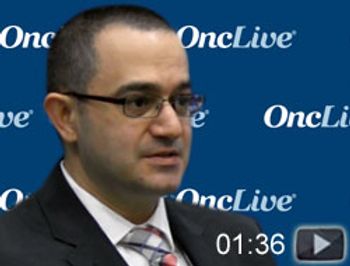
Ismail Baris Turkbey, MD, staff clinician in the Molecular Imaging Program, Center for Cancer Research, National Cancer Institute, discusses sodium fluoride PET imaging for patients with prostate cancer.

Galeterone is being explored in the ARMOR 3-SV study, in which men with progressive metastatic disease who have received prior androgen deprivation therapy are randomized to receive either galeterone or enzalutamide.

Fred Saad, MD, discusses treatment with radium-223 in asymptomatic patients and potential combination regimens with the radiopharmaceutical in castration-resistant prostate cancer.

Neal Shore, MD, discusses the evolution of radiopharmaceuticals, how radium-223 works, and its potential for use in combination with other agents.

The FDA has accepted, for review, a supplemental new drug application for enzalutamide (Xtandi) capsules in patients with metastatic castration-resistant prostate cancer that includes findings from the head-to-head studies, TERRAIN and STRIVE.

Mark Emberton, MD, professor of Interventional Oncology, Division of Surgery and Interventional Science, University College London Hospitals, clinical director, Clinical Effectiveness Unit, Royal College of Surgeons of England, discusses techniques of focal therapy in patients with prostate cancer.

Fred Saad, MD, FRCSC, principal scientist, full professor, Department of Surgery, chair in Prostate Cancer Research, Université de Montréal, medical director, Interdisciplinary Urologic Oncology Group, head, Urologic Oncology, CHUM, discusses the expanded access program (EAP) of radium-223 for the treatment of patients with metastatic castration-resistant prostate cancer (mCRPC).


E. David Crawford, MD, discusses his view of the current role for PSA testing in prostate cancer and the need for continued innovation and advancement with new screening technologies.

The landscape for the patient with localized prostate cancer is filled with both new and exciting treatments. With better methods to screen, improved imaging scans to determine physical location and extent of cancer, and even active surveillance, there are many options to consider.

Leonard G. Gomella, MD, discusses intermittent hormonal therapy for patients with prostate cancer as well as its benefits and challenges.

Using a genomic classifier that identifies men who are at highest risk for developing metastasis after prostatectomy and salvage radiation therapy can help clinicians distinguish which patients would benefit from more aggressive follow-up therapy, according to recent research.

Olaparib (Lynparza) has received an FDA breakthrough therapy designation as a treatment for patients with BRCA1/2 or ATM-mutated metastatic castration-resistant prostate cancer in those who have received a prior taxane-based chemotherapy and at least either hormonal agent enzalutamide (Xtandi) or abiraterone acetate (Zytiga).

Michael Morris, MD, a medical oncologist at Memorial Sloan Kettering Cancer Center, discusses the mechanism of action for radium-223 dichloride as a treatment for patients with prostate cancer.

Retreatment with radium-223 dichloride (Xofigo) after initial therapy and progression was determined to be safe in patients with bone-metastatic castration-resistant prostate cancer.

Phillip J. Koo, MD, discusses the benefits of radium-223 and why he thinks it is time the use of the drug becomes more widespread for the treatment of mCRPC, and potentially other cancers.

Steven Finkelstein, MD, explains why radiation and immunotherapy may be an effective combination in prostate cancer.

David T. Marshall, MD, MS, professor, director, Medical Residency Program, Department of Radiation Oncology, Medical University of South Carolina, discusses the ASCENDE-RT trial, which compared dose-escalated external beam radiation therapy versus low-dose-rate brachytherapy for men with unfavorable-risk localized prostate cancer.

Daniel A. Hamstra, MD, PhD, assistant professor of Radiation Oncology, University of Michigan Health System, discusses clinical trials comparing the length of radiation treatments for patients with prostate cancer.

Hypofractionated radiotherapy demonstrated similar toxicity and was noninferior to standard radiation therapy for preventing PSA increases or disease recurrences for men with intermediate-risk prostate cancer.

Adding celecoxib and zoledronic acid to standard treatment extended survival in men with metastatic prostate cancer commencing first-line hormone therapy, according to updated data from the STAMPEDE trial.

Adam S. Kibel, MD, disease center leader, urology chief, urologic surgery, Brigham and Women's Hospital, professor of Surgery, Harvard Medical School, Dana-Farber Cancer Institute, discusses take-home messages for community oncologists out of the 2016 Genitourinary Cancers Symposium.
Advertisement
Advertisement
Trending on OncLive
1
FDA Approves Neladalkib for Locally Advanced or Metastatic ALK+ NSCLC
2
Pertuzumab Biosimilar Gains FDA Approval for HER2+ Breast Cancer
3
FDA Removes Limitations of Use for Liso-Cel in Primary Central Nervous System Lymphoma
4
FDA Accepts sNDA for Selinexor Plus Ruxolitinib in Myelofibrosis
5