





Urothelial Cancer
Latest News

Advertisement
Latest Videos




































































Advertisement
More News

Mark T. Fleming, MD, reviews the use of first-line checkpoint inhibitors in bladder cancer, the efficacy of enfortumab vedotin-ejfv in urothelial cancer, and the clinical benefits of using different mechanisms of action to treat renal cell carcinoma.

Petros Grivas, MD, PhD, discusses the future of the phase 2 TROPHY U-01 trial regimen in metastatic urothelial cancer.
The recombinant humanized anti–PD-1 monoclonal antibody toripalimab elicited an encouraging objective response rate with an acceptable toxicity profile in patients with metastatic urothelial cancer who were refractory to frontline chemotherapy.

Nadofaragene firadenovec combined with immune checkpoint inhibitors such as pembrolizumab may play a synergistic role in the treatment of patients with Bacillus Calmette–Guérin-unresponsive non–muscle invasive bladder cancer.
Data from a retrospective analysis demonstrated that mitomycin gel was safe and effective when administered using an antegrade approach in real-world populations of patients with low-grade upper tract urothelial cancer.
The combination of neoadjuvant tislelizumab and nab-paclitaxel elicited a high rate of pathologic complete response in patients with muscle-invasive bladder cancer, according to preliminary findings from the phase 2 TRUCE-01 trial.

The combination of nivolumab plus ipilimumab was not found to significantly improve overall survival over standard-of-care chemotherapy when used in the first-line treatment of patients with unresectable or metastatic urothelial carcinoma with a PD-L1 expression of 1% or higher.

Fady Ghali, MD, discusses the expression of Nectin-4 and TROP-2 in variant histology bladder cancer and urothelial cancer.

TROP-2 and Nectin-4, surface cell targets of sacituzumab govitecan and enfortumab vedotin, respectively, are highly expressed in urothelial cancer and variant histology bladder cancer.

Infigratinib yielded notable activity and tolerability in patients with localized upper tract urothelial carcinoma harboring FGFR1/2/3 mutations.

Patients with low-grade non-muscle invasive bladder cancer who received the chemoablative reverse thermal gel UGN-102 were found to have maintained health-related quality-of-life outcomes.

Anirban P. Mitra, MD, PhD, discusses data from an assessment of PD-1 and PD-L1 status on transurethral resection specimens collected from patients with non–muscle-invasive bladder cancer who received nadofaragene firadenovec as part of a phase 3 trial.

Cisplatin-ineligible patients with locally advanced muscle invasive bladder cancer undergoing chemotherapy may benefit from simultaneous treatment with intravenous vitamin C.

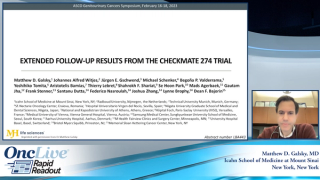
Matthew Galsky, MD, discusses long-term data from the phase 3 CheckMate 274 trial evaluating adjuvant nivolumab vs placebo in patients with high-risk, muscle-invasive urothelial cancer.

Avelumab plus best supportive care produced a benefit in overall survival in patients with advanced urothelial carcinoma that had not progressed with first-line platinum-based chemotherapy.

Pramit Khetrapal, MD, discusses the results of evaluating intracorporeal robotic vs open cystectomy in a multicenter, randomized trial in patients with muscle-invasive bladder cancer.

According to longer follow-up data from the phase 3 CheckMate 274 trial, patients with high-risk, muscle-invasive urothelial carcinoma continued to experience clinically meaningful improvements in disease-free survival when treated with adjuvant nivolumab vs placebo.

The addition of the IL15RaFc superagonist N-803 to Bacillus Calmette–Guérin led to prolonged complete responses and disease-free survival (DFS) in patients with BCG-unresponsive non–muscle invasive bladder cancer with carcinoma in situ and papillary histology, respectively.
Patients with metastatic urothelial carcinoma who received pembrolizumab achieved prolonged median progression-free and overall survival after experiencing an immune-related adverse effect.
Pembrolizumab plus concurrent chemoradiotherapy is being investigated as a potential therapy in patients with muscle-invasive bladder cancer.
The safety and efficacy of the combination of the oncolytic immunotherapy CG0070 and nivolumab is under exploration as a potential therapeutic option in patients with muscle-invasive bladder cancer who are ineligible for cisplatin-based chemotherapy, as part of the phase 1b CORE-002 trial.

Petros Grivas, MD, PhD, discusses the phase 2 TROPHY U-01 trial in metastatic urothelial cancer.

Roberto Iacovelli, MD, PhD, discusses the key takeaways of the phase 2 ARIES trial in urothelial cancer.

Ravi Munver, MD, discusses the approval of mitomycin gel in urothelial cancer.

Matthew Galsky, MD, discusses the impact of recent developments in the advanced urothelial carcinoma treatment paradigm.
Advertisement
Advertisement
Trending on OncLive
1
INBRX-106 Plus Pembrolizumab Improves Responses and PFS in First-Line PD-L1–Positive HNSCC
2
FDA Approves Pirtobrutinib for Previously Untreated CLL/SLL
3
Five Under 5: Top Oncology Videos for the Week of 9/27
4
AUA Releases Guideline Amendment for NMIBC
5