
The first MRD data from the phase 3 EXCALIBER-RRMM trial support iberdomide-based triplet therapy as early as first relapse, with PFS follow-up ongoing.
The first MRD data from the phase 3 EXCALIBER-RRMM trial support iberdomide-based triplet therapy as early as first relapse, with PFS follow-up ongoing.
After nearly 7 years of follow-up, daratumumab added to VRd continued to improve PFS, PFS2, and sustained MRD negativity in transplant-eligible myeloma.
Peter Voorhees, MD, discusses CRS and infection data for etentamig from the phase 3 CERVINO trial in triple-class–exposed relapsed/refractory myeloma.
Peter Voorhees, MD, discusses phase 3 CERVINO data for etentamig vs standard therapies and next steps for the agent in relapsed/refractory myeloma.

Sagar Lonial, MD, FACP, FASCO, discusses MRD-negativity data with iberdomide plus daratumumab and dexamethasone in relapsed/refractory multiple myeloma.
Sagar Lonial, MD, FACP, FASCO, discusses Project Optimus dose selection and MRD as an early end point in the phase 3 EXCALIBER-RRMM trial.
Monthly etentamig significantly improved response and PFS over standard available therapies in the phase 3 CERVINO trial, with low rates of high-grade CRS.
Dirk van Esser, MD, discusses safety with KRd in the EMN15/HOVON147 trial and how to select patients with high-risk smoldering myeloma for treatment.
Dirk van Esser, MD, discusses long-term EMN15/HOVON147 data for KRd vs Rd in high-risk smoldering multiple myeloma.

Jessica Encinas Mayoral, PhD, discusses preclinical data on an AI-designed BCMA/FcRL5 trispecific antibody in multiple myeloma.
Jessica Encinas Mayoral, PhD, discusses the design and antigen-independent activity of a BCMA/FcRL5 trispecific antibody in multiple myeloma.
Extended follow-up from the phase 1b CAMMA 1 trial showed durable responses across two cevostamab dose levels, supporting selection of a recommended phase 3 regimen.
A MAIC found anito-cel produced response rates similar to those of cilta-cel, with fewer high-grade toxicities, in relapsed/refractory multiple myeloma.
Updated phase 2 LINKER-SMM1 data show single-agent, fixed-duration linvoseltamab produced deep, durable, and MRD-negative responses in high-risk smoldering multiple myeloma.

Ja Min Byun, MD, PhD, discusses response consistency and the future of mezigdomide plus elranatamab in multiple myeloma.
Ja Min Byun, MD, PhD, discusses updated phase 1 findings with mezigdomide plus elranatamab in relapsed/refractory multiple myeloma.
OncLive heard from myeloma experts about the biggest developments in the field at the 22nd Annual International Myeloma Society Meeting and Exposition.
Isa-VRd produced a VGPR or better rate of 87.8% in transplant-ineligible newly diagnosed multiple myeloma.

Sonrotoclax plus dexamethasone was well tolerated and produced early efficacy signals in relapsed/refractory multiple myeloma with t(11;14).

Belantamab mafodotin plus carfilzomib and dexamethasone was active in patients with relapsed/refractory multiple myeloma.

Belantamab mafodotin plus lenalidomide maintenance was active and had an expected safety profile in transplant-eligible, newly diagnosed myeloma.
Belantamab mafodotin monotherapy was active and safe in patients with relapsed/refractory multiple myeloma.
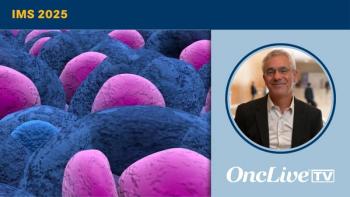
Xavier Leleu, MD, PhD, discusses the role of subcutaneous isatuximab delivered via an on-body delivery system in patients with relapsed/refractory multiple myeloma.

Carfilzomib, lenalidomide, and dexamethasone after transplant improved PFS and OS in high-risk, newly diagnosed multiple myeloma.
Efficacy and pharmacokinetic measures with IV vs SC isatuximab delivered via an on-body injector were comparable in patients with multiple myeloma.
Maintenance therapy with daratumumab plus lenalidomide led to higher MRD-negativity conversion rates vs lenalidomide alone in newly diagnosed myeloma.
Larry Anderson, MD, PhD, discusses updated efficacy and safety findings of subcutaneous daratumumab plus lenalidomide in newly diagnosed multiple myeloma following autologous stem cell transplant.
Linvoseltamab monotherapy generated responses and had a favorable safety profile with low rates of high-grade TEAEs in high-risk smoldering myeloma.
Treatment with BVd led to favorable survival outcomes and prolonged responses vs DVd in lenalidomide-refractory patients with multiple myeloma.
The combination of daratumumab, lenalidomide, ixazomib, and dexamethasone was efficacious in transplant-ineligible, newly diagnosed myeloma.