

Within the week, thousands of abstracts spanning a multitude of tumor types will be presented at the 2019 ASCO Annual Meeting, many of which will lead to practice-changing implications for oncologists.

Your AI-Trained Oncology Knowledge Connection!
Within the week, thousands of abstracts spanning a multitude of tumor types will be presented at the 2019 ASCO Annual Meeting, many of which will lead to practice-changing implications for oncologists.

Entrectinib induced objective responses in 100% of pediatric patients with tumors harboring NTRK1/2/3, ROS1, or ALK gene fusions or mutations.

About a quarter of pediatric patients with cancer were able to be screened for targetable alterations in their tumor and directed to a treatment targeting that alteration of pathway in the screening protocol of the National Cancer Institute-Children’s Oncology Group Pediatric MATCH trial.

A lower dose of oxaliplatin and capecitabine had comparable efficacy and minimized adverse events in elderly and frail patients with advanced gastroesophageal cancer.

In patients with smoldering multiple myeloma, lenalidomide induced a 72% reduction in the risk for progression to symptomatic disease at 3 years.

Women who eat a balanced, low-fat diet and daily portions of vegetables, fruit, and grains have a 21% lower risk of dying from breast cancer.

Atezolizumab plus bevacizumab, carboplatin, and paclitaxel has emerged as a potential new standard of care for patients with EGFR-positive metastatic nonsquamous non–small cell lung cancer who have failed prior TKIs.
Niels Reinmuth, MD, PhD, discusses the results of the MYSTIC study, which evaluated first-line durvalumab plus tremelimumab versus platinum-based chemotherapy in patients with metastatic non–small cell lung cancer.

James Chih-Hsin Yang, MD, discusses the final safety and efficacy results from 2 phase I expansion cohorts from the phase I/II AURA trial.

Tony Mok, MD, discusses the KEYNOTE-042 trial and the implications of its findings, and sheds light on the evolving role of immunotherapy in non–small cell lung cancer.

No overall survival advantage was obtained from maintenance therapy comprising nivolumab (Opdivo) alone or in combination with ipilimumab (Yervoy) over placebo in patients with extensive-stage small cell lung cancer.

Suresh S. Ramalingam, MD, describes findings with osimertinib, and discusses the emerging body of data exploring primary and acquired resistance mechanisms to the third-generation agent.

Final results from 2 phase I expansion cohorts of frontline osimertinib (Tagrisso) presented at the 2019 European Lung Cancer Congress confirmed the efficacy of the third-generation TKI in patients with EGFR-positive non­–small cell lung cancer.

Martin Reck, MD, PhD, head of the department of thoracic oncology at Lung Clinic Grosshansdorf, discusses the rationale for the IMpower150 study.

Luis G. Paz-Ares, MD, PhD, chief physician at the Hospital Universitario Doce De Octubre, discusses an integrated analysis of patients with NTRK fusion–positive non–small-cell lung cancer enrolled in the STARTRK-2, STARTRK-1, and ALKA-372-001 trials, which evaluated the safety and efficacy of entrectinib in patients with solid tumors.

Patients with ROS1-positive non–small cell lung cancer showed high response rates and durable responses following treatment with entrectinib.

Patient reported outcomes according to PD-L1 expression did not show clinically meaningful differences in quality of life with either durvalumab or placebo in patients with stage III non–small cell lung cancer, according to a retrospective analysis of the phase III PACIFIC study.

The initial overall survival analysis of the phase III MYSTIC trial of first-line durvalumab (Imfinzi) alone or in combination with tremelimumab compared with platinum-based chemotherapy in patients with metastatic non–small cell lung cancer, may have been confounded by high rates of post-study immunotherapy given in the control arm.
Antonio Passaro, MD, PhD, of the Division of Thoracic Oncology, European Institute of Oncology, discusses a study that sought to determine the factors that have an impact on 5-year survival among patients treated for metastatic non–small cell lung cancer using ALK TKIs.

Larotrectinib showcased an overall response rate of 71% in patients with non–small cell lung cancer harboring NTRK gene fusions.

Leora Horn, MD, MSc, associate professor of cancer research, Vanderbilt University Medical Center, discusses the use of circulating tumor DNA analysis as a means to monitor response to, as well as resistance to, ensartinib in patients with ALK–positive non–small cell lung cancer.
Sandip Patel, MD, associate professor of medicine at the University of California San Diego School of Medicine, discusses the benefit of the immune checkpoint inhibitor combination of ipilimumab (Yervoy) and nivolumab (Opdivo) in patients with rare, high-grade neuroendocrine tumors.

Primary tumor surgery for patients with stage IV HER2-positive breast cancer is associated with an improvement in overall survival, according to results of a retrospective cohort review presented at the 2019 AACR Annual Meeting.
Lecia V. Sequist, MD, MPH, thoracic medical oncologist and director of the Center for Innovation in Early Cancer Detection at Massachusetts General Hospital Cancer Center, discusses the rationale for the TATTON trial in non–small cell lung cancer (NSCLC).

A third of patients with advanced TRK fusion tumors had objective responses to the second-generation TRK inhibitor LOXO-195 after failure of initial anti-TRK therapy.

Maintenance therapy with rucaparib maintained disease control and was well tolerated in patients with platinum-sensitive, advanced BRCA1/2- or PALB2-mutant pancreatic cancer, according to preliminary interim findings of a single-arm, phase II trial.
Tumor mutational burden identified patients who obtained a survival benefit with the PD-L1 inhibitor durvalumab, as initial therapy versus chemotherapy for advanced non–small cell lung cancer, even though the primary analysis of the randomized trial showed no difference between treatment groups, according to a new analysis.

Pembrolizumab (Keytruda) demonstrated promising antitumor activity with durable responses in patients with pretreated advanced small cell lung cancer.

Eric J. Jacobs, PhD, cancer epidemiologist and strategic director of pharmacoepidemiology, American Cancer Society, discusses results from a prospective cohort study examining the association between BMI and pancreatic cancer mortality.
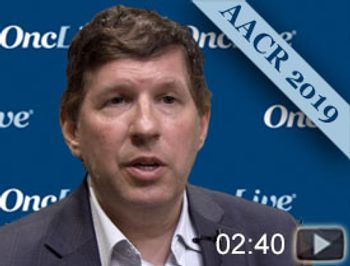
Steven M. Lipkin, MD, PhD, the Gladys and Roland Harriman Professor of Medicine, professor of medicine in the Division of Gastroenterology and Hepatology, and vice chair for research in the Weill Department of Medicine at Weill Cornell Medicine; and a geneticist at NewYork-Presbyterian/Weill Cornell Medical Center, discusses a study of a cancer prevention vaccine in a preclinical model of Lynch syndrome during the 2019 AACR Annual Meeting