
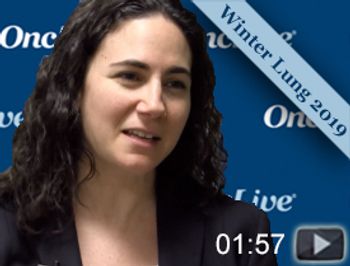
Sarah B. Goldberg, MD, MPH, an assistant professor of medicine at the Yale School of Medicine and Yale Cancer Center, discusses traditional and emerging treatment approaches for patients with mesothelioma.

Your AI-Trained Oncology Knowledge Connection!
Sarah B. Goldberg, MD, MPH, an assistant professor of medicine at the Yale School of Medicine and Yale Cancer Center, discusses traditional and emerging treatment approaches for patients with mesothelioma.
A growing focus on smaller oncogenic drivers in lung cancer has opened up new treatment options and many potential drugs in development for patients with less common alterations.
The treatment paradigm for EGFR-mutant non–small cell lung cancer has grown significantly with many EGFR TKIs now available to treat patients with this disease.
Rogerio Lilenbaum, MD, highlights the current treatment approaches for patients with EGFR-positive non–small cell lung cancer and shed light on the potential for immunotherapy in the space.

Julie R. Brahmer, MD, associate professor of oncology, co-director of the Upper Aerodigestive Department, Bloomberg Kimmel Institute for Cancer Immunotherapy, Johns Hopkins Medicine, discusses managing immune-related adverse events in lung cancer.

Edward B. Garon, MD, director of Thoracic Oncology at the Jonsson Comprehensive Cancer Center at University of California, Los Angeles, discusses the potential for immunotherapy in the treatment of patients with EGFR-positive non–small cell lung cancer.
Successful application of immunotherapy in endometrial cancer means identifying the patients with inflamed tumors who will respond to treatment and those who will not, and finding ways to treat noninflamed tumors with immunotherapy agents.

Patients with previously untreated hepatocellular carcinoma lived twice as long if they responded to TKI therapy as compared with patients who did not achieve an objective response.

Jonathan R. Strosberg, MD, discusses the findings from the phase II KEYNOTE-158 trial investigating pembrolizumab in patients with advanced neuroendocrine tumors.
Robert Coleman, MD, highlights recent advances made in gynecologic cancers and provide insight into ongoing research to move the needle forward.

The combination use of durvalumab and tremelimumab plus best supportive care prolonged median overall survival by 2.5 months compared with supportive care alone in patients with advanced refractory colorectal cancer.

The PD-L1 inhibitor durvalumab achieved objective responses in about a fourth of patients with microsatellite instability-high advanced solid tumors, including colorectal cancer.

Charles A. Leath III, MD, gyn oncologist at the University of Alabama at Birmingham, discusses the glaring unmet need in cervical cancer.

Robert L. Coleman, MD, FACOG, FACS, professor, Department of Gynecologic Oncology and Reproductive Medicine, The University of Texas MD Anderson Cancer Center, discusses advances made in the treatment of ovarian cancer.
Clinical outcomes with the combination of encorafenib, binimetinib, and cetuximab exceed historic data in patients with BRAF V600E-mutant metastatic colorectal cancer.

For all the positive data associated with PARP inhibitors in patients with epithelial ovarian cancer who have known BRCA mutations and despite several agents winning FDA approval over the past few years, PARP inhibitors aren’t curing patients.

The oral multi-kinase inhibitor regorafenib extended progression-free survival in patients with metastatic or unresectable biliary tract cancer who were previously treated with gemcitabine and a platinum-based chemotherapy.

Shannon Westin, MD, discusses the evolving role of PARP inhibitors in ovarian cancer, novel investigational agents, and the importance of molecular testing.

Josep M. Llovet, MD, PhD, discusses the results from the phase III REACH-2 study of ramucirumab as a second-line treatment of patients with advanced hepatocellular carcinoma.
The combination of dabrafenib and trametinib induced responses in nearly half of patients with BRAF V600E–mutated biliary tract cancer who participated in a phase II basket trial that enrolled patients with BRAF V600E–mutated rare cancers.

The novel oral anticancer regimen known as SM-88, which consists of a tyrosine derivative, an mTOR inhibitor, a CYP3a4 inducer, and an oxidative stress catalyst, has promising efficacy with no meaningful toxicity in patients with metastatic pancreatic cancer who have progressed on at least 1 prior line of therapy.

Adria Suarez Mora, MD, second-year fellow at UPMC Magee-Womens Hospital, discusses how sequential sampling of intraperitoneal fluid during chemotherapy help better define the immunogenic effects of the treatment.
Kathleen G. Essel, MD, gynecologic oncology fellow at the University of Oklahoma Health Science Center with the Stephenson Cancer Center, discusses the benefits of using quantitative computed tomography image feature analysis to predict response to immune checkpoint inhibitors in patients with gynecologic cancers.

Carolyn Lefkowits, MD, gynecologic oncologist, and palliative care doctor, at the University of Colorado, addresses common misconceptions regarding palliative care integration.
Targeted therapy is effectively established as an option for patients with ovarian cancers. However, beyond PARP inhibition in the BRCA-mutated or homologous recombination deficient population, questions remain about how to best treat these patients.

Daniela Molena, MD, discusses what she believes is the Achilles heel of endoscopic resection in patients with esophageal cancer.
The prognosis for women with recurrent or metastatic cervical cancer after treatment failure is notoriously poor, but immunotherapy agents may offer longer survival for this population.

Overall survival in metastatic gastric/gastroesophageal junction cancer improved significantly in patients who received the combination therapy TAS-102, irrespective of prior gastrectomy.

Katherine Kurnit, MD, OBGYN oncology fellow at the University of Texas MD Anderson Cancer Center, compares the benefit of gastrointestinal-based versus gynecologic-based adjuvant chemotherapy regimens in patients with mucinous ovarian cancer.
Results from a recent retrospective study indicate that treatment with a gastrointestinal-based adjuvant chemotherapy regimen may be more beneficial than that of a gynecologic-based one in patients with mucinous ovarian cancer.