
Graham Jackson, MD, PhD, Northern Institute for Cancer Research, Newcastle University, discusses results of a study that determined lenalidomide (Revlimid) is a highly-effective maintenance therapy in myeloma patients of all ages.
Graham Jackson, MD, PhD, Northern Institute for Cancer Research, Newcastle University, discusses results of a study that determined lenalidomide (Revlimid) is a highly-effective maintenance therapy in myeloma patients of all ages.

Almost 80% of patients with treatment-refractory non-Hodgkin lymphoma had objective responses following treatment with KTE-C19, a chimeric antigen receptor T-cell therapy targeting CD19.

An FDA-approved blood cancer drug has demonstrated encouraging findings, including an overall response rate of 67%, in treatment of patients with chronic graft-versus-host-disease that was not resolved by corticosteroids.
Jennifer Woyach, MD, associate professor, Ohio State University, discusses a study examining the use of MOR208 combined with lenalidomide (Revlimid) for the treatment of chronic lymphotic leukemia (CLL) during the American Society of Hematology (ASH) Annual Meeting.
Osimertinib (Tagrisso) reduced the risk of disease progression by 70% compared with a chemotherapy doublet in patients with EGFR T790M-mutant non–small cell lung cancer (NSCLC) who progressed after first-line targeted therapy.
Frontline treatment with ceritinib (Zykadia) improved progression-free survival over standard chemotherapy in patients with ALK-rearranged non–small cell lung cancer.
Rosalyn Juergens, MD, PhD, assistant professor, Department of Oncology, Division of Medical Oncology, McMaster University, discusses the results of the IND.226 trial, in an interview at the IASLC 17th World Conference on Lung Cancer in Vienna, Austria.
Claire Verschraegen, MD, professor of Medical Oncology, University of Vermont Cancer Center, discusses the results of the JAVELIN Solid Tumor trial during an interview at the IASLC 17th World Conference on Lung Cancer in Vienna, Austria.
Treatment with icotinib more than doubled intracranial progression-free survival compared with whole brain irradiation combined with standard chemotherapy.
Subcutaneous delivery of daratumumab was well tolerated with comparable efficacy to the FDA-approved intravenous dose in patients with relapsed/refractory multiple myeloma.
Adding venetoclax to bortezomib and dexamethasone showed very promising efficacy and acceptable safety for patients with relapsed/refractory multiple myeloma.
Selinexor, in combination with dexamethasone, induced a response rate of 20.5% (n = 16) among 78 heavily pretreated patients with relapsed/refractory multiple myeloma, according to results from the phase IIb STORM trial presented at the 2016 ASH Annual Meeting.
Heinz Gisslinger, MD, Medical University of Vienna, discusses the phase III PROUD-PV study, which evaluated ropeginterferon alfa-2b (P1101) for the treatment of polycythemia vera (PV) during the American Society of Hematology (ASH) Annual Meeting.

Treatment with the CD19-directed CAR T-cell therapy KTE-C19 showed a complete remission rate of 73% for patients with aggressive, chemorefractory primary mediastinal B-cell lymphoma and transformed follicular lymphoma.
Findings from an efficacy update of patients participating in a study in the CheckMate series revealed that first-line nivolumab (Opdivo) demonstrated activity in advanced non–small cell lung cancer, and the addition of ipilimumab (Yervoy) resulted in enhanced activity, specifically in prolonged progression-free survival and higher objective response rates.

Adding the oral BCL-2 inhibitor venetoclax (Venclexta) to obinutuzumab (Gazyva) and ibrutinib (Imbruvica) in patients with relapsed/refractory chronic lymphocytic leukemia is safe and is demonstrating encouraging signs of efficacy.
An induction regimen of ibrutinib (Imbruvica) and obinutuzumab (Gazyva) after bendamustine debulking induced a 100% response rate in patients with chronic lymphocytic leukemia.

Treatment with the BTK inhibitor BGB-3111 had an objective response rate of 96% for patients with chronic lymphocytic leukemia and small lymphocytic leukemia.
The investigational Bruton tyrosine kinase inhibitor acalabrutinib was shown to be well-tolerated in patients with chronic lymphocytic leukemia and small lymphocytic leukemia who display intolerance to ibrutinib (Imbruvica).

Treatment with first-line avelumab yielded promising clinical benefit and durable antitumor activity in patients with advanced non–small cell lung cancer.
The combination of the PI3 kinase inhibitor TGR-1202 and ibrutinib demonstrated a high response rate without dose-limiting toxicities for patients with relapsed/refractory chronic lymphocytic leukemia and mantle cell lymphoma.
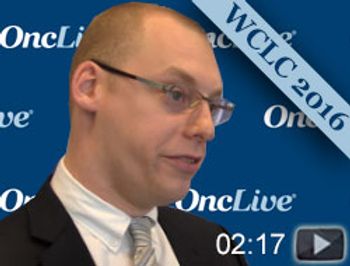
Joshua Roth, PhD, assistant member, Fred Hutchinson Cancer Research Center, discusses the rationale behind the development of a novel risk-prediction algorithm in the context of screening patients for lung cancer. He discussed this during an interview at the IASLC 17th World Conference on Lung Cancer in Vienna, Austria.
Javier Zulueta, MD, head of the Pneumology Department, co-director, Lung Cancer Area, Clinica Universidad de Navarra, discusses the LuCED test, a non-invasive tool used to detect early stage lung cancer, during an interview at the IASLC 17th World Conference on Lung Cancer in Vienna, Austria.
While treatment with nivolumab (Opdivo) significantly improved overall survival over docetaxel in patients with advanced non–small cell lung cancer in the CheckMate-057 trial, an analysis of deaths occurring within 3 months of initiation of therapy showed numerically more deaths in the nivolumab arm.
Douglas Arenberg, MD, discusses preliminary findings of a screening study, and the critical importance of maintaining quality tobacco cessation practices in healthcare clinics.
John M. Burke, MD, discusses the GOYA study, a phase III study investigating obinutuzumab plus CHOP in patients with previously untreated diffuse large B-cell lymphoma. Burke discussed the study during the American Society of Hematology (ASH) Annual Meeting.
Combining obinutuzumab with chemotherapy in the first-line setting reduced the risk of disease progression or death by 34% versus rituximab plus chemotherapy in patients with follicular lymphoma, according to findings from the phase III GALLIUM study.
Treatment with the combination of pembrolizumab, pomalidomide, and dexamethasone demonstrated promising durable efficacy and a tolerable safety profile for patients with relapsed/refractory multiple myeloma.
Michael A. Thompson, MD, PhD, medical director, precision medicine, Vince Lombardi Cancer Clinic, Aurora Health Care, discusses some of the recent exciting advancements in the field of multiple myeloma during the American Society of Hematology (ASH) Annual Meeting.

Ibrutinib showed an 89% response rate in both treatment-naïve and relapsed patients with chronic lymphocytic leukemia/small lymphocytic lymphoma in findings from the longest follow-up to date for the BTK inhibitor.