

Brian P. Mulherin, MD, discusses using AI tools to improve the implementation of NGS in community oncology practice.
Brian P. Mulherin, MD, discusses using AI tools to improve the implementation of NGS in community oncology practice.
Brian P. Mulherin, MD, discusses how artificial intelligence is helping shape smarter cancer care.

AI-powered clinical decision support systems can help oncologists manage rising information demands without forfeiting autonomy in care delivery.

Lalan Wilfong, MD, expands on the value of AI prediction models for consensus on patient prognosis and better end-of-life care in oncology.

Douglas Flora, MD, LSSBB, discusses how the use of artificial intelligence tools could improve patient screening and drug development in oncology.

Lalan Wilfong, MD, discusses the patient- and provider-facing implications that may result from renewed focus on improving care navigation in oncology.

Doug Flora, MD, FACC, LSSBB, explains how AI is transforming cancer care, urging oncologists to engage and guide its responsible use.
OncLive social media polls reveal which lung cancer abstracts are generating excitement ahead of the 2025 ESMO Congress.
OncLive social media polls reveal which prostate, kidney, and bladder cancer abstracts are generating excitement ahead of the 2025 ESMO Congress.
Ahead of the 2025 ESMO Congress, breast cancer experts share the most anticipated research being presented during the meeting.
OncLive heard from myeloma experts about the biggest developments in the field at the 22nd Annual International Myeloma Society Meeting and Exposition.
Isa-VRd produced a VGPR or better rate of 87.8% in transplant-ineligible newly diagnosed multiple myeloma.

Sonrotoclax plus dexamethasone was well tolerated and produced early efficacy signals in relapsed/refractory multiple myeloma with t(11;14).

Belantamab mafodotin plus carfilzomib and dexamethasone was active in patients with relapsed/refractory multiple myeloma.
Belantamab mafodotin plus lenalidomide maintenance was active and had an expected safety profile in transplant-eligible, newly diagnosed myeloma.
Belantamab mafodotin monotherapy was active and safe in patients with relapsed/refractory multiple myeloma.
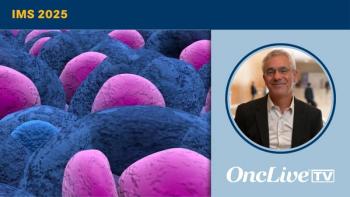
Xavier Leleu, MD, PhD, discusses the role of subcutaneous isatuximab delivered via an on-body delivery system in patients with relapsed/refractory multiple myeloma.

Carfilzomib, lenalidomide, and dexamethasone after transplant improved PFS and OS in high-risk, newly diagnosed multiple myeloma.
Efficacy and pharmacokinetic measures with IV vs SC isatuximab delivered via an on-body injector were comparable in patients with multiple myeloma.
Maintenance therapy with daratumumab plus lenalidomide led to higher MRD-negativity conversion rates vs lenalidomide alone in newly diagnosed myeloma.
Larry Anderson, MD, PhD, discusses updated efficacy and safety findings of subcutaneous daratumumab plus lenalidomide in newly diagnosed multiple myeloma following autologous stem cell transplant.
Linvoseltamab monotherapy generated responses and had a favorable safety profile with low rates of high-grade TEAEs in high-risk smoldering myeloma.
Treatment with BVd led to favorable survival outcomes and prolonged responses vs DVd in lenalidomide-refractory patients with multiple myeloma.
The combination of daratumumab, lenalidomide, ixazomib, and dexamethasone was efficacious in transplant-ineligible, newly diagnosed myeloma.
The addition of belantamab mafodotin to standard-of-care VRd proved feasible as frontline therapy in newly diagnosed multiple myeloma.
Omar Nadeem, MD, discusses updated data with the GPRC5D-targeted CAR T-cell therapy arlocabtagene autoleucel in relapsed/refractory multiple myeloma.
Paula Rodriguez-Otero, MD, discusses safety and efficacy findings with linvoseltamab, a bispecific antibody targeting BCMA, in patients with high-risk smoldering multiple myeloma.
Belantamab mafodotin plus lenalidomide and dexamethasone induced CRs or better in over half of patients with newly diagnosed multiple myeloma.
Administering the anti-GPRC5D agent MCARH109 and anti-BCMA therapy MCARH125 in tandem was feasible and tolerable in relapsed/refractory multiple myeloma.
Eque-cel was effective for the treatment of patients with relapsed/refractory multiple myeloma.