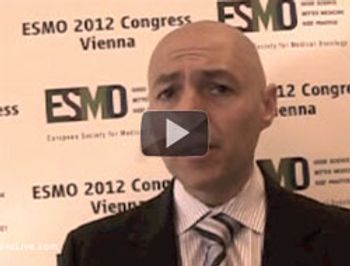
Ezra E.W. Cohen, MD, from the University of Chicago Medical Center, on the pharmacokinetics and efficacy of cabozantinib for medullary thyroid cancer.

Your AI-Trained Oncology Knowledge Connection!
Ezra E.W. Cohen, MD, from the University of Chicago Medical Center, on the pharmacokinetics and efficacy of cabozantinib for medullary thyroid cancer.
Two analyses, two different conclusions in Asian START trial when docetaxel was added to S-1 for patients with previously untreated advanced or recurrent gastric cancer.
Combining the new drugs dabrafenib and trametinib provided a clinically meaningful improvement in patients with melanoma that had BRAF V600 mutations.
Gefitinib improved progression-free survival and some quality of life measures when used as second-line therapy for esophageal cancer.

Cabozantinib significantly prolonged progression-free survival in medullary thyroid cancer compared with placebo among patients with radiographically confirmed progressive disease at study onset.

Photos from the 82nd Annual Meeting of the American Thyroid Association held in Quebec City, Canada, on September 19-23, 2012.

Rebecca S. Sippel, MD, from the University of Wisconsin, discusses the importance of the initial surgery for patients with medullary thyroid cancer on outcomes.
The application of molecular markers is already significantly improving the diagnosis of thyroid cancer and broader application could help prevent unnecessary surgeries to confirm the diagnosis.

Four histopathologic features of papillary microcarcinoma help predict how aggressive the tumor will be and subsequently how aggressive treatment must be to prevent its spread.

OncLive presents live coverage from the 2012 NCONN Changing the Face of Cancer Care Conference, held at the Gaylord Opryland Hotel from October 4th to 6th, in Nashville, TN.

Dr. Bryan Haugen, from University of Colorado School of Medicine, Describes the 82nd Annual Meeting of the American Thyroid Association.
Dr. Yuri Nikiforov, from the University of Pittsburgh, on Molecular Testing to Diagnose Cancerous Thyroid Nodules.
A blanket approach to the use of radioactive iodine may not be necessary in many patients with papillary thyroid cancer provided they undergo expert total thyroidectomy first.
The availability of molecular agents that target oncogenic signaling pathways now offers the possibility of achieving disease stabilization in a proportion of patients with metastatic medullary thyroid cancer.

The initial surgical procedure performed for the management of medullary thyroid cancer is the best chance surgeons have for a cure.

Coverage from the 2012 European Society for Medical Oncology congress, held at the Austria Center Vienna from September 28 - October 2, in Vienna, Austria.
Dr. David Spigel, from the Sarah Cannon Research Institute, discusses the rapidly evolving non-small cell lung cancer treatment landscape.
Dr. Karen Reckamp, from City of Hope, evaluates the predictive efficacy of the pretreatment serum test VeriStrat for non-small cell lung cancer.

Patients with refractory non-small cell lung cancer had a statistically significant improvement in PFS when treated with targeted therapy duo versus a single agent.
A common mutation in NSCLC confers resistance to tyrosine kinase inhibitors and worsens survival, creating a need for an alternative approach to treating the subgroup of patients with the mutation.
Patients with advanced non-small cell lung cancer lived twice as long when they received an indirect angiogenesis inhibitor plus docetaxel instead of docetaxel alone.

A brief introduction to the topics and focus of the 2012 Chicago Multidisciplinary Symposium in Thoracic Oncology.
Jeffrey Crawford, MD, from Duke University Medical Center, on Managing Febrile Neutropenia.
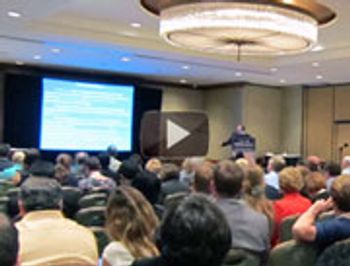
A compilation of photos from the 2012 combined conferences of the Multinational Association of Supportive Care in Cancer (MASCC) and the International Society of Oral Oncology (ISOO).
Dr. Jimmie Holland, from Memorial Sloan-Kettering Cancer Center, on the Stigma Toward Psychosocial Care.

Recent evidence shows that some of the newer molecularly targeted therapies can cause diarrhea, which can lead to dose reductions and alterations.

Although molecularly targeted agents can cause cardiac damage, it appears to be reversible and related to cellular dysfunction, as distinct from agents such as anthracyclines that cause cellular death and irreversible cardiac dysfunction.
Dr. Richard Gralla, from the Quality of Life Research Associates, on Chemotherapy-Induced Nausea and Vomiting.
Dr. Kathleen Foley, from Memorial Sloan-Kettering Cancer Center, Discusses the World Health Organization Guidelines for Cancer Pain Management.
Dr. Steven Grunberg, from the Vermont Cancer Center, Describes the 2012 Multinational Association of Supportive Care in Cancer Symposium.