
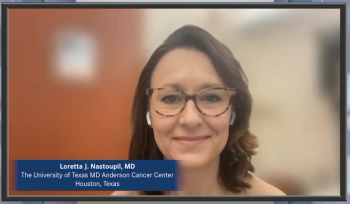
Wrapping up their discussion, Loretta J. Nastoupil, MD, and Marc S. Hoffman, MD, look at the use of CAR T-cell therapy for patients with mantle cell lymphoma, a rare subtype of non-Hodgkin’s lymphoma.

Your AI-Trained Oncology Knowledge Connection!
Wrapping up their discussion, Loretta J. Nastoupil, MD, and Marc S. Hoffman, MD, look at the use of CAR T-cell therapy for patients with mantle cell lymphoma, a rare subtype of non-Hodgkin’s lymphoma.

High initial complete remission with or without platelet recovery, as well as an improvement in durable complete remission was achieved with the use of Iomab-B-based conditioning prior to allogeneic hematopoietic cell transplantation compared with conventional care in older patients with relapsed/refractory acute myeloid leukemia.
The addition of vedolizumab added to standard prophylaxis following unrelated allogeneic hematopoietic stem cell transplantation was superior to placebo at preventing lower gastrointestinal acute graft-vs-host disease.
Second infusion with tisagenlecleucel after prior tisagenlecleucel infusion produced short durations of minimal residual disease-negative responses in children and young adults with B-cell acute lymphoblastic leukemia.

The combination of nivolumab and cabozantinib produced prolonged progression-free survival and higher response rates compared with sunitinib alone as frontline therapy in patients with advanced renal cell carcinoma, regardless of International Metastatic RCC Database Consortium risk status.
Idecabtagene vicleucel demonstrated a statistically significant and clinically meaningful improvement in progression-free survival and objective response compared with standard of care approaches in patients with triple-class-exposed relapsed/refractory multiple myeloma.

Aristotelis Bamias, MD, discusses key efficacy data from a final analysis of the phase 3 IMvigor130 trial in metastatic urothelial carcinoma.

Laurence Albigès, MD, PhD, discusses the main objective and trial design of the phase 2 CaboPoint study in renal cell carcinoma, as well as key efficacy and safety data reported in an interim analysis of this study.
The combination of frontline cabozantinib, nivolumab, and ipilimumab led to a greater improvement in progression-free survival in patients with intermediate- vs poor-risk advanced renal cell carcinoma.

Patients with multiple myeloma who were treated with autologous stem cell transplantation were found to be utilizing chronic opioids at high rates, in turn leading to worse overall survival outcomes at 6 months of follow-up.

Treatment with cabozantinib elicited responses in patients with locally advanced or metastatic renal cell carcinoma with a clear-cell component who had progressed after first-line treatment with checkpoint inhibitor–based combination therapy.

Treatment with the cellular therapy Orca-T produced an improved graft-vs-host-disease and relapse-free survival rate in patients with high-risk myelodysplastic syndrome or acute leukemias.

First-line atezolizumab plus platinum-based chemotherapy and gemcitabine trended toward improved overall survival compared with placebo plus chemotherapy in patients with locally advanced or metastatic urothelial carcinoma.

At extended follow-up, nivolumab monotherapy showed improved disease-free survival, non-urothelial tract recurrence-free survival, and disease-specific survival vs placebo in patients with resected, high-risk muscle-invasive urothelial carcinoma.

Atezolizumab monotherapy failed to show an improvement in overall survival compared with placebo plus platinum-based chemotherapy and gemcitabine in patients with untreated locally advanced or metastatic urothelial cancer.

Pembrolizumab monotherapy led notable antitumor activity with manageable toxicity in patients with Bacillus Calmette-Guérin–unresponsive, papillary high-risk non–muscle-invasive bladder cancer

Yago L. Nieto, MD, PhD, professor, Department of Stem Cell Transplantation and Cellular Therapy, Division of Cancer Medicine, The University of Texas MD Anderson Cancer Center, discusses findings from a phase 2 trial investigating panobinostat (Farydak), gemcitabine, busulfan, and melphalan plus autologous stem cell transplant (ASCT) in patients with high-risk or relapsed/refractory multiple myeloma.

Samer A. Srour, MB ChB, MS, discusses findings with Orca-Q, an investigational therapy consisting of enriched CD34+ stem cells plus T-cell subsets, in patients with high-risk hematologic malignancies eligible for myeloablative conditioning and allogeneic stem cell transplant.
The PARP inhibitor rucaparib improved median radiographic progression-free survival by 4.8 months compared with physician’s choice of therapy for men with BRCA-altered metastatic castration-resistant prostate cancer.
The combination of niraparib, abiraterone acetate, and prednisone produced prolonged survival and delayed progression rates in patients with metastatic castration-resistant prostate cancer harboring homologous recombination repair gene alterations.

Rahul Aggarwal, MD, discusses the association between baseline characteristics and prostate-specific antigen progression-free survival in patients with high-risk biochemically relapsed prostate cancer from the phase 3 PRESTO trial.
Neeraj Agarwal, MD, discusses the efficacy of talazoparib plus enzalutamide in first-line metastatic castration-resistant prostate cancer.
Radium-223 demonstrated efficacy with low rates of treatment-related adverse effects and treatment discontinuation in patients with metastatic castration-resistant prostate cancer that metastasized to the bones.
Treatment with the anti–Trop-2 antibody-drug conjugate sacituzumab govitecan elicited an objective response rate of 32% in platinum-ineligible patients with metastatic urothelial cancer following progression on an immune checkpoint inhibitor, according to the primary analysis of TROPHY-U-01 cohort 2.
Tumor mutational burden and alterations in CDKN2A, CDKN2B, and MTAP were among several biomarkers that were predictive of response to enfortumab vedotin in patients with advanced urothelial carcinoma, according to findings from a retrospective analysis.

Because of an economic burden on the healthcare system occurring through the per-patient cost of allogeneic hematopoietic cell transplant, novel treatments to replace transplant and prevent graft-vs-host disease are necessary.
The presence of cytopenias did not affect the favorable and durable responses seen with ruxolitinib vs best available therapy in patients with steroid-refractory acute graft-vs-host disease.
Transurethral resection of bladder tumor followed by gemcitabine, cisplatin, and nivolumab led to stringent clinical complete responses in patients with muscle-invasive bladder cancer.
Early treatment with ruxolitinib led to high response rates in patients with steroid refractory acute graft-vs-host-disease, although benefits with ruxolitinib vs best available therapy were observed regardless of the timing of ruxolitinib administration.
A study did not find a correlation between the pharmacokinetics and pharmacodynamics of ruxolitinib for the treatment of patients 2 years of age and younger with graft-vs-host disease.