
Dr Reckamp discusses the definition of pragmatic clinical trials and ways that clinical trial investigators can make their research more pragmatic.
Dr Reckamp discusses the definition of pragmatic clinical trials and ways that clinical trial investigators can make their research more pragmatic.
Dr Rosenberg discusses strategies for managing nasopharyngeal cancer and the role of toripalimab in this treatment paradigm.
Dr Paik discusses the VISION trial of tepotinib in NSCLC harboring MET exon 14 skipping alterations and real-world data from the TOGETHER pooled analysis.
Dr Levy discusses the indication for trastuzumab deruxtecan in HER2+ NSCLC, other ADCs in development, and where the future of ADCs in NSCLC is headed.
Dr Ganjoo discusses unmet needs for patients with malignant PEComa, treatment plan considerations, and the use of nab-sirolimus in this disease.
Dr Brown discusses the rationale for the RAMP-301 trial of avutometinib plus defactinib in low-grade serous ovarian cancer.
Dr Kummar discusses the significance of targeting TP53 Y220C in solid tumors and early data reported with rezatapopt in TP53 Y220C–mutant solid tumors.
Dr Goy discusses the impact of CAR T-cell therapy on the lymphoma and multiple myeloma treatment paradigms and his anticipations for the future of hematologic oncology.
Drs Merkow and Connell discuss the use of HAI therapy for patients with colorectal cancer.
Dr Wagner discusses unmet needs for patients with PEComa, ongoing research to address these gaps, and findings from the AMPECT trial.
Dr Bagley discusses the evaluation of the small molecule ONC201 in the phase 3 ACTION trial in H3 K27M–mutant diffuse midline gliomas.
Dr Kyriakopoulos sheds light on the potential synergy between masofaniten and enzalutamide when used in combination for patients with prostate cancer.
Dr Kang discusses the significance of the FDA approval of toripalimab for nasopharyngeal carcinoma and his anticipated use of the agent.

Dr Mims discusses the utility of emavusertib in acute myeloid leukemia and myelodysplastic syndrome and the rationale for the TakeAim Leukemia trial.

Drs Kitko and Patel discuss graft-versus-host disease recognition, treatment selection, and ongoing research with novel agents and biomarkers of response.
Drs Monk and Tarantino highlight current research investigating B7-H4–directed antibody-drug conjugates. in multiple solid tumor types.

Drs Donington and Stiles discuss the implications of perioperative immunotherapy trials on early-stage lung cancer management, definitions of resectability, and the incorporation of new multidisciplinary management guidance.
Dr Santos discusses findings from the EMPOWER-Lung 3 trial of cemiplimab plus chemotherapy in patients with advanced non–small cell lung cancer, as well as data from subgroup analyses of the EMPOWER-Lung 1 trial of cemiplimab monotherapy in patients with NSCLC and a PD-L1 score over 50%.
Drs Simeone and Fakih discuss the main objective and design of the observational BASECAMP-1 study and how it functions alongside the EVEREST-1 study, which is evaluating the autologous CAR T-cell therapy A2B530 in patients with CEA-expressing solid tumors that have lost HLA-A*02 expression.
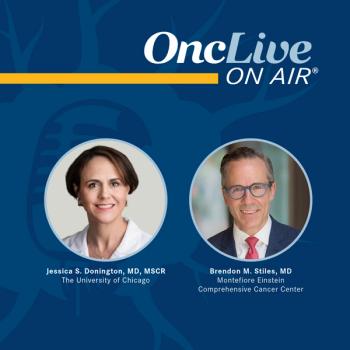
Drs Donington and Stiles discuss how the findings from the ADAURA trial with adjuvant osimertinib have changed thoracic surgery expectations, the potential surgical implications of the ALINA trial with adjuvant alectinib, and the importance of early-stage molecular testing in lung cancer.
Dr Abdou discusses how characteristics of patients with breast cancer impact ADC treatment selection and highlights some of the topline takeaways from breast cancer treatment to come out of the 2023 ASCO Annual Meeting.

Dr Dumbrava discusses the rationale and design of the PYNNACLE trial; phase 1 efficacy and safety findings with PC14586 in patients with p53 Y220C–mutated advanced solid tumors; and the next steps for this research.
Dr Halmos discusses the ongoing investigation of the potent, selective, and irreversible EGFR inhibitor BDTX-1535 in patients with non–small cell lung cancer.
Dr Khouri discusses unmet needs in AL amyloidosis, the potential for birtamimab to become a new frontline standard of care, and the importance of confirming earlier post-hoc results from the VITAL trial in the AFFIRM-AL trial in patients with Mayo stage IV AL amyloidosis with cardiac involvement.
Dr Trent discusses the need for improved awareness around mutation testing in GIST, the limitations of current clinical trial criteria, and the potential for ctDNA to become a longitudinal cancer monitoring tool, helping to prevent invasive means of measuring disease progression.
Dr Bhatnagar discusses the prior and ongoing studies evaluating the addition of uproleselan to standard-of-care regimens for patients with AML, why uproleselan could affect the treatment paradigm across AML subtypes, and the rationale for pursuing minimal residual disease negativity as a clinical end point in AML.
Dr Danish discusses barriers to using radiotherapy for the treatment of patients with metastatic lung and bone cancers; the novel capabilities of SCINTIX biology-guided technology; and how John Theurer Cancer Center plans to use this technology and help advance its role in the field of radiation oncology.
Dr Trent discusses the current role and significance of using MRD in gastrointestinal stromal tumor, current guidelines around mutation testing, and research seeking to expand the targeted therapy armamentarium.
Dr Kremyanskaya discusses the results from cohort 1 of the MANIFEST trial in treatment-naïve myelofibrosis, differentiating features of pelabresib and recently approved JAK inhibitors, and next steps for the investigation of BET inhibitors in this population.
Dr Reuss discusses the development of LP-300 in advanced NSCLC, the mechanisms of LP-300 that may help synergize with the activity of platinum-based chemotherapy, and its ongoing investigation in the phase 2 HARMONIC trial.