
Edward Kim, MD, MBA, describes the potential role of tyrosine kinase inhibitors (TKIs) in the treatment of patients with HER2-mutated non–small cell lung cancer.
Edward Kim, MD, MBA, describes the potential role of tyrosine kinase inhibitors (TKIs) in the treatment of patients with HER2-mutated non–small cell lung cancer.
Lyudmila A. Bazhenova, MD, an expert on non–small cell lung cancer, provides clinical insights on the management of adverse events associated with antibody-drug conjugates.
Edward S. Kim, MD, MBA, discusses the DESTINY-Lung04 trial, a study evaluating trastuzumab deruxtecan as first-line treatment for patients with HER2-mutated NSCLC.
Experts on HER2-mutated NSCLC discuss the patient populations in which they’d utilize trastuzumab deruxtecan and share their clinical experiences with the therapy.
Medical professionals discuss the recently published real-world evidence presented at the American Thyroid Association 2023 Conference.
Hyunseok Kang, MD, discusses the importance of balancing toxicities and other factors when initiating first-line treatments for patients with refractory differentiated thyroid cancer (DTC), while emphasizing the need to set clear goals and communicate potential adverse reactions before allowing patients to make informed decisions.
Lyudmila A. Bazhenova, MD, and D. Ross Camidge, MD, PhD, review the DESTINY-Lung01 and DESTINY-Lung02 trials, and the panel provides its impressions of the data.
The panel discusses the role of antibody-drug conjugates (ADCs) and the treatment of patients with HER2-mutated non–small cell lung cancer.
In case you missed any, below is a recap of every episode of OncLive On Air that aired in March 2024.
S. Alex Mastroyannis, MD, MSCE, discusses the administration and role of hyperthermic intraperitoneal chemotherapy in ovarian cancer, as well as its benefit for patients in the phase 3 OVHIPEC-1 trial.
D. Ross Camidge, MD, PhD, discusses the rationale for the ongoing phase 2 TRUST-II trial of taletrectinib in patients with non–small cell lung cancer harboring ROS1 mutations.
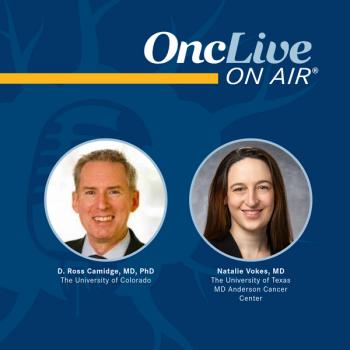
In this episode of "How This Is Building Me," Drs Camidge and Vokes discuss the span of countries and institutions along Dr Vokes’ journey to MD Anderson Cancer Center, how Dr Vokes balances research and work in the clinic, and how the correct mentors can help shape career paths in oncology.
Breelyn Wilky, MD, discusses the rationale for investigating the addition of doxorubicin to zalifrelimab and balstilimab in patients with advanced/metastatic soft tissue sarcoma, expands on results from the phase 2 trial, and emphasizes the need for continued research for the potential role of immunotherapy in this patient population.
The combination of teclistamab and nirogacestat produced high and deep responses in patients with relapsed/refractory multiple myeloma.
Dr Lunning sits down with Kamdar to discuss the design of the POLARIX trial, the ways in which its results have changed their practice when treating patients with DLBCL, and the importance of further research investigating the molecular heterogeneity of DLBCL to determine potential causes of early relapse with pola-R-CHP.

Jeffrey V. Matous, MD, discusses upcoming and ongoing clinical trials in multiple myeloma being conducted at the Colorado Blood Cancer Institute.
Jeffrey V. Matous, MD, discusses the benefit derived from the phase 3 IKEMA trial in patients with relapsed/refractory multiple myeloma, highlighting the key factors to take into account when evaluating patients for relapsed/refractory disease within this treatment space.

Jeffrey V. Matous, MD, discusses potential strategies to overcome barriers to receiving CAR T-cell therapy for patients with multiple myeloma, and how the potential use of these agents in earlier lines could improve infusion wait times and rates of disease progression.
Jeffrey V. Matous, MD, highlights takeaways from the phase 3 IKEMA trial and notes the benefits of administering CAR T-cell therapy in earlier lines, as evidenced in primary results from the phase 3 CARTITUDE-4 trial.
Jill Alldredge, MD, discusses the toxicities associated with PARP inhibition and the management of those adverse effects in patients with ovarian cancer.
Virginia F. Borges, MD, MMSc, and colleagues highlight updates across the breast cancer landscape, including key updates from the 2022 SABCS.
Saketh Guntupalli, MD, highlights data supporting PARP inhibitors as the standard-of-care frontline therapy, strategies for the management of PARP-related toxicities, and the importance of testing for HRD and BRCA status in patients with ovarian cancer.
Jill Alldredge, MD, discusses the management of symptoms in patients with ovarian cancer during treatment with a PARP inhibitor.
Ross Camidge, MD, PhD, discusses toxicities observed with sunvozertinib in EGFR exon 20–mutated non–small cell lung cancer.
Bradley R. Corr, MD, discusses the utilization of molecular profiling in endometrial cancer.
A non-chemotherapy–based targeted regimen comprised of tucatinib, palbociclib, and letrozole resulted in prolonged central nervous system progression-free survival in patients with hormone receptor–positive, HER2-positive breast cancer.
Wells Messersmith, MD, discusses the potential for fam-trastuzumab deruxtecan-nxki as a treatment for patients with HER2-positive colorectal cancer.
Bradley Corr, MD, discusses the rationale to evaluate WNT pathway inhibition in gynecologic cancers.

D. Ross Camidge, MD, PhD discusses the role of targeted therapy and how it is rapidly expanding in the treatment paradigm of patients with non–small cell lung cancer.
Erin Schenk, MD, PhD, discusses the rapidly evolving treatment landscape in lung cancer.