
Eric S. Christenson, MD, discusses efficacy data for copanlisib plus nivolumab in patients with pretreated, MSS metastatic colorectal cancer.
Eric S. Christenson, MD, discusses efficacy data for copanlisib plus nivolumab in patients with pretreated, MSS metastatic colorectal cancer.

Dipti Patel-Donnelly, MD, discusses key factors to consider when selecting consolidation therapies in high-risk hematologic malignancies.

Keeping investigators on the edge of their seats, new data from clinical trials evaluating ADCs continue to impress.
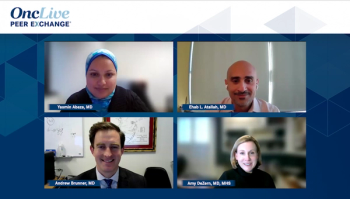
Following its comprehensive discussion on the treatment of MDS, the expert panel concludes with thoughts on the overall treatment landscape.
Experts on myelodysplastic syndromes offer their key takeaways from the 2023 ASH Annual Meeting in the higher-risk disease space.
Hematologist-oncologists review clinical trial data updates presented at ASH 2023 in higher-risk MDS.
Comprehensive insights on the current treatment landscape and remaining unmet needs for patients with higher-risk MDS.
The panel discusses emerging clinical trials in the MDS treatment space and offers key takeaways from the 2023 ASH Annual Meeting.
An MDS specialist discusses cytopenias associated with imetelstat treatment in patients with lower-risk MDS, highlighting findings from the IMerge clinical trial.
The expert panel discusses abstracts surrounding the IMerge clinical trial on imetelstat in patients with lower-risk myelodysplastic syndromes.
Benjamin Philip Levy, MD, discusses lingering questions regarding the use of antibody-drug conjugates in lung cancer.
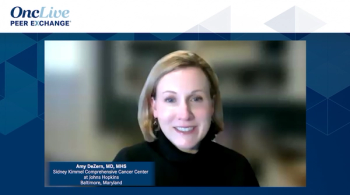
Amy DeZern, MD, MHS, discusses a retrospective study on healthcare claims for patients with MDS treated with luspatercept and reviews patient-reported outcomes from the COMMANDS trial.
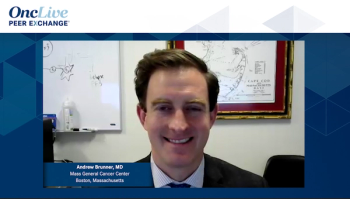
Following ASH 2023, Andrew Brunner, MD, reviews key updates from the COMMANDS trial investigating frontline luspatercept in patients with lower-risk MDS.
Benjamin Philip Levy, MD, details how antibody-drug conjugates are shifting the HER2-mutated non–small cell lung cancer treatment paradigm.
Clinical insights on selecting appropriate erythropoiesis-stimulating agents in patients with myelodysplastic syndromes.
Hematologist-oncologists address adverse event management and discuss the unmet needs of patients with lower-risk MDS and symptomatic anemia.
The expert panel provides comprehensive insights on another patient case, a 77-year-old with MDS who presented with symptomatic anemia.
Continuing their discussion on the first patient profile, the expert panel focuses on the second-line treatment of patients with lower-risk MDS and symptomatic anemia.
Identifying biomarkers and the mechanism of action of antibody-drug conjugates may optimize benefits with these agents in non–small cell lung cancer.
Andrew Brunner, MD, presents the profile of a 72-year-old man with MDS and the panel offers their initial impressions on the case, focusing on the treatment decisions.
Amy DeZern, MD, MHS, provides clinical insights on the first-line treatment of patients with lower-risk MDS and symptomatic anemia.
Benjamin Levy, MD, discusses the mechanism of action of antibody-drug conjugates in patients with non–small cell lung cancer.
Hematologist-oncologists discuss the risk stratification of patients with myelodysplastic syndromes and how patient risk status determines prognosis.
A panel of experts on myelodysplastic syndromes (MDS) introduce themselves and provide an overview of diagnosis practices, highlighting common symptoms and the typical patient presentation.
Dipti Patel-Donnelly, MD, discusses the management of high-risk hematologic malignancies in community practice.
The expert panel closes its discussion with advice for community physicians and discusses the future treatment landscape for advanced non–small cell lung cancer.
The panel discusses the use of antibody-drug conjugates for patients with EGFR-mutant non–small cell lung cancer, with a focus on the HERTHENA-Lung01 and TROPION-Lung05 studies.
A panel of experts on non–small cell lung cancer provide their thoughts MARIPOSA-2, which studied amivantamab and chemotherapy in EGFR-mutant NSCLC in the second line and beyond.
Joshua K. Sabari, MD, reviews data from the MARIPOSA-2 trial and discusses treatment options in the second line and beyond for patients with EGFR-mutant non–small cell lung cancer.
The panel reacts to the MARIPOSA trial, which looked at amivantamab and lazertinib in the front line in patients with EGFR-mutant non–small cell lung cancer.