

Key opinion leaders discuss other clinical trials, including the EMERALD study, and targeted therapies for the treatment of HR+/HER2- locally advanced or metastatic breast cancer in later lines of therapy.
Key opinion leaders discuss other clinical trials, including the EMERALD study, and targeted therapies for the treatment of HR+/HER2- locally advanced or metastatic breast cancer in later lines of therapy.
Erika P. Hamilton, MD, discusses the CAPItello-291 trial, which investigated the combination of capivasertib and fulvestrant in advanced HR+, HER2- locally advanced or metastatic breast cancer and led to its FDA approval, emphasizing the improved progression-free survival observed in patients with PIK3CA, AKT1, and PTEN alterations.
The panel examines how resistance mutations influence the efficacy of subsequent treatment lines and delves into the process of selecting later-line therapies based on next-generation sequencing results.
Key opinion leaders explore the mechanisms of resistance that can develop after endocrine therapy and CDK4/6 inhibitor treatment in HR+/HER2- locally advanced or metastatic breast cancer, emphasizing the uncertain etiology of resistance and current hypotheses, while also examining biomarkers that may predict resistance to CDK4/6 inhibitors and endocrine therapy.
Vivek Subbiah, MD, details the rationale for combining sapanisertib with ziv-aflibercept or metformin and next steps for mTOR inhibitors in solid tumors.
Adam M. Brufsky, MD, PhD, and Erika P. Hamilton, MD, delve into the most clinically significant genomic tests and biomarker assays employed in HR+/HER2- breast cancer, focusing on BRCA mutations, PIK3CA alterations, AKT1 alterations, and PTEN alterations, which play crucial roles in determining prognosis and guiding treatment decisions.
Medical experts share their strategies for choosing initial treatment options for HR+/HER2- locally advanced or metastatic breast cancer, debating the most effective frontline therapies based on clinical trial evidence, while also discussing their aspirations for a new standard of care, and the challenges of managing disease progression.
Minoo Battiwalla, MD, discusses the role of bispecific antibodies as an alternative to CAR T-cell therapies in NHL, treatment strategies for aggressive follicular lymphomas, and more.
Minoo Battiwalla, MD, MS, discusses the impact of earlier-line FDA approvals for CAR T-cell therapies on treatment outcomes in multiple myeloma.

David R. Spigel, MD, discusses findings from the phase 3 ADRIATIC trial in patients with limited-stage small cell lung cancer.

Trastuzumab deruxtecan improved responses and survival vs T-DM1 in HER2+ metastatic breast cancer after prior exposure to trastuzumab and a taxane.
Consolidation treatment with durvalumab after concurrent chemoradiation led to a survival benefit vs placebo in limited-stage small cell lung cancer.

Minoo Battiwalla, MD, discusses recent advancements in the multiple myeloma treatment paradigm.

Jeremy M. Pantin, MD, discusses the evolution of the PNH treatment paradigm and agents that are available or being investigated in this disease.
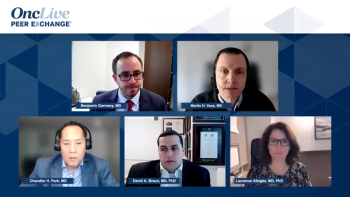
Focusing on the KEYNOTE-B61 trial evaluating lenvatinib plus pembrolizumab in the first line, a panel of medical oncologists react to clinical trial data on combination regimens in non–clear cell renal cell carcinoma.
Chandler H. Park, MD, highlights cabozantinib monotherapy data from the SWOG 1500 study in non–clear cell renal cell carcinoma.

Benjamin Garmezy, MD, discusses key factors influencing treatment selection for patients with variant renal cell carcinoma.
The expert panel gives an overview of non–clear cell renal cell carcinoma, highlighting disease subtypes and treatment approaches.
Following a review of research on belzutifan in the advanced RCC space, the expert panel has a comprehensive discussion on treatment approaches and toxicity management.
Focusing on belzutifan, Laurence Albigès, MD, PhD, reviews data from the LITESPARK-005 clinical trial, and Martin H. Voss, MD, discusses the ongoing LITESPARK-011 trial.
Experts on advanced RCC discuss the CONTACT-03 trial evaluating atezolizumab plus cabozantinib following immune checkpoint inhibitor treatment in patients with inoperable disease.
David A. Braun, MD, PhD, provides clinical insights on factors that influence treatment decisions in the second line and beyond for patients with advanced clear cell RCC.
Focusing on the LITESPARK-003 and LITESPARK-024 trials, Laurence Albigès, MD, PhD, discusses novel doublet regimens under investigation in the first-line setting in advanced renal cell carcinoma.
Medical oncologists provide clinical insights on managing adverse events associated with IO-TKI and IO-IO regimens in patients with advanced renal cell carcinoma.
The expert panel reacts to 55-month follow-up data from CheckMate 9ER assessing nivolumab plus cabozantinib in patients with newly diagnosed advanced RCC.
David A. Braun, MD, PhD, shares his takeaways from the network meta-analysis on lenvatinib plus pembrolizumab in advanced RCC, and Martin H. Voss, MD, discusses outcomes with cabozantinib following frontline lenvatinib plus pembrolizumab.
Chandler H. Park, MD, discusses the LEAP study investigating lenvatinib plus pembrolizumab in patients with renal cell carcinoma with brain metastasis.
Martin H. Voss, MD, gives an overview of the CLEAR study evaluating lenvatinib plus pembrolizumab in frontline advanced RCC and discusses recent subgroup analyses.

Laurence Albigès, MD, PhD, reviews recently presented data from CheckMate 67T, which is assessing subcutaneous vs intravenous nivolumab in patients with previously treated RCC.
In case you missed it, read a recap of every episode of OncLive On Air recorded in January 2024.