

Experts on ovarian cancer discuss germline and somatic testing practices and provide clinical insights on factors that influence treatment decisions.
Experts on ovarian cancer discuss germline and somatic testing practices and provide clinical insights on factors that influence treatment decisions.
A panel of expert gynecologic oncologists introduce themselves and review frontline maintenance treatment options in ovarian cancer.
Panelists expand upon the most important clinical factors that inform selection amongst available systemic therapy regimens in the neoadjuvant setting of HER2+ eBC, comment on the potential for treatment de-escalation in lower-risk patients, and discuss exciting treatments on the horizon.
Heather McArthur, MD, and Debu Tripathy, MD, lead a discussion on risk stratification and optimizing treatment for HER2+ early breast cancer (eBC), followed by a review of standard-of-care systemic therapy regimens in the preoperative/neoadjuvant setting.
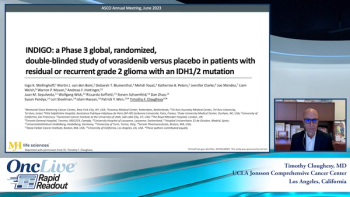
Timothy Cloughesy, MD, reviews data from the phase 3 INDIGO trial investigating vorasidenib in patients with residual or recurrent grade 2 glioma with an IDH1 or IDH2 mutation.

Amy L. Cummings, MD, PhD, discusses key findings from the phase 3 ADAURA trial in patients with non–small cell lung cancer harboring EGFR mutations.

Aaron Lisberg, MD, discusses ongoing and future efforts to expand effective treatment options for patients with osimertinib-resistant, EGFR-mutant non–small cell lung cancer.

Edward B. Garon, MD, MS, discusses challenges associated with the incorporation of immunotherapy into the treatment paradigm for EGFR-mutant non–small cell lung cancer.
Dr Kishan discusses the use of MRI-guided SBRT in prostate cancer to reduce acute genitourinary and gastrointestinal toxicity; findings from the MIRAGE study; and how MRI-guided SBRT allows for tighter planning margins, thereby reducing both physician-reported and patient-reported bowel and bladder toxicities.
As the development of systemic treatments for metastatic colorectal cancer move toward precision therapy, guidelines have adjusted to integrate decisions based on molecular drivers.

Amy L. Cummings, MD, discusses the significance of the phase 3 FLAURA trial evaluating osimertinib in locally advanced or metastatic non–small cell lung cancer (NSCLC).
Edward B. Garon, MD, MS, discusses the use of PD-L1 inhibitor and CTLA-4 inhibitor combinations in non–small cell lung cancer.
Jeremie Calais, MD, MSc, discusses the role of prostate-specific membrane antigen-PET imaging in metastatic-castrate resistant prostate cancer, and touches on the importance of integrating PSMA-PET imaging into community settings for clinical practice.
Matthew Rettig, MD, discusses the evolution of triplet therapy within the landscape of metastatic hormone-sensitive prostate cancer, as well as the importance of considering key prognostic factors when utilizing this approach.
Zev A. Wainberg, MD, discusses the rationale behind the phase 3 NAPOLI 3 trial in patients with metastatic pancreatic ductal adenocarcinoma.
Despite incremental advances in the treatment landscape of metastatic colorectal cancer, patients with the disease still face a poor prognosis.
Closing out their review on treatment strategies for HER2-expressing breast cancer, panelists share practical advice for the community setting.
Panelists share a brief discussion on early-stage HER2-low breast cancer and identify treatment options available in that setting.
Comprehensive insight on evolving management strategies for patients diagnosed with HER2-low breast cancer.
Matthew Rettig, MD, discusses emerging treatment options for patients with stage IV metastatic prostate cancer and highlights key data from clinical trials in the space.
Centered discussion on the advent of HER2-low breast cancer and how it is differentiated from HER2+ and HER2- disease.
Expert panelists provide a broad overview on HER2+ breast cancer and review the evolving treatment armamentarium.

Bartosz Chmielowski, MD, discusses the rationale for IGNYTE, the unique mechanism of action of RP1, and how melanoma research is seeking to determine treatments for patients based on their individual resistance mechanisms.

Bartosz Chmielowski, MD, discusses the current treatment landscape of metastatic melanoma.
Drew Moghanaki, MD, MPH, discusses questions that still need to be addressed following the phase 3 CheckMate-816 trial of the neoadjuvant combination nivolumab plus chemotherapy in patients with non–small cell lung cancer.
J. Randolph (Randy) Hecht, MD, discusses the investigation of XL092 plus atezolizumab in patients with microsatellite stable/microsatellite instability–low metastatic colorectal cancer.
Edward B. Garon, MD, MS, describes research combining angiogenesis and PD-1/PD-L1 inhibition stemming from the phase 3 IMpower150 trial in patients with metastatic nonsquamous NSCLC.

Amar U. Kishan, MD, discusses interim results from the phase 3 MIRAGE trial of magnetic resonance imaging–guided stereotactic body radiotherapy in prostate cancer.

Ritu Salani, MD, MBA, discusses the continued evolution of molecular profiling in endometrial cancer, advances in immunotherapy for endometrial and cervical cancer, and ongoing research in gynecologic cancers.

Sara A. Hurvitz, MD, discusses sequencing therapeutic options for patients with HER2-positive breast cancer.