


Videos

Advertisement




Advertisement



Emiel J. Rutgers, MD, surgical oncologist, Netherlands Cancer Institute, Amsterdam, discusses a study analyzing radiotherapy or surgery of the axilla after a positive sentinel node in breast cancer patients.
Richard Finn, MD, from the Jonsson Comprehensive Cancer Center, describes the potential impact of the cyclin-dependent kinase 4/6 inhibitor palbociclib (PD-0332991) in the treatment of patients with ER-positive metastatic breast cancer.

Women with early sentinel lymph node-positive breast cancer achieve as much of a disease-free and survival benefit from axillary radiotherapy as they do from axillary lymph node dissection with significantly less risk of lymphedema.

Jane E. Churpek, MD, discusses a study that found the inherited mutations in breast cancer genes in African American breast cancer patients were revealed by targeted genomic capture and next-generation sequencing.
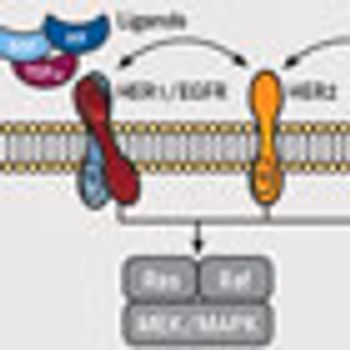
New research suggests that HER2-targeted drugs may actually have much broader applications, benefiting patients who are not designated HER2-positive by routine testing.

Low-dose weekly paclitaxel is as effective and has fewer side effects than the standard biweekly schedule for patients with early-stage breast cancer.

Clifford A. Hudis, MD, ASCO President-Elect, describes the focus on global medicine at the 2013 American Society of Clinical Oncology Annual Meeting.

A British study has confirmed that 10 years of adjuvant tamoxifen substantially reduces late breast cancer recurrence and mortality among women with estrogen receptor-positive disease.

Richard G. Gray, MA, MSc, from the University of Oxford in Oxford, United Kingdom, discusses the phase III aTTom trial that explored a longer duration of treatment with tamoxifen in women with estrogen receptor-positive early breast cancer.

Joyce A. O'Shaughnessy, MD, the Co-Director of Breast Cancer Research at the Baylor Charles A. Sammons Cancer Center, describes potentially practice changing findings from the BOLERO-3 trial.

Max S. Wicha, MD, is an internationally renowned research expert in the field of breast oncology. His lab was part of the first team to discover stem cells in breast cancer, and he is among the most highly cited investigators in the field of cancer stem cells.

Martine Piccart, MD, PhD, director of medicine at the Jules Bordet Institute in Brussels, Belgium, discusses the success of trastuzumab for the treatment of breast cancer.

Some HER2-positive breast cancer patients may be able to receive targeted neoadjuvant therapy with lapatinib and trastuzumab without chemotherapy.
Hope S. Rugo, MD, professor of medicine and director of breast oncology and clinical trials education at the University of California, San Francisco, Helen Diller Family Comprehensive Cancer Center, discusses the treatment of patients with metastatic breast cancer with chemotherapy.

The decision about whether to get tested for a genetic mutation that may predispose a person to certain cancers is a difficult one for many patients to make. Even more difficult for mutation carriers is deciding whether to undergo a prophylactic surgical procedure.

Breast cancer clinicians today are faced with an ever-expanding number of older patients, yet determining the most appropriate treatment for these individuals can be challenging.

Patrick Borgen, MD, chair, Department of Surgery, director, Maimonides Breast Cancer Center, discusses a patient's decision to be tested for a BRCA gene.

Emanuel F. "Chip" Petricoin III, PhD, Co-Director, Center for Applied Proteomics & Molecular Medicine, Professor of Life Sciences, George Mason University, discusses the discovery of new biomarkers in breast cancer.

While chemotherapy might initially be effective in the treatment of patients with metastatic breast cancer, it is very common for patients to develop resistance to such agents.

Researchers are attempting to determine if targeting more than one tyrosine kinase provide a greater benefit in several clinical trials involving the investigational drug afatinib.
A high-profile case of a medical decision being based primarily on the results of a genetic test has prompted a national discussion on the benefits and risks associated with acting on the results of such a test.

The technological advances in analyzing the human genome have spawned a new era in breast cancer as well as other types of malignancies that will affect oncology practice and will necessitate dramatic changes in the clinical trials system.
Advertisement
Advertisement
Trending on OncLive
1
Long-Term Cilta-Cel Data Show Low Rates of PFS Events in Standard-Risk R/R Myeloma
2
FDA Updates Axi-Cel Label to Remove Limitation of Use in R/R PCNSL
3
Real-World Data Support Clinical Benefit With Lifileucel in Previously Treated Advanced Melanoma
4
Nonresponse to Bridging Therapy and Peak ALC After Cilta-Cel Are Associated With Neurotoxicity, NRM in Myeloma
5