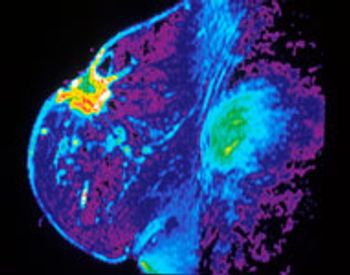
Two large cohort studies, suggest that the costly scan is being overused in women who won't benefit from it and underused in women who could gain benefit from it.

Your AI-Trained Oncology Knowledge Connection!
Two large cohort studies, suggest that the costly scan is being overused in women who won't benefit from it and underused in women who could gain benefit from it.
A Dutch team is recommending the continued use of primary granulocyte colony-stimulating factor (G-CSF) prophylaxis throughout all chemotherapy cycles in women with early breast cancer who are at high risk of febrile neutropenia (FN).
Richard S. Finn, MD, associate professor of medicine, Department of Medicine, Division of Hematology/Oncology, Geffen School of Medicine at UCLA, discusses current research in triple-negative breast cancer (TNBC).
New analyses of the BOLERO-2 trial found that everolimus and exemestane produced significantly longer progression-free survival than placebo and exemestane in several previously unstudied patient subgroups.

Lawrence N. Shulman, MD, chief of staff, senior vice president for medical affairs, director, Center for Global Cancer Medicine, director, Department of Regional Strategy and Development, chief, Division of General Oncology, Dana-Farber Cancer Institute, discusses the results of the CALGB 40101 trial.
Women with HER2-positive early breast cancer favor subcutaneous over intravenous (IV) administration of trastuzumab (Herceptin).
Torsten O. Nielsen, MD, PhD, FRCPC, a professor of pathology at the University of British Columbia, discusses the differences between the PAM50 assay and other approved molecular tests for patients with breast cancer.
Selecting the optimal treatment for postmenopausal patients with hormone receptor (HR)-positive metastatic breast cancer (MBC) remains a challenge, given a preponderance of data for several approved therapeutics
Minetta Liu, MD, Breast Cancer Specialist, Mayo Clinic, Rochester, Minnesota, describes the CellSearch CTC Test in breast cancer.
Michael Gnant, MD, professor of the Department of Surgery at the Medical University of Vienna in Vienna, Austria, discusses the four intrinsic subtypes of the PAM50 recurrence score test and a clinical trial comparing this test with OncotypeDX.

Patients with DCIS who received an MRI added to mammography before or immediately after receiving a lumpectomy did not experience an improvement in the rate of disease recurrence

Suzanne A. W. Fuqua, PhD, professor of medicine, Baylor College of Medicine, says that it is an exciting time for the treatment of patients with metastatic breast cancer.
Clifford A. Hudis, MD, ASCO president, chief, Breast Cancer Medicine Service, attending physician, Memorial Sloan-Kettering Cancer Center, discusses the challenges and recent advancements of treating patients with triple-negative breast cancer.
Debu Tripathy, MD, co-leader, Women's Cancer Program, Norris Comprehensive Cancer Center, University of Southern California, discusses integrative oncology

Few of ASCO's past presidents were faced with the multitude of challenges that arose during the presidency of Sandra M. Swain, MD, who is medical director of the Washington Cancer Institute at Medstar Washington Hospital Center and a professor of Medicine at Georgetown University, and is currently ASCO's immediate past president.
Hope S. Rugo, MD, professor of medicine and director of breast oncology and clinical trials education at the University of California, San Francisco, Helen Diller Family Comprehensive Cancer Center, discusses new guidelines for the treatment of patients with metastatic breast cancer.
It is well recognized that advances in cancer management have most often resulted from a close collaboration between clinical and laboratory investigative efforts.

The American Society of Clinical Oncology (ASCO) and the College of American Pathologists (CAP) have released updated recommendations for HER2 testing in breast cancer.
Jo Anne Zujewski, MD, head, breast cancer therapeutics, cancer therapy evaluation program, National Cancer Institute (NCI), discusses the development of drugs to treat patients with breast cancer.
Clifford A. Hudis, MD, ASCO president, chief, Breast Cancer Medicine Service, attending physician, Memorial Sloan-Kettering Cancer Center, comments on exploratory biomarker observations from the BOLERO-3 trial.

Breast cancer patients with PI3KCA mutations are less likely to achieve a pathological complete response from dual HER2 blockade in the neoadjuvant setting.

Pertuzumab in combination with trastuzumab and chemotherapy has become the first FDA-approved neoadjuvant treatment for patients with breast cancer

Exploratory analysis of biomarkers in the BOLERO-3 trial suggests that the addition of everolimus to trastuzumab plus vinorelbine for HER2-positive advanced breast cancer may be most beneficial in patients with low PTEN or high pS6 levels.

T-DM1 extended progression-free survival compared with "physician's choice of treatment" in women with metastatic HER2-positive breast cancer.

Torsten O. Nielsen, MD, PhD, FRCPC, a professor of pathology at the University of British Columbia, discusses the pros and cons of using the Ki67 as a prognostic marker in breast cancer.
Kathy S. Albain, MD, medical oncologist, Loyola University Chicago, professor, Stritch School of Medicine, director, Breast Clinical Research Program, Thoracic Oncology Research Program, Cardinal Bernardin Cancer Center, discusses staging versus biology in breast cancer.
Minetta Liu, MD, breast cancer specialist, Mayo Clinic, Rochester, Minnesota, discusses the limitations of radiology in metastatic breast cancer treatment.

The PAM50 test, designed to determine a risk of recurrence score for patients with breast cancer, adds significant prognostic information to clinical decision making and might be superior to other risk assays.
Rebecca L. Aft, MD, PhD, professor of surgery at the Washington University School of Medicine in St. Louis and a physician at Siteman Cancer Center, discusses the use of bisphosphonates for patients with breast cancer.
G. Thomas Budd, MD, Medical Oncologist, Taussig Cancer Center at Cleveland Clinic, Professor, Hematology & Medical Oncology, Case Western Reserve University, discusses prior treatment with trastuzumab and the effect on two regimens of paclitaxel.