
Opinion|Videos|January 2, 2026
Future Directions, Community Collaboration, and Key Takeaways for Clinicians
Author(s)Amitkumar Mehta, MD, Lucy Bailey, CRNP
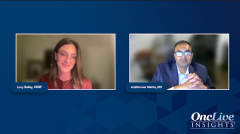
The final segment looks ahead to future directions in follicular lymphoma management while emphasizing the essential partnership between academic and community practices. Dr. Mehta describes how evolving therapies, particularly bispecific antibodies, are increasingly being adopted in community settings, supported by collaborative frameworks that allow patients to receive advanced treatments while minimizing travel burdens. The faculty highlight ongoing clinical studies suggesting that bispecific antibodies may soon move into frontline settings for both follicular and large B-cell lymphoma. Dr. Mehta predicts that over the next several years, a majority of community practices will gain the capacity to deliver bispecific therapy independently, mirroring trends already seen in solid tumor settings. The discussion transitions to CD19-directed approaches, including tafasitamab and loncastuximab, and how these therapies complement CD20-based strategies. The importance of checking CD19 expression at relapse is emphasized when considering sequencing and future CAR T eligibility. In concluding remarks, Dr. Mehta outlines key messages for clinicians: R2 is no longer the standard of care in relapsed follicular lymphoma; newly approved regimens have demonstrated superior efficacy; and therapy selection should be guided by practice resources, patient goals, and toxicity profiles. The program ends with a forward-looking perspective on how novel therapeutics and collaborative care models will continue to elevate patient outcomes in relapsed/refractory follicular lymphoma.
Advertisement
Episodes in this series
The final segment looks ahead to future directions in follicular lymphoma management while emphasizing the essential partnership between academic and community practices. Dr. Mehta describes how evolving therapies, particularly bispecific antibodies, are increasingly being adopted in community settings, supported by collaborative frameworks that allow patients to receive advanced treatments while minimizing travel burdens.
The faculty highlight ongoing clinical studies suggesting that bispecific antibodies may soon move into frontline settings for both follicular and large B-cell lymphoma. Dr. Mehta predicts that over the next several years, a majority of community practices will gain the capacity to deliver bispecific therapy independently, mirroring trends already seen in solid tumor settings.
The discussion transitions to CD19-directed approaches, including tafasitamab and loncastuximab, and how these therapies complement CD20-based strategies. The importance of checking CD19 expression at relapse is emphasized when considering sequencing and future CAR T eligibility.
In concluding remarks, Dr. Mehta outlines key messages for clinicians: R2 is no longer the standard of care in relapsed follicular lymphoma; newly approved regimens have demonstrated superior efficacy; and therapy selection should be guided by practice resources, patient goals, and toxicity profiles. The program ends with a forward-looking perspective on how novel therapeutics and collaborative care models will continue to elevate patient outcomes in relapsed/refractory follicular lymphoma.
Advertisement
Related to this article

Breast cancer experts address frequently asked questions on adjuvant and metastatic CDK4/6 inhibitor selection in HR-positive breast cancer.

The European Commission approved pembrolizumab plus enfortumab vedotin for muscle-invasive bladder cancer, irrespective of cisplatin eligibility.

Thoracic oncologists weigh how TROP2-directed antibody-drug conjugates fit into sequencing and combination strategies for EGFR-mutated NSCLC.

Patients with pancreatic cancer experience measurable changes in body composition years before diagnosis that differ from those seen in similar individuals without cancer.

Lisaftoclax plus acalabrutinib earned breakthrough therapy status in China for untreated CLL/SLL.

Andrea Cercek, MD, discusses the FDA approval of dostarlimab and its significance for dMMR locally advanced rectal cancer management.
Fadi Haddad, MD, discusses TKI adherence barriers, adverse effect management, and the role of alternative TKI formulations in CML.

Updated ARC-20 data showed casdatifan activity as monotherapy and in combinations across treatment lines in advanced clear cell RCC.
Advertisement
Advertisement
Trending on OncLive
1
FDA Approval of Dostarlimab Brings Potential Organ-Sparing Approach in dMMR Locally Advanced Rectal Cancer
2
Casdatifan Demonstrates Activity in Advanced Clear Cell RCC
3
Treatment Tailoring and Weighing Alternative Formulations Support Optimal TKI Deployment in CML
4
HER2+ Maintenance Therapy Approvals and Innovative Brain Metastasis Care Reshape Breast Cancer Management
5