
Opinion|Videos|May 2, 2025
Translating OS Data Into Patient Conversations: Balancing Benefit and Burden
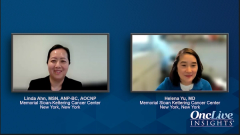
Panelists discuss how explaining survival benefits to patients must be tailored to individual goals and expectations, with many patients having specific life milestones they hope to reach.
Advertisement
Episodes in this series
Communicating Survival Benefits and Treatment Trade-Offs
Main Discussion Topics:
- Strategies for explaining survival benefits to patients
- Incorporating patient goals into treatment discussions
- Avoiding preconceived notions about patient preferences based on age or other factors
Key Points for Physicians:
- Focus on patient-specific goals (eg, attending important life events) when discussing treatments
- Recognize that patient preferences don’t always align with physician assumptions
- Consider results from patient surveys that reveal preferences for quality of life over extended therapy
Notable Insights:
Data from a Chinese survey showed that over 70% of patients, family members, and doctors would prefer osimertinib monotherapy over combination therapy despite a 9-month delay in recurrence with the latter.
Clinical Significance:
Effective shared decision-making requires understanding individual patient goals and preferences rather than making assumptions based on demographic factors or physician biases.
Advertisement
Related to this article

Benjamin Weinberg, MD, discusses the FDA approval of daraxonrasib, RASolute 302 survival data, safety considerations, and future RAS-targeted therapies in pancreatic cancer.

Half of lenalidomide-refractory patients with 1 to 3 prior lines remained alive and progression free at least 5 years after a single cilta-cel infusion.

Andrew Kuykendall, MD, discusses the FDA approval of rusfertide and how to apply it in clinical practice for polycythemia vera management.

An NDA seeks FDA approval of savolitinib plus osimertinib for EGFR-mutated NSCLC with MET overexpression or amplification after EGFR TKI therapy.

Jason Hafron, MD, discusses the emotional, clinical, and financial burden of false positive cancer screening results and improved risk stratification.

Raajit K. Rampal, MD, PhD, discusses JAK inhibitor choice in cytopenic myelofibrosis, emerging combinations, and anemia-directed agents.

The sNDA for elinzanetant seeks FDA approval for moderate-to-severe vasomotor symptoms in women receiving endocrine therapy for HR-positive breast cancer.

The NMPA has approved of pirtobrutinib in treatment-naive and previously treated CLL/SLL.
Advertisement
Advertisement
Trending on OncLive
1
Ifinatamab Deruxtecan BLA Voluntarily Withdrawn in Previously Treated Extensive-Stage SCLC
2
China's NMPA Approves Pirtobrutinib Across CLL
3
FDA Grants Priority Review to Elinzanetant for Endocrine Therapy–Associated Vasomotor Symptoms in HR+ Breast Cancer
4
Long-Term PERSEUS Data Confirm Durable PFS Benefit With D-VRd in Transplant-Eligible Newly Diagnosed Myeloma
5