Aditya Bardia, MD, MPH, FASCO, discusses the need for widespread HER2 testing in patients with HER2-low and -ultralow metastatic breast cancer.

Aditya Bardia, MD, MPH, FASCO, is a professor in the Department of Medicine, Division of Hematology/Oncology and director of Translational Research Integration at UCLA Health Jonsson Comprehensive Cancer Center.
Aditya Bardia, MD, MPH, FASCO, discusses the need for widespread HER2 testing in patients with HER2-low and -ultralow metastatic breast cancer.
Dr Bardia discusses the FDA approval of T-DXd for patients with unresectable or metastatic, hormone receptor–positive, HER2-low/-ultralow breast cancer.
Dr Bardia discusses the significance of the FDA approval of Dato-DXd, and pivotal findings from the phase 3 TROPION-Breast01 trial that led to the approval.

Aditya Bardia, MD, MPH, FASCO, discusses the FDA approval of Dato-DXd for pretreated, hormone receptor–positive, HER2-negative metastatic breast cancer.

Aditya Bardia, MD, MPH, FASCO, discusses the FDA approval of T-DXd for patients with pretreated HER2-low and -ultralow metastatic breast cancer.
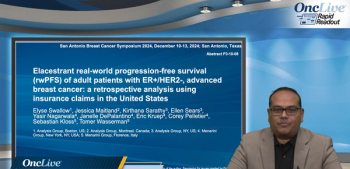
Dr. Aditya Bardia presents real-world findings on elacestrant, demonstrating prolonged real-world progression-free survival (rwPFS) in ER+/HER2- advanced breast cancer patients across all clinically relevant subgroups, with benefits observed particularly in earlier treatment lines and in those without prior fulvestrant exposure.
Aditya Bardia, MD, MPH, FASCO, discusses the efficacy of T-DXd in HER2-low/ultralow metastatic breast cancer by disease progression on prior therapy.
Aditya Bardia, MD, MPH, FASCO, discusses QOL outcomes among patients with HER2-low and HER2-ultralow breast cancer from the DESTINY-Breast06 trial.
Panelists discuss how addressing unmet needs in patient selection, resistance mechanisms, and long-term outcomes can enhance the efficacy of antibody-drug conjugates in breast cancer treatment.
Panelists discuss how, despite the investigational status of agents like patritumab deruxtecan (HER3-DXd) and datopotamab deruxtecan (Dato-DXd), it’s crucial for community oncologists to be aware of the treatment-related adverse effects (TRAEs) associated with these therapies and to consider effective management strategies as reported in clinical trials.
Panelists discuss how ongoing clinical trials of investigational antibody-drug conjugates (ADCs) are advancing treatment options for breast cancer, particularly in patients with active brain metastases and advanced disease.
Panelists discuss how the multidisciplinary team plays a crucial role in managing treatment-resistant adverse effects for patients receiving antibody-drug conjugates, emphasizing collaboration among oncologists, pharmacists, nurses, and specialists to optimize patient care and ensure comprehensive support.
Panelists discuss how management and monitoring for pneumonitis and cardiotoxicity in trastuzumab deruxtecan (T-DXd) is similar to trastuzumab emtansine (T-DM1), while also emphasizing the need for awareness of adverse effects such as peripheral neuropathy, thrombocytopenia, and hepatotoxicity, along with strategies for their management and when to consider therapy modifications.
Experts on breast cancer provide clinical insights on the management of pneumonitis associated with trastuzumab deruxtecan.
Experts on breast cancer discuss the potential adverse events related to trastuzumab deruxtecan (T-DXd).
Panelists discuss how to manage side effects of sacituzumab govitecan (SG), including counseling on alopecia, proactive management strategies, routine antiemetic premedications, and adjustments for chemotherapy-induced nausea and vomiting, as well as recommended breakthrough antinausea medications for home use.
Panelists discuss how to manage sacituzumab govitecan therapy, including absolute neutrophil count cutoffs for dose adjustments, handling febrile neutropenia, comparing diarrhea rates to clinical trials, identifying risk factors, and strategies for managing SG-related diarrhea.
This discussion focuses on strategies to manage neutropenia associated with SG, including the use of prophylactic growth factors and timing of their administration, comparing management approaches between clinicians.
This discussion explores the occurrence and risk factors of neutropenia associated with SG treatment, comparing clinical practice experiences with trial data.
Medical experts discuss the distinct mechanisms and components of different antibody-drug conjugates (ADCs), including the drug, antibody, and linker, and how these components contribute to the mechanisms of ADC-related toxicities.
Medical experts review the currently available antibody-drug conjugates for breast cancer, including Sacituzumab govitecan (Trop-2 directed ADC), Kadcyla (ado-trastuzumab emtansine, T-DM1, HER2-directed ADC), and Enhertu (fam-trastuzumab deruxtecan-nxki, T-DXd, HER2-directed ADC).
The panel looks to the future landscape for HER2+ breast cancer, highlighting emerging treatment practices and currently unmet needs.
Focusing on the selection of subsequent therapies for patients with HER2-low/HER2+ metastatic breast cancer, the panel discusses treatment sequencing considerations and practices.
Breast cancer specialists discuss adverse events associated with T-DXd, focusing on monitoring for interstitial lung disease (ILD) and the role of re-challenging patients with T-DXd after resolution of grade 1 ILD.
Aditya Bardia, MD, MPH, shares comprehensive insights on the DESTINY-Breast06 study evaluating T-DXd in HER2-low and HER2 ultra-low metastatic breast cancer, and the panel offers its initial impressions.
Ian Krop, MD, PhD, provides an overview of HER2-low and HER2 ultra-low breast cancer and discusses challenges encountered during diagnosis.
Experts on breast cancer discuss the potential impact of ongoing research in HER2+ breast cancer, highlighting how results from the DESTINY-Breast07 study may translate to DESTINY-Breast09.
Melinda Telli, MD, provides an overview of ongoing research in HER2+ metastatic breast cancer, highlighting the DESTINY-Breast09, PATINA, INAVO122, and HER2CLIMB-05 studies.
The panel provides comprehensive insights on approaching first-line treatment of patients with HER2+ metastatic breast cancer and the role of neratinib.

Aditya Bardia, MD, MPH, FASCO, discusses HER2 IHC testing in patients with HER2-low and -ultralow metastatic breast cancer.
August 1st 2022
January 31st 2022