
Drs Nunnery and Teplinsky discussed how to manage the adverse effects associated with endocrine therapy in hormone receptor–positive breast cancer.
Drs Nunnery and Teplinsky discussed how to manage the adverse effects associated with endocrine therapy in hormone receptor–positive breast cancer.
Dr. Weinberg envisions increasing ctDNA incorporation into adjuvant decision-making, anticipating that Circulate North America results will provide comfort for de-escalating ctDNA-negative patients while escalating ctDNA-positive patients.
Dr. Raez addresses choosing between tumor-informed and tumor-naïve platforms, noting no formal prospective comparison exists.
Dr. Weinberg addresses where evidence is strongest versus where the field risks getting ahead of itself.
Dr. Teplinsky, reflecting on commonalities across tumor types, notes that although the discussion focused on early-stage breast cancer, increasing ctDNA use exists in metastatic disease to identify treatment-emergent mutations guiding therapy selection, representing a different application context.
Dr. Raez discusses IASLC 2025 data, now published in the Journal of Thoracic Oncology, representing important progress for lung cancer's MRD research, which has historically lagged behind gastrointestinal and genitourinary cancers.
Dr. Weinberg addresses practical workflows for ctDNA-positive, imaging-negative patients, noting no current standard of care exists despite NCCN guidelines addressing elevated CEA management.
Dr. Weinberg discusses 2 major observational datasets informing colorectal cancer ctDNA practice.
Dr. Teplinsky discusses the evolving breast cancer surveillance paradigm, noting historical data showing routine imaging surveillance doesn't impact outcomes, though this data predates modern imaging technology.
Dr. Grivas confirms ctDNA integration into multidisciplinary tumor boards is increasing, describing his bladder cancer multidisciplinary clinic involving urology, medical oncology, radiation oncology, and pathology/radiology review focused on localized muscle-invasive bladder cancer.
Dr. Weinberg explains the treatment on molecular recurrence (TOMR) concept, drawing parallels to biochemical relapse monitoring in prostate cancer. In colorectal cancer, patients with positive ctDNA after completing curative-intent surgery and adjuvant chemotherapy will experience radiographic recurrence at a median of approximately 5.5 months, representing a population potentially amenable to curative intervention through escalated imaging to identify oligometastatic disease suitable for metastasectomy, or enrollment in novel drug development trials.
Dr. Teplinsky addresses where ctDNA and MRD testing fit within the patient care continuum, noting that value isn't uniform across disease stages or tumor types. The strongest signal currently exists in the post-treatment surveillance setting, where tumor-informed assays can identify patients at higher recurrence risk before disease becomes visible on imaging.
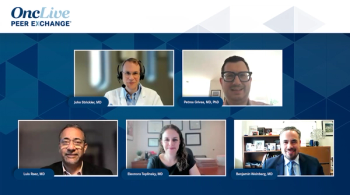
Dr. John Strickler introduces the program on circulating tumor DNA (ctDNA) and minimal residual disease (MRD) testing across solid tumors, joined by Dr. Eleonora Teplinsky (breast and gynecologic oncology, Valley Health System), Dr. Ben Weinberg (gastrointestinal oncology, Georgetown University), Dr. Petros Grivas (genitourinary oncology, Fred Hutchinson Cancer Center), and Dr. Luis Raez (thoracic oncology, Memorial Healthcare System).

Human epidermal growth factor receptor 2 (HER2)-positive disease accounts for 20% to 25% of breast cancers, as represented by amplification of the HER2 gene and/or HER2 protein overexpression
March 21st 2014