Francis Paul Worden, MD, University of Michigan Comprehensive Cancer Center
Articles by Francis Paul Worden, MD, University of Michigan Comprehensive Cancer Center
Panelists discuss how emerging areas in recurrent/metastatic (R/M) head and neck squamous cell carcinoma (HNSCC) research include novel immunotherapy combinations, biomarker development for treatment selection, targeted therapies against new molecular pathways, and strategies to overcome resistance to existing treatments.
Panelists discuss key research priorities for recurrent/metastatic (R/M) head and neck squamous cell carcinoma (HNSCC), which include expanding PDS0101/pembrolizumab trials to identify optimal patient subgroups, addressing resistance mechanisms, and exploring novel biomarkers. Emerging immunotherapy combinations and targeted therapies show promise.
Panelists discuss the priority next steps for PDS0101 plus pembrolizumab in recurrent/metastatic (R/M) head and neck squamous cell carcinoma (HNSCC): expand clinical trials, identify predictive biomarkers, assess long-term safety, and explore additional combination approaches.
Panelists discuss how, PDS0101 uses Versamune® lipid nanoparticles to deliver HPV16 antigens, activating T-cells. Early Phase 2 data with pembrolizumab showed promise in HPV16+ head & neck cancer patients.
Panelists discuss how human papillomavirus (HPV)–related tumors vary in aggressiveness, with HPV-positive head and neck squamous cell carcinoma (HNSCC) presenting unique challenges. Key treatment hurdles include tumor heterogeneity, resistance development, and optimizing de-escalation strategies while maintaining efficacy.
Panelists discuss how, HPV+ head and neck cancer treatment typically follows NCCN guidelines: primary therapy includes surgery and/or chemoradiation based on staging. Immunotherapy like pembrolizumab is increasingly used, especially for recurrent/metastatic disease. Prognosis is generally better than HPV- cases.
Panelists discuss how, HPV-positive head and neck squamous cell carcinoma (HPV+ HNSCC) typically presents differently from HPV-negative cases. Patients often present with smaller primary tumors but more advanced nodal disease, commonly with cystic lymph node metastases in the neck. The most frequent site is the oropharynx, particularly the tonsils and base of tongue.

Sequencing Throughout Multiple Lines of Therapy in RR DTC
ByLori J. Wirth, MD, Massachusetts General Hospital,Ezra Cohen, MD, FRCPSC, FASCO, UC San Diego,Francis Paul Worden, MD, University of Michigan Comprehensive Cancer Center,Marcia S. Brose, MD, PhD Before closing out their discussion on RR DTC management, panelists consider the advent of sequencing through multiple lines of therapy.
Optimizing Use of RET Inhibitors in Patients With RR DTC
ByLori J. Wirth, MD, Massachusetts General Hospital,Ezra Cohen, MD, FRCPSC, FASCO, UC San Diego,Francis Paul Worden, MD, University of Michigan Comprehensive Cancer Center,Marcia S. Brose, MD, PhD Shared insight on the optimal use of RET inhibitor therapy in select patients with RET-rearranged radioiodine-refractory differentiated thyroid cancer.
Patient Scenario 3: Treating RR DTC With an Identified RET Fusion
ByLori J. Wirth, MD, Massachusetts General Hospital,Ezra Cohen, MD, FRCPSC, FASCO, UC San Diego,Francis Paul Worden, MD, University of Michigan Comprehensive Cancer Center,Marcia S. Brose, MD, PhD Centering discussion on the final clinical scenario of RR DTC, Francis Worden, MD, highlights the management of a patient with an identified RET rearrangement.
Practical Considerations for Utilizing Second-Line Therapy in RR DTC
ByLori J. Wirth, MD, Massachusetts General Hospital,Ezra Cohen, MD, FRCPSC, FASCO, UC San Diego,Francis Paul Worden, MD, University of Michigan Comprehensive Cancer Center,Marcia S. Brose, MD, PhD Expert panelists provide comprehensive insight to the utilization of second-line therapy for patients with RR DTC, covering formulation, dosing, and adverse event management.
Clinical Data Behind Second-Line Therapy in RR DTC
ByLori J. Wirth, MD, Massachusetts General Hospital,Ezra Cohen, MD, FRCPSC, FASCO, UC San Diego,Francis Paul Worden, MD, University of Michigan Comprehensive Cancer Center,Marcia S. Brose, MD, PhD A broad view of clinical data behind use of cabozantinib therapy in the second-line setting of radioiodine-refractory differentiated thyroid cancer.
Patient Scenario 2: Second-Line Management of RR DTC With Cabozantinib
ByLori J. Wirth, MD, Massachusetts General Hospital,Ezra Cohen, MD, FRCPSC, FASCO, UC San Diego,Francis Paul Worden, MD, University of Michigan Comprehensive Cancer Center,Marcia S. Brose, MD, PhD Moving on to a new clinical scenario, Lori Wirth, MD, reviews the second-line management of a patient who progresses on frontline systemic therapy.
RR DTC: Managing Adverse Events With Dose Reductions or Holds
ByLori J. Wirth, MD, Massachusetts General Hospital,Ezra Cohen, MD, FRCPSC, FASCO, UC San Diego,Francis Paul Worden, MD, University of Michigan Comprehensive Cancer Center,Marcia S. Brose, MD, PhD Before closing out their discussion on the frontline treatment setting of RR DTC, panelists highlight dose reductions and planned treatment holidays to mitigate adverse events.
Quality of Life and Real-World Data in Patients With RR DTC
ByLori J. Wirth, MD, Massachusetts General Hospital,Ezra Cohen, MD, FRCPSC, FASCO, UC San Diego,Francis Paul Worden, MD, University of Michigan Comprehensive Cancer Center,Marcia S. Brose, MD, PhD Expert perspectives on real world and quality of life data behind systemic therapy in patients with radioiodine-refractory differentiated thyroid cancer.
Overview of Available Treatment Options for RR DTC
ByLori J. Wirth, MD, Massachusetts General Hospital,Ezra Cohen, MD, FRCPSC, FASCO, UC San Diego,Francis Paul Worden, MD, University of Michigan Comprehensive Cancer Center,Marcia S. Brose, MD, PhD Expert oncologists work together to review the treatment armamentarium for radioiodine-refractory differentiated thyroid cancer and identify factors that best inform selection of therapy.
RR DTC: Active Surveillance vs Initiating Systemic Therapy
ByLori J. Wirth, MD, Massachusetts General Hospital,Ezra Cohen, MD, FRCPSC, FASCO, UC San Diego,Francis Paul Worden, MD, University of Michigan Comprehensive Cancer Center,Marcia S. Brose, MD, PhD A brief review of when it is appropriate to initiate systemic therapy in patients with differentiated thyroid cancer as opposed to continuing active surveillance.
Defining Radioiodine-Refractory Differentiated Thyroid Cancer
ByLori J. Wirth, MD, Massachusetts General Hospital,Ezra Cohen, MD, FRCPSC, FASCO, UC San Diego,Francis Paul Worden, MD, University of Michigan Comprehensive Cancer Center,Marcia S. Brose, MD, PhD Key opinion leaders in differentiated thyroid cancer take a moment to define radioiodine refractory disease and consider its implications in establishing a treatment pathway.
Practical Considerations for Managing RR DTC With Systemic Therapy
ByLori J. Wirth, MD, Massachusetts General Hospital,Ezra Cohen, MD, FRCPSC, FASCO, UC San Diego,Francis Paul Worden, MD, University of Michigan Comprehensive Cancer Center,Marcia S. Brose, MD, PhD Comprehensive insight on best practices in dose adjustment and adverse event management in patients receiving systemic therapy for RR DTC.
Patient Scenario 1: RR DTC Managed With Frontline Lenvatinib
ByLori J. Wirth, MD, Massachusetts General Hospital,Ezra Cohen, MD, FRCPSC, FASCO, UC San Diego,Francis Paul Worden, MD, University of Michigan Comprehensive Cancer Center,Marcia S. Brose, MD, PhD Expert Marcia Brose, MD, PhD, reviews a patient case of radioiodine-refractory differentiated thyroid cancer (RR DTC) managed with frontline lenvatinib therapy.
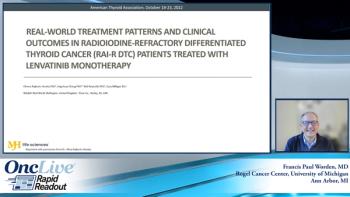
Dr Worden reviews and discusses real-world data of lenvatinib monotherapy in patients with radioiodine-refractory differentiated thyroid cancer.