
Oncology care thrives on teamwork, emphasizing patient education and communication to manage treatment-related ocular toxicities effectively.

Laura Huppert, MD, is an assistant professor of medicine in the Department of Medicine at the University of California, San Francisco School of Medicine
Oncology care thrives on teamwork, emphasizing patient education and communication to manage treatment-related ocular toxicities effectively.
Explore the differences in supportive care for antibody-drug conjugates and their impact on ocular health in patients.
Experts discuss the importance of monitoring ocular toxicities in cancer treatment, emphasizing timely interventions and effective communication between oncologists and ophthalmologists.
Experts discuss the alignment of clinical trial data with real-world experiences in managing ocular toxicities in cancer treatments.
Explore the roles of optometrists and ophthalmologists in managing ocular toxicities, ensuring timely patient care and effective treatment strategies.
Experts discuss the challenges of ocular toxicities in oncology, emphasizing collaboration and the importance of preservative-free eye drops for patient care.
Experts discuss the challenges of ocular toxicities in oncology, emphasizing collaboration and the importance of preservative-free eye drops for patient care.
Explore the latest insights on antibody-drug conjugates in oncology and their associated ocular toxicities, enhancing patient care and treatment outcomes.
Medical oncologists explore the importance of ophthalmology referrals for ocular toxicities, emphasizing collaboration for optimal patient care.
Ophthalmologists discuss the importance of grading dry eye symptoms and the necessity of eye exams before starting certain treatments.
Experts discuss the integration of ocular toxicity management in solid tumor care, focusing on antibody-drug conjugates and their impact on treatment.
Ocular toxicities from cancer treatments present complexities; understanding symptoms and timely ophthalmology involvement is crucial for effective management.
Experts discuss the integration of ocular toxicity management in solid tumor care, focusing on antibody-drug conjugates and their impact on treatment.
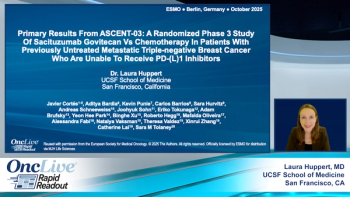
Laura Huppert, MD discusses LBA20 – primary results from ASCENT-03: a randomized phase 3 study of Sacituzumab Govitecan (SG) vs chemotherapy (Chemo) in patients (Pts) with previously untreated Advanced Triple-Negative Breast Cancer (TNBC) who are unable to receive PD-(L)1 inhibitors (PD-[L]1i)

Laura A. Huppert, MD, discusses how the approval of the SERENA-6 regimen could affect second-line treatment decision-making in HR-positive breast cancer.

Laura Huppert, MD, discusses ways that the frontline use of T-DXd in HER2-positive metastatic breast cancer may affect later-line treatment decisions.

Panelists discuss how the continued evolution of HER2-directed therapies, particularly the expanding role of trastuzumab deruxtecan (T-DXd) across different breast cancer settings, has transformed the treatment landscape, while emphasizing the importance of appropriate patient selection, optimal sequencing strategies, and the need for education around early adoption of promising therapies in community practice settings.
Panelists discuss how emerging data from trials such as DESTINY-Breast09, which is evaluating first-line trastuzumab deruxtecan (T-DXd) with or without pertuzumab, could potentially reshape the treatment paradigm for HER2+ metastatic breast cancer (mBC) by establishing new standards for initial therapy and optimal combination approaches.
Panelists discuss how sequential therapy selection for patients with HER2+ breast cancer with progressive brain metastases requires careful consideration of prior treatments, patterns of progression, symptom burden, and available clinical trials, while balancing the need for both systemic disease control and CNS -specific approaches.
Panelists discuss how the DESTINY-Breast12 trial evaluated trastuzumab deruxtecan (T-DXd) in patients with HER2+ metastatic breast cancer (mBC) with brain metastases, demonstrating encouraging intracranial responses and overall survival outcomes while maintaining a manageable safety profile consistent with previous T-DXd studies.
Panelists discuss how treatment selection for patients with HER2+ breast cancer with brain metastases requires careful consideration of factors such as metastatic burden, symptomatology, and prior therapies, typically incorporating both local approaches and systemic agents with CNS activity while accounting for individual patient characteristics such as performance status, comorbidities, and preferences in developing personalized treatment plans.
Panelists discuss how patients with HER2+ breast cancer frequently develop brain metastases, with recent pivotal trials such as HER2CLIMB and DESTINY-Breast03 demonstrating improved intracranial responses with newer agents such as tucatinib, and how trastuzumab deruxtecan leads to evolving standards of care (SOC) that now incorporate these targeted therapies alongside traditional local therapies.
Panelists discuss how trastuzumab deruxtecan’s (T-DXd's) key adverse events (AEs) include interstitial lung disease, neutropenia, and nausea/fatigue, emphasizing the importance of proactive monitoring, early intervention through coordinated multidisciplinary care, and comprehensive patient education with clear communication channels for reporting symptoms.
Panelists discuss how trastuzumab deruxtecan (T-DXd) demonstrated favorable patient-reported outcomes and quality of life measures in HER2-low hormone receptor-positive metastatic breast cancer patients in DESTINY-Breast06, suggesting it could be a well-tolerated therapeutic option that maintains patients' daily functioning while providing clinical benefit.
Panelists discuss how emerging data on HER2-ultralow breast cancer is informing treatment decisions, particularly regarding the potential role of trastuzumab deruxtecan, while acknowledging the need for careful patient selection and consideration of traditional treatment sequences.
Panelists discuss how DESTINY-Breast06 demonstrated meaningful clinical activity of trastuzumab deruxtecan in both HER2-low and ultralow metastatic breast cancer populations.
Panelists discuss how clinical trials like DESTINY-Breast04, TROPiCS-02, and TROPION-Breast01 have revolutionized treatment options for HER2-low advanced breast cancer by validating novel targeted therapies and antibody-drug conjugates.
Panelists discuss how evolving HER2 classification methods and recent trial data are reshaping treatment approaches for advanced breast cancer, particularly regarding the clinical significance of HER2-low and ultralow categories.

Laura A. Huppert, MD, discusses survival outcomes of patients with metastatic breast cancer and leptomeningeal disease according to disease subtype.
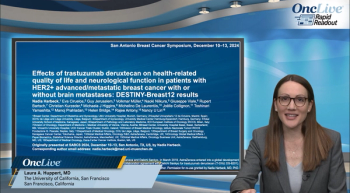
Dr. Laura Huppert presents key data from the DESTINY-Breast12 study, showcasing the effects of trastuzumab deruxtecan on health-related quality of life and neurological function in HER2+ metastatic breast cancer patients, with findings demonstrating preserved quality of life and neurological stability, regardless of brain metastasis status.