

Oncology Business Management
Latest News
Advertisement
Latest Videos






























































Advertisement
More News
Oncology practices may soon find themselves working directly with employers on benefits and treatment strategies.
Comprehensive Cancer Centers of Nevada's exponential expansion is, in part, a result of both the surging local headcount and the national trend toward oncology practice consolidation.
Members of Congress on both sides of the aisle have responded to urgings from the oncology sector that they join in the effort to quash a proposal to change the rule on physician pay under Medicare Part B.

The FDA has granted a priority review to an application to expand the approval of blinatumomab (Blincyto) to include the treatment of pediatric and adolescent patients with Philadelphia chromosome-negative relapsed or refractory B-cell precursor acute lymphoblastic leukemia.
For most oncologists at Texas Oncology, healthcare quality reporting to the CMS went smoothly, but serious complications were encountered.
Enzalutamide (Xtandi) pricing heightens the likelihood of pre-authorization requirements and cost-sharing arrangements that may be financially burdensome, ruinous, or simply impossible to meet.
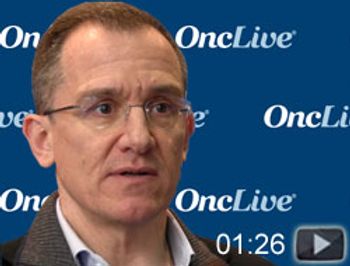
Mark A. Rubin, MD, professor of Pathology and Laboratory Medicine, vice chairman for Experimental Pathology, director, Translational Research Laboratory Services, Weill Cornell Medicine and New-York Presbyterian, discusses the advantages of whole-exome sequencing and how it compares with targeted sequencing.
The FDA has granted a breakthrough therapy designation to nivolumab as a single-agent treatment for patients with recurrent or metastatic squamous cell carcinoma of the head and neck following a platinum-based therapy.
Clinical oncologists may not be fully aware of shortcomings in the laboratory research paradigm that have the potential to distort the scientific underpinnings of vital cancer studies.
Peter Bach, MD, is heading the Evidence Driven Drug Pricing Project, a 3-year initiative that will pilot value- and indication-based payment structures for drugs, funded by the Laura and John Arnold Foundation.
The addition of three biological markers to conventional breast cancer risk models significantly improved the ability to distinguish women at high and low risk.
The FDA has granted a breakthrough therapy designation to pembrolizumab as a treatment for patients with relapsed or refractory classical Hodgkin lymphoma.
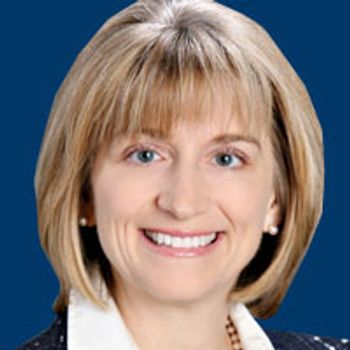
Jennie R. Crews, MD, FACP, discusses how her 18 years of diverse activity in the oncology sector would translate into strong leadership for the Association of Community Cancer Centers and its membership of 20,000.
Aligning physician compensation to performance can be a dicey matter, as it is difficult to reach a consensus on how to measure physician success. However, a number of oncology practices have been developing systems for doing this and achieving success.
The FDA has granted nivolumab (Opdivo) a priority review for use in previously treated patients with classical Hodgkin lymphoma.
A profusion of so-called “liquid biopsy†tests that extract circulating tumor cells, cell-free DNA, or exosomes from blood and urine are under investigation at research institutions and startup firms, and in some cases are already being used to supplement or replace traditional biopsies.
The FDA approved the BCL-2 inhibitor venetoclax (Venclexta) for patients with chronic lymphocytic leukemia (CLL) who have a 17p deletion (del[17p]), following at least 1 prior therapy.
The FDA has granted a priority review to atezolizumab for the treatment of patients with locally advanced or metastatic non–small cell lung cancer who express PD-L1 and have progressed after a platinum-containing regimen.
Biologic chemotherapy spending soared several hundred percent from 2004 to 2014; but despite rising treatment costs in general, oncology spending kept pace with spending for all categories of medical care.
While biosimilars have the potential to create competition and result in healthcare savings, the path to the marketplace has proven complex.
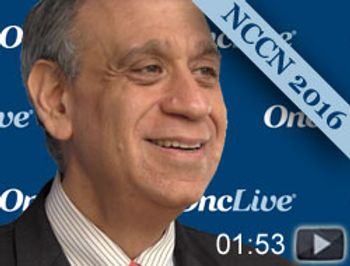
Andrew D. Zelenetz, MD, PhD, medical director, Quality Informatics, Memorial Sloan Kettering Cancer Center, discusses the role of biosimilars in cancer care. Zelenetz spoke about this topic at the 2016 NCCN Annual Conference.
Puma Biotechnology announced that it plans to delay the submission of a new drug application until mid-2016 for neratinib as an extended adjuvant treatment for patients with HER2-positive early breast cancer following a trastuzumab-based regimen.
The FDA has approved defibrotide sodium as a treatment for severe hepatic veno-occlusive disease with associated kidney or lung abnormalities following hematopoietic stem cell transplantation.
A mandate enacted after the 2010 Patient Protection and Affordable Care Act was supposed to improve health coverage for patients enrolled in clinical trials; however, nearly 63% of cancer centers and organizations that responded to a recent survey reported insurance denials of routine care costs associated with patient involvement in clinical trials during 2014.

Hematology/oncology fellowship coordinator, Theresa Marcus, reflects on what it was like to receive a diagnosis of cancer, experience recurrence, and later learn that she had finally become cancer-free with the help of her colleagues.
Advertisement
Advertisement
Trending on OncLive
1
FDA Approves Nogapendekin Alfa Inbakicept Plus BCG for High-Grade, Papillary-Only BCG-Unresponsive NMIBC
2
SurVaxM Cancer Vaccine Shows Clinically Meaningful OS Signal in Newly Diagnosed Glioblastoma
3
VS-7375 Elicits Responses in KRAS G12D–Mutated Pancreatic Cancer
4
FDA Receives NDA Resubmission for Rivoceranib Plus Camrelizumab in Frontline Unresectable or Metastatic HCC
5