

Colorectal Cancer
Latest News
Advertisement
Latest Videos





































































Advertisement
More News

During the past 15 years, minimally invasive general surgery has rapidly expanded to include laparoscopic and robotic techniques for cholecystectomy, colectomy, gastric weight loss, and other procedures
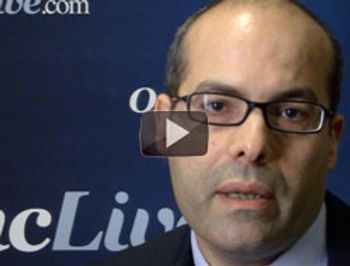
Marwan G. Fakih, MD, professor, director, Gastrointestinal Medical Oncology, City of Hope, discusses anti-angiogenesis versus anti-EGFR therapy in patients who have RAS wild-type colorectal cancer.
The members of the RAS oncogene family are central cogs in many different cell-signaling pathways, coordinate a variety of important cellular processes, and are highly mutated in a number of different cancers, including several with extremely poor prognosis.

Gene rearrangements ALK and ROS1 that are known to drive subsets of lung cancer are also present in colorectal cancer according to a recent study in Molecular Cancer Research.

Marc Peeters, MD, PhD, department of oncology, Antwerp University Hospital, Antwerpen, Belgium, discusses an analysis of RAS mutations in the phase III study 20050181, which compared panitumumab plus FOLFIRI versus FOLFIRI for second-line treatment of mCRC

Robert McCormack, PhD, head, Technology Innovation, Janssen Diagnostics, LLC, explains the circulating tumor cell test CellSearch.

The management of patients with malignant peritoneal surface disease (PSD) commonly known as "carcinomatosis" continues to evolve.

Epidemiologic and scientific research indicates that diet and other lifestyle factors have a significant influence on the risk of developing colorectal cancer.

Roberto Bordonaro, MD, discusses first-line treatment options for advanced colorectal cancer (CRC).

Marwan G. Fakih, MD, professor, director, Gastrointestinal Medical Oncology, City of Hope, discusses extended RAS mutations in colon cancer.
Studies presented at the 2014 GI Cancers Symposium emphasized the need for full RAS mutational analyses in the management of metastatic colorectal cancer prior to initiating treatment with anti-EGFR monoclonal antibodies.

John L. Marshall, MD, from Georgetown University Hospital, on the recent advancements in colorectal cancer.

Single-agent neoadjuvant capecitabine combined with radiation therapy demonstrated similar outcomes as previously established standards of care for patients with stage II or stage III rectal cancer.

An analysis of phase III, second-line data has shown that RAS mutations beyond KRAS exon 2 are negative predictive biomarkers for the EGFR-inhibitor panitumumab in metastatic colorectal cancer.
Charles S. Fuchs, MD, MPH, director, Gastrointestinal Cancer Center, Dana-Farber Cancer Institute, discusses the use of aspirin for the prevention and treatment of colorectal cancer.

Colorectal cancer is the third leading cause of cancer death among African Americans. The CRC mortality rate among African Americans is 29.8% compared with 19.5% among Caucasians.

Forty percent of cases of colorectal cancer may be prevented if patients at average risk for the disease undergo a screening colonoscopy every 10 years

Paul Ruff, MD, director of Medical Oncology at the University of Witwatersrand, Johannesburg, South Africa, discusses the decision regarding the timing of treatment with aflibercept for patients with colorectal cancer.







Advertisement
Advertisement
Trending on OncLive
1
The OncFive: Top Oncology Articles for the Week of 10/4/2026
2
FDA Approves Atezolizumab Plus Chemo for Stage III dMMR Colon Cancer
3
FDA Grants Breakthrough Device Designation to Natera’s Multi-Cancer Early Detection Assay
4
FDA Flashback: Hematologic Cancer Decisions and News From September 2026
5