Gastrointestinal Cancer
Latest News
Latest Videos

CME Content
More News

Adding panitumumab (Vectibix) to best supportive care reduced the risk of death by 30% for patients with RAS wild-type chemorefractory metastatic colorectal cancer.

Neoadjuvant treatment with carboplatin and paclitaxel-based chemotherapy produced a 27.9% pathologic complete response rate in patients with resectable esophageal cancer, according to results of the NEOSCOPE trial.

The investigational anti–PD-L1 antibody avelumab demonstrated clinical activity as a second-line and maintenance therapy for patients with unresectable gastric or gastroesophageal junction cancer.

Safi Shahda, MD, assistant professor of Clinical Medicine, Indiana University School of Medicine, discusses a phase Ib study examining the cancer stem cell pathway inhibitor BBI-608 in combination with gemcitabine and nab-paclitaxel in patients with metastatic pancreatic ductal adenocarcinoma.

Theodore S. Hong, MD, director, Gastrointestinal Service, Department of Radiation Oncology, discusses high-dose hypofractionated proton beam therapy for unresectable primary liver cancers.

Nearly a quarter of patients with resectable hepatocellular carcinoma experienced major tumor necrosis of greater than or equal to 50% following preoperative treatment with sorafenib.

The PD-1 inhibitor nivolumab (Opdivo) had an overall response rate of 14% with an acceptable safety profile in patients with gastric or gastroesophageal junction cancer.

Ghassan K. Abou-Alfa, MD, medical oncologist, Memorial Sloan Kettering Cancer Center, discusses the CALGB 80802 study, which examined sorafenib versus sorafenib plus doxorubicin in patients with advanced hepatocellular carcinoma in the first-line setting.

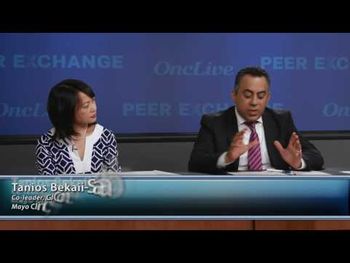
Tanios Bekaii-Saab, MD, associate professor, Department of Internal Medicine, The Ohio State University Comprehensive Cancer Center, discusses sequencing regorafenib and TAS-102 for the treatment of patients with colorectal cancer.


The immune checkpoint inhibitor nivolumab demonstrated activity in patients with previously treated esophageal cancer.

Adding liposomal irinotecan to 5-fluorouracil and leucovorin reduced the risk of death by 25% for patients with metastatic pancreatic cancer following progression on a gemcitabine-based regimen.

Holly G. Prigerson, PhD, professor of Sociology in Medicine, Irving Sherwood Wright Professor in Geriatrics, Joan and Sanford I. Weill Department of Medicine, director, Center for Research on End of Life Care, Weill Cornell Medicine and NewYorkPresbyterian Hospital, discusses chemotherapy regimens for patients with advanced gastric cancer.

Amitabh Chak, MD, professor of Medicine, Gastroenterology, Case Western Reserve University School of Medicine, discusses challenges with screening patients for Barrett's esophagus and esophageal cancer.

Geoffrey Krampitz, MD, Department of Stem Cell Biology and Regenerative Medicine, Stanford School of Medicine, identifies tumorigenic cells and therapeutic targets in patients with pancreatic neuroendocrine tumors.

Yelena Y. Janjigian, MD, discusses possible causes of the negative LOGiC trial results, HER2 as a driver in esophagogastric cancer, and what the future holds for lapatinib.

Pamela L. Kunz, MD, discusses several recent studies that shown promise for the treatment of pancreatic neuroendocrine tumors (NETs), as well as other ongoing trials investigating the potential of immunotherapies in NETs.

Jennifer Wu, MD, sheds light on TAS-102, as well as some emerging agents likely to play a role in the treatment of patients with colorectal cancer.

John L. Marshall, MD, discusses treatment advancements and other ongoing developments in colorectal cancer.

Georgia L. Wiesner, MD, MS, director, Clinical and Translational Hereditary Cancer Program, Ingram Professor of Cancer Research, professor of Medicine, cancer geneticist, Vanderbilt-Ingram Cancer Center, discusses the importance of genetic testing for colorectal cancer.

Jennifer Wu, MD, assistant professor of Medicine, Department of Medicine, Perlmutter Cancer Center, NYU Langone Medical Center, discusses potential combinations with TAS-102 for the treatment of patients with colorectal cancer.

John Marshall, MD, Chief, Division Of Hematology/Oncology, Georgetown University Hospital Associate Director, Clinical Research, Lombardi Comprehensive Cancer Center at Georgetown University Hospital, discusses curing colorectal cancer.

Contemporary efforts toward defining molecular subsets of colorectal cancer can potentially aid our ability to refine therapy and improve outcomes for patients with colorectal cancer.

Jennifer Wu, MD, assistant professor of Medicine, Department of Medicine, Perlmutter Cancer Center, NYU Langone Medical Center, discusses the potential for immunotherapy in colorectal cancer with mismatch repair deficiency.

John Marshall, MD, Chief, Division of Hematology/Oncology, Medstar Georgetown University Hospital, Chief, Division Of Hematology/Oncology, Georgetown University Hospital Associate Director, Clinical Research, Lombardi Comprehensive Cancer Center at Georgetown University Hospital, discusses the importance of molecular testing in colorectal cancer.

Jennifer Wu, MD, assistant professor of Medicine, Department of Medicine, Perlmutter Cancer Center, NYU Langone Medical Center, discusses the efficacy of regorafenib and TAS-102 for the treatment of patients with colorectal cancer.