


Gastrointestinal Cancer
Latest News


Pembrolizumab/Chemo Approved in Europe for Select Esophageal Cancer or HER2– GEJ Adenocarcinoma
By Kristi Rosa

Frontline Cabozantinib Plus Atezolizumab Significantly Improves PFS in Advanced HCC
By Kristi Rosa
Advertisement
Latest Videos

























































Advertisement
More News

The addition of sintilimab to chemotherapy significantly improved overall survival over chemotherapy alone when used as a first-line treatment in patients with unresectable, locally advanced, recurrent, or metastatic esophageal squamous cell carcinoma, meeting the primary end point of the phase 3 ORIENT-15 trial.

Alison Schram, MD, discusses the results of the phase 1/2 eNRGy trial, which were presented during the 2021 ASCO Annual Meeting, in NRG1 fusion–positive solid tumors.
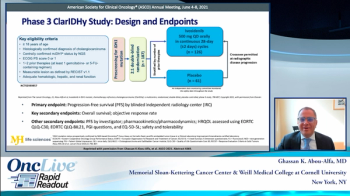
Ghassan K. Abou-Alfa, MD, reports on data presented at the 2021 American Society of Clinical Oncology (ASCO) Annual Meeting regarding final results from the ClarIDHy trial. In the phase 3 study, investigators examined ivosidenib vs placebo in patients with previously treated cholangiocarcinoma and an isocitrate dehydrogenase 1 mutation.

Bassam Sonbol, MD, discusses the role of pembrolizumab in the treatment of patients with gastric cancer.

Daniel H. Ahn, DO, shares how to navigate among the therapeutic options available for patients with advanced, unresectable hepatocellular carcinoma.

Daniel H. Ahn, DO, discusses considerations for treatment with atezolizumab and bevacizumab in patients with hepatocellular carcinoma.

This article discusses case studies and treatment strategies in HER2-postive gastrointestinal malignancies, and features insights from experts John Marshall, MD, Yelena Y Janjigian, MD, Melissa Lumish, MD, Daniel Catenacci, MD, Carolina Soto Chervin, MD, PhD, Wells Messersmith, MD, Robert Lentz, MD, Zev Wainberg, MD, and Vina Pulido Nguyen, MD. Sponsored in part by Daiichi Sankyo. Content independently developed by OncLive.

The National Medical Products Administration of China has approved surufatinib for the treatment of patients with advanced pancreatic neuroendocrine tumors.

Daniel H. Ahn, DO, discusses the utility of atezolizumab in combination with bevacizumab in hepatocellular carcinoma.
The FDA has granted an orphan drug designation to gunagratinib as a potential therapeutic option for patients with cholangiocarcinoma.

Dr. George discusses treatment considerations in the first-line setting of metastatic pancreatic cancer, signs that may indicate disease progression and the need for second-line therapy, and investigational agents in the pipeline.

Michael R. Charlton, MD, MBBS, discusses the interaction between liver disease and hepatocellular carcinoma.
Dr. Pant discusses the current role for germline and somatic testing in pancreatic cancer, examines the research landscape with PARP inhibitors, KRAS inhibitors, and other targeted agents, and shares his hope for the future of drug development in the field.

Katelyn M. Atkins, MD, PhD, discusses safety considerations for neoadjuvant approaches in patients with gastric cancer.
Dr. Patel discusses the significance of the new collaboration between The University of Texas MD Anderson Cancer Center and TriSalus™ Life Sciences.

The combination of regorafenib plus pembrolizumab in the first-line setting for patients with advanced hepatocellular carcinoma showed encouraging anti-tumor activity with a disease control rate of 91%, and did not display any new safety signals.
The addition of toripalimab and hepatic arterial infusion chemotherapy to lenvatinib yielded robust, durable responses in patients with advanced hepatocellular carcinoma, and represents a potential new treatment option for patients in the first line setting.

In patients with metastatic colorectal cancer who received cetuximab as a second-line therapy after irinotecan or oxaliplatin-based regimens have failed, KRAS mutational status and geographical region were associated with time on treatment, while body mass index and age were linked with overall survival.

The addition of regorafenib to avelumab demonstrated modest anti-tumor responses and survival benefit in patients with heavily pretreated biliary tract cancer.

The addition of panitumumab to 5-fluorouracil and leucovorin significantly improved progression-free survival as a maintenance treatment over 5-FU/leucovorin alone in patients with RAS wild-type metastatic colorectal cancer.

Final results of the DESTINY-CRC01 trial were consistent with primary analysis, establishing the benefit of fam-trastuzumab deruxtecan-nxki in patients with HER2-overexpressing metastatic colorectal cancer.

Ghassan K. Abou-Alfa, MD, discusses the efficacy of ivosidenib in IDH1-mutant cholangiocarcinoma based on the results of the phase 3 ClarIDHy study.

Cetuximab added to mFOLFOXIRI induced superior depth of response than mFOLFOXIRI plus bevacizumab in treatment-naïve patients with RAS wild-type metastatic colorectal cancer.

The chemotherapy regimen of FOLFOXIRI plus bevacizumab was found to be preferred in terms of antitumor activity compared with FOLFOXIRI plus cetuximab in patients with RAS wild-type, BRAF V600E–mutant metastatic colorectal cancer.

OncLive sits down with Erika P. Hamilton, MD, and Milind Javle, MD, on the pivotal studies in breast cancer and gastrointestinal cancers, respectively, at the 2021 ASCO Annual Meeting.
Advertisement
Advertisement
Trending on OncLive
1
Epcoritamab Plus R-CHOP Meets PFS End Point in Newly Diagnosed DLBCL
2
‘Our Impact Will Be Broad and Transformative’: Wells Messersmith, MD, Takes the Reins at CU Anschutz Cancer Center
3
FDA Approves Pirtobrutinib for Previously Untreated CLL/SLL
4
Berzosertib Plus Carboplatin Fails to Improve Responses in Pretreated mCRPC
5