






Gastrointestinal Cancer
Latest News
Advertisement
Latest Videos
























































Advertisement
More News

Derazantinib continued to induce encouraging responses in patients with FGFR2 gene fusion–positive intrahepatic cholangiocarcinoma, according to updated data from cohort 1 of the phase 2 FIDES-01 trial.

Innovative strategies are vital for patients diagnosed with rare cancers, who are frequently at a disadvantage compared with those who have more common malignancies, experts say.

Parissa Tabrizian, MD, MSc, discusses the rationale for evaluating cemiplimab in the neoadjuvant setting for patients with resectable hepatocellular carcinoma, the results of the trial, and next steps planned to identify optimal clinical end points that correlate with survival benefit.

Milind Javle, MD, discusses the FDA approval of infigratinib in FGFR-mutated cholangiocarcinoma.
The FDA has approved infigratinib for the treatment of patients with previously treated locally advanced or metastatic cholangiocarcinoma harboring an FGFR2 fusion or rearrangement.

Nataliya V. Uboha, MD, PhD, zeros in on the developments with ADCs and monoclonal antibodies in gastric cancer and recent changes in pancreatic cancer as key takeaways from the event.
The University of Texas MD Anderson Cancer Center and the immuno-oncology company TriSalus™ Life Sciences announced a strategic research collaboration to evaluate SD-101 in pancreatic cancer and hepatocellular carcinoma.

The European Medicines Agency’s Committee for Medicinal Products for Human Use has recommended the approval of cemiplimab for use in 2 advanced cancers: non–small cell lung cancer and basal cell carcinoma.
The European Medicines Agency’s Committee for Medicinal Products for Human Use has recommended the approval of pembrolizumab plus platinum- and fluoropyrimidine-based chemotherapy for the frontline treatment of patients with locally advanced unresectable or metastatic esophageal carcinoma or HER2-negative gastroesophageal junction adenocarcinoma with PD-L1 positivity.

The PARP inhibitor rucaparib has proven to be a safe and effective maintenance option for patients with platinum-sensitive, advanced pancreatic cancer that harbors pathogenic variants such as BRCA1, BRCA2, or PALB2.
The FDA has approved nivolumab for the adjuvant treatment of completely resected esophageal or gastroesophageal junction cancer with residual pathologic disease, in patients have received neoadjuvant chemoradiotherapy.

Aravind R. Sanjeevaiah, MD, discusses the benefit of immunotherapy agents in the treatment of patients with gastric cancers.

The addition of the first-in-class chimeric monoclonal antibody zolbetuximab to frontline epirubicin, oxaliplatin, and capecitabine chemotherapy resulted in prolonged progression-free survival and overall survival compared with EOX alone in patients with advanced Claudin 18.2-positive gastric and gastroesophageal junction adenocarcinoma, according to the primary results of the phase 2 FAST trial.

Katelyn M. Atkins, MD, PhD, examines the evolving role of radiotherapy in the treatment of patients with gastric cancer, the subgroups who might derive the most benefit from this approach, and ongoing research efforts that are seeking to address remaining questions with this modality.

Jun Gong, MD, discusses the impact of the IMbrave150 trial on the advanced HCC treatment paradigm and challenges faced with sequencing.

Offering patients with metastatic gastroesophageal tumors a more personalized and adaptable treatment approach using monoclonal antibodies matched to genetic profiles in combination with chemotherapy may result in higher rates of survival compared with historic controls.
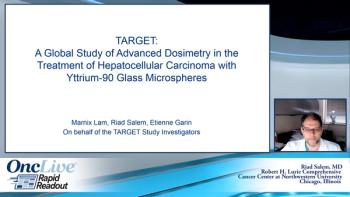
Riad Salem, MD, presents slides supporting global real-world data confirming a significant association between tumor-absorbed dose, objective response between tumor-absorbed dose and overall survival in patients with hepatocellular carcinoma (HCC) treated with yttrium-90 glass microspheres.

Yelena Y. Janjigian, MD, discusses the FDA approval of nivolumab plus chemotherapy in frontline gastric cancer.

Monica A. Patel, MD, discusses factors that determine whether a patient with hepatocellular carcinoma is a good candidate to receive a combination of atezolizumab and bevacizumab.

The FDA has granted an orphan drug designation to the first-in-class ruthenium-based small molecule therapeutic BOLD-100 for the treatment of patients with gastric cancer.

Although the standard-of-care treatment for patients with metastatic pancreatic cancer remains largely unchanged with multi-agent chemotherapy, the role for multidisciplinary care has expanded significantly in recent years.
Arsen Osipov, MD, discusses the potential for ongoing research with immunotherapeutic approaches in gastrointestinal malignancies, including CAR T-cell therapy, bispecific T-cell engagers, and vaccines.

Yoomi Lee, MD, discusses her process for selecting a treatment approach for patients with neuroendocrine tumors.

Nataliya V. Uboha, MD, PhD, discusses early efficacy data demonstrated with zanidatamab in HER2-expressing upper gastrointestinal cancers.
The FDA has approved pembrolizumab for use in combination with trastuzumab, fluoropyrimidine- and platinum-containing chemotherapy for the frontline treatment of patients with locally advanced unresectable or metastatic HER2 positive gastric or gastroesophageal junction adenocarcinoma.
Advertisement
Advertisement
Trending on OncLive
1
Epcoritamab Plus R-CHOP Meets PFS End Point in Newly Diagnosed DLBCL
2
‘Our Impact Will Be Broad and Transformative’: Wells Messersmith, MD, Takes the Reins at CU Anschutz Cancer Center
3
FDA Approves Pirtobrutinib for Previously Untreated CLL/SLL
4
Berzosertib Plus Carboplatin Fails to Improve Responses in Pretreated mCRPC
5