

Gastrointestinal Cancer
Latest News
Advertisement
Latest Videos




















































Advertisement
More News
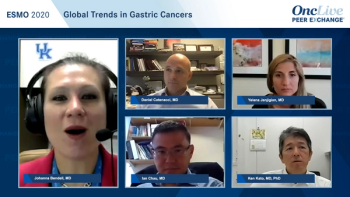

Manish A. Shah, MD, FASCO, discusses key clinical trials that have evaluated the utility of pembrolizumab and nivolumab in the gastric/gastroesophageal junction cancer, and esophageal squamous cell carcinoma paradigms.

Zarnie Lwin, MBBS, FRACP, discusses the design of the phase 2 LEAP-005 trial in previously treated patients with advanced solid tumors.

Allyson Ocean, MD, discusses determining the optimal frontline treatment of patients with metastatic pancreatic cancer.

Gagandeep Brar, MD, discusses the need to identify biomarkers in hepatocellular carcinoma.

The first patient has officially been dosed with investigational anti-Dickkopf-1 antibody plus tislelizumab with or without chemotherapy as part of the ongoing phase 2a DisTinGuish study (NCT04363801) in patients with gastric or gastroesophageal junction cancer.
Weijing Sun, MD, FACP, discusses remaining challenges in the first-line treatment of patients with gastric cancer.

The European Medicines Agency’s Committee for Medicinal Products for Human Use has adopted a positive opinion for nivolumab in the treatment of adult patients with unresectable advanced, recurrent, or metastatic esophageal squamous cell carcinoma following previous fluoropyrimidine- and platinum-based chemotherapy.

Allyson Ocean, MD, discussed the importance of clinical trials and how they should not be viewed as a last resort for patients with metastatic pancreatic cancer.

Gagandeep Brar, MD, discusses how the treatment paradigm has expanded in hepatocellular carcinoma, continuing sequencing challenges, and ongoing trials that are expected to impact the landscape.
New data showing efficacy and tolerability with ADP-A2AFP, alpha-fetoprotein–directed specific peptide enhanced affinity receptor T-cells, suggest that further research evaluating the 5 billion or more cell dosing regimen is warranted in hepatocellular carcinoma.

The combination of bavituximab and pembrolizumab demonstrated synergistic antitumor activity and was well tolerated in patients with pretreated advanced gastric or gastroesophageal junction cancer.

The combination of onvansertib plus with 5-fluorouracil, FOLFIRI, and bevacizumab was shown to have preliminary efficacy with acceptable safety when used as a second-line treatment for patients with KRAS-mutated metastatic colorectal cancer.

Molecular profiling has led to a better understanding of biliary tract cancers by revealing new markers that can be targeted by novel therapies, and several are currently under investigation.

XmAb18087 demonstrated a disease control rate of 43% across dose levels in patients with neuroendocrine tumors and a favorable safety profile.
The novel somatostatin analog for the Targeted Alpha-emitter Therapy 212Pb-DOTAMTATE has demonstrated early efficacy and a tolerable safety profile in a small cohort of patients with metastatic somatostatin receptor–expressing neuroendocrine tumors irrespective of location of the primary tumor.
Aman Chauhan, MD, a medical oncologist at the University of Kentucky, discusses key recent advances in therapeutics for patients with neuroendocrine tumors, and points to the future with ongoing combination studies.

Increasing the dosage of lanreotide autogel from every 28 days to every 14 days led to encouraging progression-free survival outcomes in patients with progressive pancreatic and midgut neuroendocrine tumors.

Jonathan Strosberg, MD, discusses retreatment with Lutathera in advanced neuroendocrine tumors.
Aman Chauhan, MD, a medical oncologist at the University of Kentucky, discusses the role of Lutathera in neuroendocrine tumors.

Tanios S. Bekaii-Saab, MD, FACP, shares key topics covered in the 17th Annual ISGIO meeting and its significance in the ever-evolving GI cancer space.

Combination CDK4/6 and MEK inhibition was “highly synergistic” in killing pancreatic neuroendocrine tumor cells in vitro and effectively suppressed PNET growth in mice.

Marianne Pavel, MD, discusses the progression-free survival of patients with pancreatic and midgut neuroendocrine tumors who are treated with lanreotide autogel in the phase 2 CLARINET FORTE trial.

Retreatment with Lutathera-based peptide receptor radionuclide therapy has been shown to have an encouraging survival benefit with an acceptable safety in patients with neuroendocrine tumors.

Edward Wolin, MD, discusses the safety profile of 177Lu-dotatate in patients with advanced neuroendocrine tumors.
Advertisement
Advertisement
Trending on OncLive
1
Epcoritamab Plus R-CHOP Meets PFS End Point in Newly Diagnosed DLBCL
2
‘Our Impact Will Be Broad and Transformative’: Wells Messersmith, MD, Takes the Reins at CU Anschutz Cancer Center
3
FDA Approves Pirtobrutinib for Previously Untreated CLL/SLL
4
Berzosertib Plus Carboplatin Fails to Improve Responses in Pretreated mCRPC
5