





Gastrointestinal Cancer
Latest News

Advertisement
Latest Videos




















































Advertisement
More News
January 27, 2021 - The combination of the polo-like kinase 1 inhibitor, onvansertib, with FOLFIRI and bevacizumab was found to have preliminary activity and favorable tolerability when used as a second-line treatment for patients with KRAS-mutated metastatic colorectal cancer.

January 27, 2021 - Perioperative chemotherapy did not improve overall survival in patients with resectable pancreatic ductal adenocarcinoma when compared with historical data from adjuvant trials.

Kanwal Raghav, MBBS, MD, discusses his approach to sequencing therapies for patients with resectable and unresectable colorectal cancer.

January 26, 2021 — Patients with colorectal cancer who had molecular residual disease positivity immediately after surgery were found to have a high risk of disease recurrence and longitudinal monitoring increased the predictive power of circulating tumor DNA.

Johanna C. Bendell, MD, moderates a peer exchange with fellow experts to discuss differences in germline and somatic BRCA mutations in pancreatic cancer, the role of molecular testing in hepatocellular carcinoma, and treatment options for patients with BRAF-mutant, microsatellite instability–high colorectal cancer.
Using real-world data from more than 4000 patients with common cancers, an algorithm was able to detect variations in care that, if reduced, could result in a median savings of $26,773 per patient.

Kristen K. Ciombor, MD, MSCI, discusses the FDA approval of fam-trastuzumab deruxtecan-nxki in HER2-positive metastatic gastric cancer.
Joseph Kim, MD, discusses the multidisciplinary management of patients with HCC.
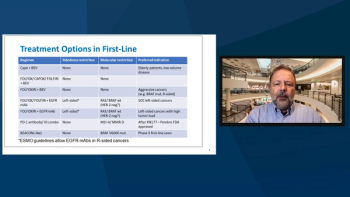
Axel Grothey, MD, and John Marshall, MD, discuss first-line treatment options in patients with metastatic colorectal cancer.
Axel Grothey, MD, discusses factors that influence treatment selection in patients with mCRC.
Beau Toskich, MD, discusses key results that demonstrate the benefit of personalized dosimetry, and offered advice to fellow clinicians as the field moves toward adopting this radiotherapeutic modality.
The FDA has granted priority review to a supplemental biologics license application for nivolumab for use as an adjuvant treatment for patients with resected esophageal or gastroesophageal junction cancer following neoadjuvant chemoradiation treatment.

January 20, 2021 - The FDA has granted a priority review to a supplemental biologics license application for nivolumab in combination with a fluoropyrimidine- and platinum-containing chemotherapy for use in patients with advanced or metastatic gastric cancer, gastroesophageal junction cancer, or esophageal adenocarcinoma.
Beau Toskich, MD, discusses the potential of TheraSphere as a therapy in hepatocellular carcinoma, the importance of utilizing a multidisciplinary approach among novel radiation oncology agents, and his hope for a future prospective clinical trial evaluating Y-90.

Prakash Pandalai, MD, discusses outcomes with adjuvant hyperthermic intraperitoneal chemotherapy in patients with colorectal cancer.

David S. Hong, MD, discusses the potential clinical implications of the phase 1 SURPASS trial in gastric/gastroesophageal junction cancer.

Single-agent pembrolizumab demonstrated durable antitumor activity among patients with treatment-naïve hepatocellular carcinoma, suggesting that the checkpoint inhibitor may have additional utility in this space, according to findings from a phase 2 trial presented during the 2021 Gastrointestinal Cancers Symposium.

January 17, 2021 - Pembrolizumab demonstrated maintained numerical improvements in overall survival and progression-free survival compared with placebo in patients with previously treated advanced hepatocellular carcinoma.

January 17, 2021 - The combination of atezolizumab and bevacizumab continued to display improved survival compared with sorafenib in previously untreated patients with advanced hepatocellular carcinoma.

January 17, 2021 - Axitinib plus octreotide LAR failed to demonstrate a significant improvement in progression-free survival (PFS) compared with placebo plus octreotide LAR in patients with advanced G1-2 extra-pancreatic neuroendocrine tumors.

January 17, 2021 - Infigratinib was found to be associated with encouraging clinical activity with a manageable safety profile in patients with chemotherapy-refractory cholangiocarcinoma whose tumors harbor FGFR2 fusions.

January 17, 2021 — Ivosidenib tablets led to a 21% reduction in the risk of death compared with placebo in previously treated patients with IDH1-mutant cholangiocarcinoma, according to the final overall survival analysis of the phase 3 ClarIDHy trial.

James J. Harding, MD, discusses the results of the ongoing, phase 2 SUMMIT basket trial in HER2-mutant advanced biliary tract cancers.

Andrew Zhu, MD, PhD, discusses the final overall survival results from the phase 3 ClarIDHy trial in previously treated patients with IDH1-mutated cholangiocarcinoma.

January 16, 2021 - Trifluridine/tipiracil, when used in combination with bevacizumab, led to an improvement in overall survival over capecitabine/bevacizumab in the frontline treatment of patients with unresectable metastatic colorectal cancer who are not eligible for standard chemotherapy.
Advertisement
Advertisement
Trending on OncLive
1
Epcoritamab Plus R-CHOP Meets PFS End Point in Newly Diagnosed DLBCL
2
‘Our Impact Will Be Broad and Transformative’: Wells Messersmith, MD, Takes the Reins at CU Anschutz Cancer Center
3
FDA Approves Pirtobrutinib for Previously Untreated CLL/SLL
4
Berzosertib Plus Carboplatin Fails to Improve Responses in Pretreated mCRPC
5