


Hematologic Oncology
Latest News
Advertisement
Latest Videos



















































Advertisement
More News
Nicole Lamanna, MD, discusses the results from the ongoing BGB-11417-101 study investigating combination zanubrutinib plus sonrotoclax in patients with treatment-naïve CLL/SLL.
A hematologist/oncologist previews updated data presented at ASH 2023 for patients with B-cell malignancies.
Nicole Lamanna, MD, gives an overview of targeted therapies and the role of prognostic markers in the treatment of B-cell malignancies.
Claire Roddie, MD, PhD, presents data from the pooled analysis of the ongoing FELIX phase Ib/II study investigating obecabtagene autoleucel in patients with relapsed/refractory adult B-cell acute lymphoblastic leukemia.
Guillermo Garcia-Manero, MD, presents data from the COMMANDS trial investigating luspatercept in erythropoiesis-stimulating agent-naive patients with transfusion-dependent lower-risk myelodysplastic syndromes.
Key opinion leaders on diffuse large B-cell lymphoma management provide a review first-line treatment options.
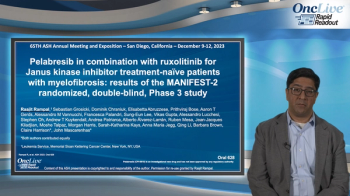
Raajit K. Rampal, MD, PhD, presents data from the MANIFEST-2 study investigating pelabresib in combination with ruxolitinib in Janus kinase inhibitor treatment–naïve patients with myelofibrosis.
Experts explain how polycythemia vera is diagnosed and the typical symptoms a patient may present with.

Sergio Giralt, MD, provides a look at an upcoming OncLive Insights program in which he will offer insights on the evolving treatment landscape for patients with veno-occlusive disease.

A comprehensive overview of clinical and patient factors that impact disease progression beyond CAR T-cell therapy in lymphoma.
Gain insights into treatment outcomes of CAR T, highlighting lisocabtagene maraleucel and the TRANSCEND NHL 001 study for R/R LBCL.
Experts on follicular lymphoma discuss first-line treatment options available for patients.

Experts discuss what role allogeneic transplants play in hematologic malignancies, specifically in AML and ALL.
Join Catherine Lai, MD, MPH in this informative OncLive News Network program as she explores strategies for optimizing outcomes in the long-term management of Acute Myeloid Leukemia (AML), with a focus on patients in first remission without a transplant. Here, she provides a brief overview of the current incidence of AML, its risk factors, and prognosis.

Akshat Jain, MBBS, discusses the importance of novel therapies in the treatment of pediatric patients with beleeding disorders.
OncLive® will be LIVE with OncLive® News Network: On Location at the 2023 ASH Annual Meeting. Each day, we will broadcast a series of interviews with top thought leaders, to learn their thoughts and reactions to data presented across oncology during the conference.

Treatment with asciminib elicited greater efficacy and had a more tolerable safety profile compared with bosutinib for patients chronic myeloid leukemia in chronic phase following treatment with 2 or more TKIs.
Following promising preclincial findings, acimtamig plus allogenic natural killer cells will be examined for the treatment of patients with relapsed/refractory Hodgkin lymphoma and CD30-positive peripheral T-cell lymphoma.

Patients with high-risk large B-cell lymphoma experienced durable responses when treated with first-line axicabtagene ciloleucel, according to results from the phase 2 ZUMA-12 trial.

The use of tafasitamab-cxix, lenalidomide, rituximab, and acalabrutinib in the first-line setting induced high responses in patients with newly diagnosed diffuse large B-cell lymphoma, with responders deriving benefit from subsequent treatment with cyclophosphamide, doxorubicin, vincristine, and prednisolone.
Pirtobrutinib demonstrated promising efficacy and a tolerable safety profile in heavily pretreated patients with relapsed/refractory mantle cell lymphoma who received prior therapy with a covalent BTK inhibitor.

The novel BTK degrader BGB-16673 was well tolerated; produced meaningful and rapid clinical responses; and demonstrated on-target effects in patients with relapsed/refractory B-cell malignancies.

Revumenib demonstrated clinically meaningful activity, including high response and minimal residual disease negativity rates, in heavily pretreated patients with KMT2A-rearranged acute leukemia.

NX-2127 showcased early efficacy in the form of responses with an acceptable toxicity profile in patients with relapsed or refractory B-cell malignancies, according to data from the ongoing phase 1 NX-2127-001 trial.
OncLive® will be LIVE with OncLive® News Network: On Location at the 2023 ASH Annual Meeting. Each day, we will broadcast a series of interviews with top thought leaders, to learn their thoughts and reactions to data presented across oncology during the conference.
Advertisement
Advertisement
Trending on OncLive
1
FDA Approves Bioequivalent Olaparib Across Previously Approved Cancer Indications
2
Experts Revisit the Most Notable Data in GU Oncology From ASCO 2026
3
Longer-Term Data Help Shape TKI Selection in ROS1+ and ALK+ NSCLC
4
Dr Mardones on Giredestrant Plus Palbociclib in Estrogen Receptor+ Breast Cancer
5